VOCABULARY / ENTRY
Security Questions
security-questions
Treating questions about a person’s life — a mother’s maiden name, a first pet’s name — as an authentication credential: the user answers at sign-up and later uses those answers to sign in or recover the account. It is presented as a supplement to a password and is in fact a weaker one.
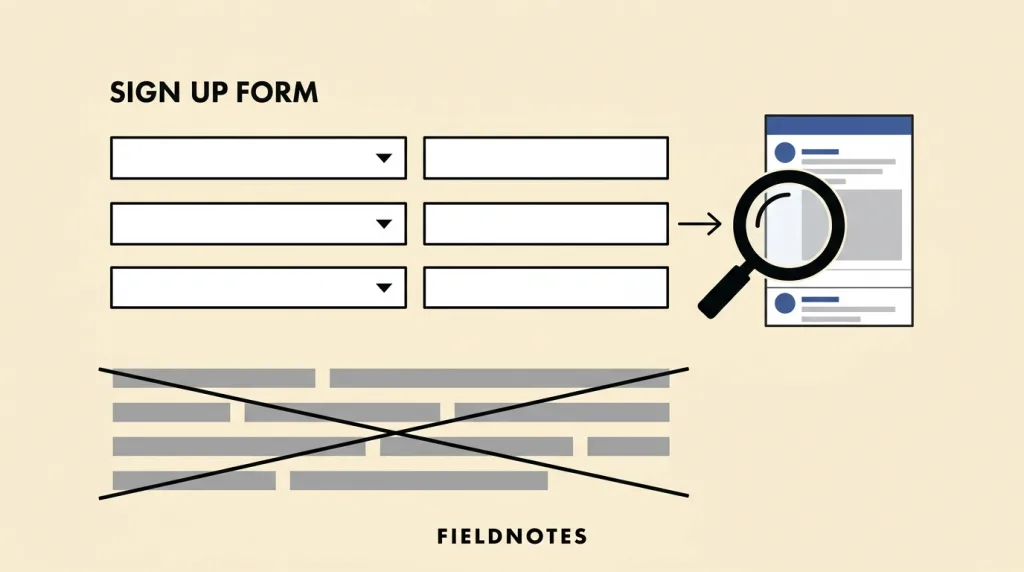
Recognizing it
- Sign-up asks the user to pick questions from a fixed list and answer them
- The answers are facts about a life rather than a secret the user generated
- The answers are used to bypass the password and become another way into the account
Concept boundary
This entry targets using knowledge questions as an authentication or account-recovery credential, not a support agent asking questions on a call to help confirm who they are speaking to. What makes it an anti-pattern is not that the questions were badly chosen — a different list does not resolve the underlying tension: the easier an answer is to remember, the easier it is for someone else to look up, and the harder it is to look up, the more likely the owner is to forget it. This entry therefore offers no list of better questions, which would only move the same problem. It is a warning entry, not a recommendation.
When to consider it
- Auditing which knowledge questions remain in an existing sign-in or recovery flow
- Assessing whether a vendor’s authentication offering still depends on this mechanism
When to be cautious
- As the authentication or account-recovery mechanism of a new product
- Fixing it by swapping in harder-to-guess questions, which leaves the structure unchanged
Tradeoff
The repair is to move recovery to something the person holds — a one-time code sent to a verified address or number, a recovery code, a passkey, or an identity provider; where human recovery must remain, hand it to a logged, auditable process rather than to a question whose answer anyone can look up on social media.
Conditional rules · Editorial advice
Related entries
Handing authentication and recovery back to an identity provider is more reliable than every product keeping its own set of guessable questions, and easier to revoke centrally.
It looks like an added layer but opens a weaker way in, and an account is only as secure as its weakest path.
The answers are sensitive personal data that cannot be rotated once leaked: nobody can change their birthplace or their mother’s maiden name.
Sources and what they support
The guideline states that verifiers and CSPs SHALL NOT prompt subscribers to use knowledge-based authentication (KBA, for example “What was the name of your first pet?”) or security questions when choosing passwords. It also lists the authentication types available at AAL1 — password, look-up secret, out-of-band device, single-factor and multi-factor one-time passwords, and single-factor and multi-factor cryptographic authentication — and knowledge-based authentication is not among them. This entry takes the current guidance from it, keeping the SHALL NOT scoped to choosing passwords as the source words it.
Retrieved: 2026-09-16The article describes a security question as a form of shared secret used as an authenticator and records the criticism of it: taking the questions online exposes them to keystroke logging, brute-force guessing, and phishing; computers are less able than a human agent to cope with inexact answers, so users must remember exact spelling and sometimes case and are more likely to write answers down; and it quotes Bruce Schneier that because these are public facts about a person they are easier for attackers to guess than passwords, while users who know this invent fake answers and then forget them, defeating the purpose and creating an inconvenience not worth the investment. This entry takes its statement of the dilemma from this.
Retrieved: 2026-09-16 · Archived 2026-09-22Definitions reference these sources. Digital specimens, selection advice, relationships, and recipes are editorial work and have not been validated through user research.
Type extensions and implementation notes
This is a warning entry and not a recommendation; the illustration is an editorial sketch whose questions and answers are invented and represent no real product. When auditing an existing product, also check whether support staff still treat the same answers as proof of identity.
{
  "harm": "It opens a path around the password that is easier to look up or to forget, lowering real account security while storing personal facts that can never be rotated",
  "repair": "Move to one-time codes sent to a verified channel, recovery codes, passkeys, or an identity provider; where human recovery is genuinely needed, use a logged and auditable process, and delete the stored questions and answers."
}
Open the Agent JSON file for this entryThis file repeats every field of this entry verbatim and adds its sources, archive status, and editorial scope.