VOCABULARY / ENTRY
Conversational Interface
conversational-interface
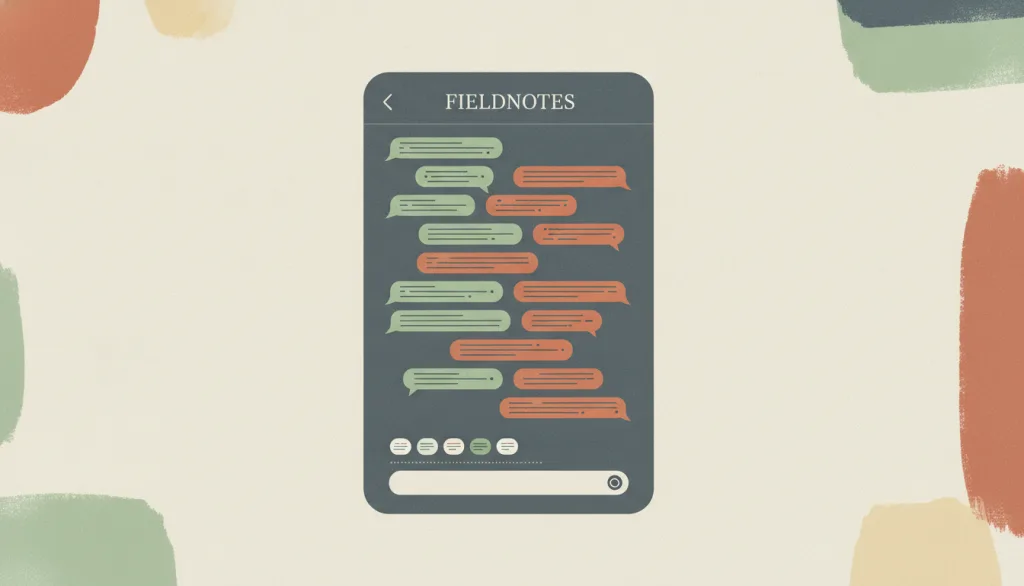
Organizes interaction as turn-taking in natural language: the user states intent instead of operating visible controls. Common in chat windows and voice assistants.
Recognizing it
- Interaction is organized as an alternating stream of turns
- The user expresses intent with free text or speech instead of choosing from fixed controls
- The system's capabilities and limits are visible at the start of the conversation or nearby
Concept boundary
Sits on a different axis from progressive disclosure, and the two are not alternatives — progressive disclosure manages when visible controls appear, while a conversational interface manages how the whole interaction is organized. A conversational surface does not by itself mean the system can understand or execute the request. Free-text input also removes the menu-like view of what the system can do, and that discoverability cost has to be made up for explicitly in the interface.
When to consider it
- The intent is easy to state in a sentence or two, but the paths to it vary too much per person to fix into a menu
- A voice or hands-free context where the user cannot or would rather not look at graphical controls
When to be cautious
- The task has a small, fixed set of options that graphical controls can show at a glance and operate faster
- The user needs to precisely compare several structured data points, such as prices or specifications
- The system has not been validated to reliably understand free text, yet conversation is made the only entry point
Tradeoff
Removes the burden of remembering a menu structure and lets expression be freer, but the user has to recall or probe for what the system can do, and the system has to handle ambiguity, spelling variation, and context continuity across turns in free text.
Conditional rules · Editorial advice
Related entries
Free text requires the user to recall from memory what to ask, which runs counter to recognition rather than recall.
Progressive disclosure stages the reveal of visible controls, while a conversational interface organizes the whole interaction as natural-language turns — a different axis, not a substitute for the other.
A modal dialog presents fixed options with visible controls, which is more direct and less ambiguous than describing the same task in free text.
Sources and what they support
Chatbots often suffer from poor discoverability because users do not treat chat as a separate interaction channel, and free-text input struggles with spelling variation, ambiguous phrasing, and context continuity across turns.
Retrieved: 2026-09-15 · Archived 2026-09-16Guideline G1 recommends making clear what the system can do, G8 recommends supporting efficient dismissal of unwanted services, and G9 recommends supporting efficient editing or correction when the system is wrong.
Retrieved: 2026-09-15 · Archived 2026-09-16Adopting a conversational surface by itself is not a substitute for judging whether it actually solves a real user need and whether the system can actually do it.
Retrieved: 2026-09-15 · Archived 2026-09-16Definitions reference these sources. Digital specimens, selection advice, relationships, and recipes are editorial work and have not been validated through user research.
Type extensions and implementation notes
No operable specimen yet; the illustration is editorial, meant to depict the concept rather than an actual product screenshot. Before shipping in a real product, still verify: whether the stated capability boundary truly reflects what the system can do, how well ambiguity in free text is actually handled, the mechanism for verifying generated content, and whether history can really be edited and retried.
{
  "states": [
    "empty",
    "composing",
    "awaiting-response",
    "responded",
    "error"
  ],
  "a11y": [
    "The message stream is an accessible live region for screen readers, and new messages are announced",
    "Suggested-action buttons and the input field can each be focused and activated with a keyboard"
  ],
  "motion": "A new message appearing can be perceived without relying on animation"
}
Full Agent entry JSON
{
  "id": "conversational-interface",
  "type": "interaction",
  "name": {
    "zh": "对话式界面",
    "en": "Conversational Interface"
  },
  "aliases": [
    "聊天式界面",
    "对话界面",
    "Chatbot Interface"
  ],
  "granularity": "flow",
  "intents": [
    "state-intent",
    "discover-capabilities"
  ],
  "tags": [
    "chat",
    "chatbot",
    "natural language",
    "voice assistant",
    "turn-taking"
  ],
  "definition": "Organizes interaction as turn-taking in natural language: the user states intent instead of operating visible controls. Common in chat windows and voice assistants.",
  "boundary": "Sits on a different axis from progressive disclosure, and the two are not alternatives — progressive disclosure manages when visible controls appear, while a conversational interface manages how the whole interaction is organized. A conversational surface does not by itself mean the system can understand or execute the request. Free-text input also removes the menu-like view of what the system can do, and that discoverability cost has to be made up for explicitly in the interface.",
  "signature": [
    "Interaction is organized as an alternating stream of turns",
    "The user expresses intent with free text or speech instead of choosing from fixed controls",
    "The system's capabilities and limits are visible at the start of the conversation or nearby"
  ],
  "when": [
    "The intent is easy to state in a sentence or two, but the paths to it vary too much per person to fix into a menu",
    "A voice or hands-free context where the user cannot or would rather not look at graphical controls"
  ],
  "when_not": [
    "The task has a small, fixed set of options that graphical controls can show at a glance and operate faster",
    "The user needs to precisely compare several structured data points, such as prices or specifications",
    "The system has not been validated to reliably understand free text, yet conversation is made the only entry point"
  ],
  "tradeoff": "Removes the burden of remembering a menu structure and lets expression be freer, but the user has to recall or probe for what the system can do, and the system has to handle ambiguity, spelling variation, and context continuity across turns in free text.",
  "comparison": {
    "focus": "Interaction is organized around natural-language turns rather than operating visible controls",
    "mechanism": "The user states intent and the system responds in conversational turns, with history that can be reviewed",
    "cost": "Discoverability of the system's capability boundary, handling ambiguity in free text, and verifying generated content"
  },
  "sources": [
    {
      "id": "nng-chatbots",
      "title": "NN/g · Chatbots",
      "url": "https://www.nngroup.com/articles/chatbots/",
      "claim": "Chatbots often suffer from poor discoverability because users do not treat chat as a separate interaction channel, and free-text input struggles with spelling variation, ambiguous phrasing, and context continuity across turns.",
      "checkedAt": "2026-09-15",
      "archive": {
        "lookupUrl": "https://web.archive.org/web/20260915*/https://www.nngroup.com/articles/chatbots/",
        "status": "available",
        "checkedAt": "2026-09-16T04:51:22.273Z",
        "jobId": "spn2-17ba5b3970d427f8e7fba298095436a101c6e7fc",
        "url": "https://web.archive.org/web/20260916045127/https://www.nngroup.com/articles/chatbots/",
        "timestamp": "20260916045127"
      }
    },
    {
      "id": "ms-hax-guidelines",
      "title": "Microsoft HAX Toolkit · Guidelines for Human-AI Interaction",
      "url": "https://www.microsoft.com/en-us/haxtoolkit/library/",
      "claim": "Guideline G1 recommends making clear what the system can do, G8 recommends supporting efficient dismissal of unwanted services, and G9 recommends supporting efficient editing or correction when the system is wrong.",
      "checkedAt": "2026-09-15",
      "archive": {
        "lookupUrl": "https://web.archive.org/web/20260915*/https://www.microsoft.com/en-us/haxtoolkit/library/",
        "status": "available",
        "checkedAt": "2026-09-16T05:43:24.829Z",
        "jobId": "spn2-7cb34684fb905780ab4c35f6e41f0ec7680b9b7e",
        "url": "https://web.archive.org/web/20260916054347/https://www.microsoft.com/en-us/haxtoolkit/library/",
        "timestamp": "20260916054347"
      }
    },
    {
      "id": "nng-ai-chat-not-answer",
      "title": "NN/g · AI Chat Is Not (Always) the Answer",
      "url": "https://www.nngroup.com/articles/ai-chat-not-the-answer/",
      "claim": "Adopting a conversational surface by itself is not a substitute for judging whether it actually solves a real user need and whether the system can actually do it.",
      "checkedAt": "2026-09-15",
      "archive": {
        "lookupUrl": "https://web.archive.org/web/20260915*/https://www.nngroup.com/articles/ai-chat-not-the-answer/",
        "status": "available",
        "checkedAt": "2026-09-16T05:43:44.651Z",
        "jobId": "spn2-9e367b19532dc846bcbffd77ac0675c638fa340b",
        "url": "https://web.archive.org/web/20260916054409/https://www.nngroup.com/articles/ai-chat-not-the-answer/",
        "timestamp": "20260916054409"
      }
    }
  ],
  "relations": [
    {
      "target": "recognition",
      "kind": "conflicts_when",
      "condition": "The system offers only a blank input field with no clickable options or examples",
      "reason": "Free text requires the user to recall from memory what to ask, which runs counter to recognition rather than recall.",
      "basis": "editorial"
    },
    {
      "target": "progressive-disclosure",
      "kind": "related",
      "condition": "Both are used to manage how content or capability is presented",
      "reason": "Progressive disclosure stages the reveal of visible controls, while a conversational interface organizes the whole interaction as natural-language turns — a different axis, not a substitute for the other.",
      "basis": "editorial"
    },
    {
      "target": "modal-dialog",
      "kind": "alternative",
      "condition": "The user needs to complete a single task with a clear boundary and a fixed set of options",
      "reason": "A modal dialog presents fixed options with visible controls, which is more direct and less ambiguous than describing the same task in free text.",
      "basis": "editorial"
    }
  ],
  "rules": [
    {
      "when": "The user enters a conversational interface for the first time",
      "instruction": "Make what the system can and cannot do visible at or near the start of the conversation; do not leave the user guessing from a blank input field.",
      "strength": "must",
      "basis": "editorial"
    },
    {
      "when": "The user has already gone through several turns of conversation",
      "instruction": "Preserve the conversation history and let the user edit or resend a single turn instead of starting the whole conversation over.",
      "strength": "recommend",
      "basis": "editorial"
    },
    {
      "when": "The conversation includes information the system generated",
      "instruction": "Do not present generated content as verified fact; give the user a way to check or trace it back to a source.",
      "strength": "must",
      "basis": "editorial"
    }
  ],
  "behavior": {
    "states": [
      "empty",
      "composing",
      "awaiting-response",
      "responded",
      "error"
    ],
    "a11y": [
      "The message stream is an accessible live region for screen readers, and new messages are announced",
      "Suggested-action buttons and the input field can each be focused and activated with a keyboard"
    ],
    "motion": "A new message appearing can be perceived without relying on animation"
  },
  "demo": null,
  "version": "0.1.0",
  "editorialStatus": "drafted",
  "requirements": [],
  "demoCapabilities": [],
  "implementationNote": "No operable specimen yet; the illustration is editorial, meant to depict the concept rather than an actual product screenshot. Before shipping in a real product, still verify: whether the stated capability boundary truly reflects what the system can do, how well ambiguity in free text is actually handled, the mechanism for verifying generated content, and whether history can really be edited and retried.",
  "image": {
    "src": "/images/conversational-interface.webp",
    "alt": "A fictional FIELDNOTES chat panel with alternating message bubbles shown as abstract colored bars, a row of suggestion buttons above the input field showing example capabilities, and a small line of text at the bottom stating the system's scope."
  },
  "searchTerms": [
    "对话",
    "聊天",
    "自然语言",
    "语音助手",
    "轮流对话"
  ]
}