VOCABULARY / ENTRY
Hick–Hyman Law
hick-hyman-law
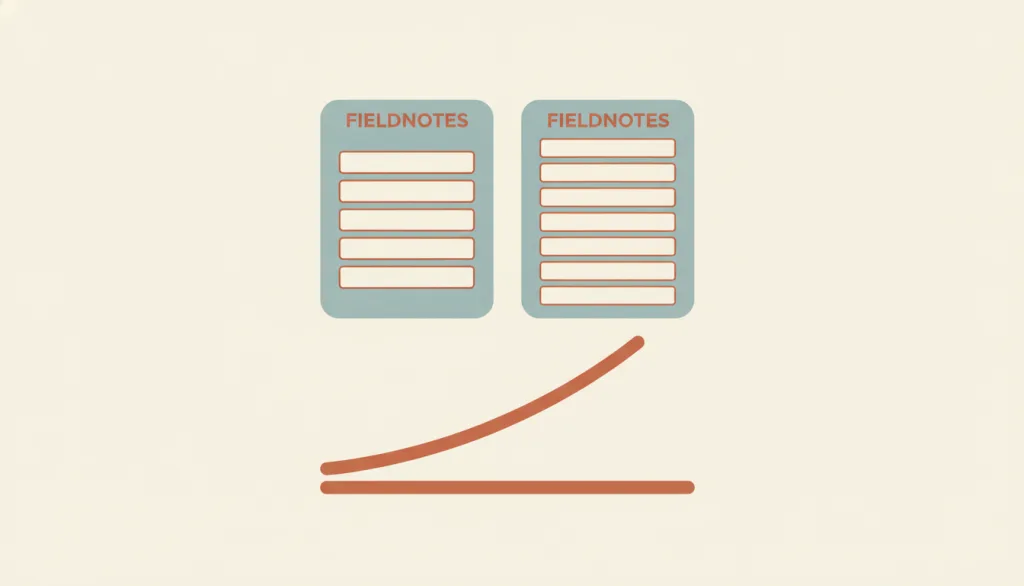
The Hick–Hyman Law is a quantitative model: when making a simple choice among several equally probable, known alternatives, the decision time grows with the number of alternatives, and that growth is logarithmic rather than linear — doubling the number of alternatives increases decision time, but not by double.
Recognizing it
- Frequent, structurally simple choices are given a limited number of clearly meaningful options rather than an undifferentiated pile
- Longer lists are grouped by category or alphabetical order so users can choose through recognition and categorization rather than counting through every item
- A complex decision is broken into several steps, each presenting fewer, independent options
Concept boundary
The Hick–Hyman Law predicts the decision time needed to choose among several equally probable, known alternatives, not the time to move to a target — that is Fitts's Law (a separate entry), and the two mechanisms are often conflated. The law was originally derived from simple choice-reaction tasks in experimental psychology: the alternatives are known in advance, equally likely to appear, and the responder is already prepared to react immediately. Applying that result directly to a user visually scanning an on-screen menu and picking from it does not hold — the time spent scanning, recognizing, and categorizing items in that scenario is usually dominated by visual search, not by the logarithmic relationship with option count, especially when items are organized alphabetically or by category and the user relies on recognition rather than counting through each one. The law therefore cannot be reduced to a general rule that "fewer menu items is always faster"; grouping and labeling change the task itself, not just the option count.
When to consider it
- Designing a one-off, equally-probable simple choice, such as a shortcut menu or a small set of action buttons
- Assessing why a structurally simple set of choices seems to slow users down, and suspecting the option count itself is the cause
When to be cautious
- Treating it as a direct predictor of how long a visual menu or long list takes to choose from — that time is dominated by visual search and categorization
- Using it as an unconditional justification for cutting options or hiding functionality a user still needs
- Focusing only on the total option count while ignoring how grouping and labeling affect choice time
Tradeoff
Reducing the number of equally probable options in a simple choice can shorten decision time, but if that hides functionality a user still needs or sacrifices necessary distinctions, the cognitive burden is only moved elsewhere — deeper hierarchy, more memory demand. Grouping and progressive disclosure usually balance speed and usability better than simply cutting options, but they cost extra design and implementation effort.
Conditional rules · Editorial advice
Related entries
The Hick–Hyman Law predicts the decision time needed to pick which option, while Fitts's Law predicts the movement time needed to reach the chosen target; the two mechanisms differ and are often conflated, yet together they determine the total time for a complete action.
Recognition rather than recall reduces the time needed to understand what each option means, bringing the actual decision time closer to the conditions of a simple choice-reaction experiment instead of being stretched by extra memory burden.
When a list is long, providing search and filtering lets users bypass scanning or counting every option, rather than relying solely on reducing the option count to keep decisions fast.
Sources and what they support
The time it takes to make a decision increases with the number and complexity of the choices available; the article recommends trimming options when speed matters and breaking complex tasks into steps, while cautioning against oversimplifying to the point of losing necessary functionality.
Retrieved: 2026-09-15 · Snapshot unconfirmedFor equally probable alternatives, reaction time is approximately T = b·log2(n+1) (n is the number of alternatives; the "+1" reflects uncertainty about whether to respond at all); the law assumes the responder uses a strategy of successively eliminating about half the remaining alternatives and is already prepared to respond immediately. Scanning a randomly ordered list word by word to find a target takes linear time and Hick's law does not apply, but if a menu is alphabetized and the user already knows the target's name, lookup can approach logarithmic time.
Retrieved: 2026-09-15 · Archived 2026-09-16The more options presented, the longer it takes a user to decide; the recommended way to handle long menus is to combine Hick's Law with other design techniques — such as grouping and progressive disclosure — rather than simply cutting options.
Retrieved: 2026-09-15 · Snapshot unconfirmedDefinitions reference these sources. Digital specimens, selection advice, relationships, and recipes are editorial work and have not been validated through user research.
Type extensions and implementation notes
This entry has no operable specimen yet; the illustration is an editorial sketch showing that decision time trends logarithmically, not linearly, with the number of options, and does not represent a verified implementation. Before applying it to a real product, still verify: whether the scenario truly resembles an equally-probable simple choice or is instead dominated by visual search and categorization; whether shortening a list removes functionality users still need; and whether alternatives such as grouping, ordering, or search/filtering work better than simply reducing the option count.
{
  "evidenceType": "A quantitative model from experimental-psychology research on simple choice-reaction time, widely cited in human-computer interaction",
  "limit": "The law applies to simple choice tasks with equally probable, known alternatives where the responder is already prepared to react immediately; it does not directly predict menu-selection time that requires visual scanning, recognition, or categorization, and it provides no measured data or specific option-count ceiling for this sample."
}
Full Agent entry JSON
{
  "id": "hick-hyman-law",
  "type": "principle",
  "name": {
    "zh": "希克–海曼定律",
    "en": "Hick–Hyman Law"
  },
  "aliases": [
    "Hick's Law",
    "希克定律",
    "选择反应时间定律"
  ],
  "granularity": "component",
  "intents": [
    "reduce-complexity",
    "narrow-results"
  ],
  "tags": [
    "decision time",
    "number of options",
    "logarithmic growth",
    "grouping and categorization",
    "visual scanning"
  ],
  "definition": "The Hick–Hyman Law is a quantitative model: when making a simple choice among several equally probable, known alternatives, the decision time grows with the number of alternatives, and that growth is logarithmic rather than linear — doubling the number of alternatives increases decision time, but not by double.",
  "boundary": "The Hick–Hyman Law predicts the decision time needed to choose among several equally probable, known alternatives, not the time to move to a target — that is Fitts's Law (a separate entry), and the two mechanisms are often conflated. The law was originally derived from simple choice-reaction tasks in experimental psychology: the alternatives are known in advance, equally likely to appear, and the responder is already prepared to react immediately. Applying that result directly to a user visually scanning an on-screen menu and picking from it does not hold — the time spent scanning, recognizing, and categorizing items in that scenario is usually dominated by visual search, not by the logarithmic relationship with option count, especially when items are organized alphabetically or by category and the user relies on recognition rather than counting through each one. The law therefore cannot be reduced to a general rule that \"fewer menu items is always faster\"; grouping and labeling change the task itself, not just the option count.",
  "signature": [
    "Frequent, structurally simple choices are given a limited number of clearly meaningful options rather than an undifferentiated pile",
    "Longer lists are grouped by category or alphabetical order so users can choose through recognition and categorization rather than counting through every item",
    "A complex decision is broken into several steps, each presenting fewer, independent options"
  ],
  "when": [
    "Designing a one-off, equally-probable simple choice, such as a shortcut menu or a small set of action buttons",
    "Assessing why a structurally simple set of choices seems to slow users down, and suspecting the option count itself is the cause"
  ],
  "when_not": [
    "Treating it as a direct predictor of how long a visual menu or long list takes to choose from — that time is dominated by visual search and categorization",
    "Using it as an unconditional justification for cutting options or hiding functionality a user still needs",
    "Focusing only on the total option count while ignoring how grouping and labeling affect choice time"
  ],
  "tradeoff": "Reducing the number of equally probable options in a simple choice can shorten decision time, but if that hides functionality a user still needs or sacrifices necessary distinctions, the cognitive burden is only moved elsewhere — deeper hierarchy, more memory demand. Grouping and progressive disclosure usually balance speed and usability better than simply cutting options, but they cost extra design and implementation effort.",
  "comparison": {
    "focus": "How long it takes to make a simple choice among several known, equally probable options, not how long it takes to move to a target",
    "mechanism": "Decision time grows logarithmically with the number of options — doubling the options increases time, but not by double",
    "cost": "Grouping, progressive disclosure, or splitting a choice into steps requires extra interface structure and design work, and does not substitute for actually testing visually scanned menu scenarios"
  },
  "sources": [
    {
      "id": "lawsofux-hicks-law",
      "title": "Laws of UX · Hick's Law",
      "url": "https://lawsofux.com/hicks-law/",
      "claim": "The time it takes to make a decision increases with the number and complexity of the choices available; the article recommends trimming options when speed matters and breaking complex tasks into steps, while cautioning against oversimplifying to the point of losing necessary functionality.",
      "checkedAt": "2026-09-15",
      "archive": {
        "lookupUrl": "https://web.archive.org/web/20260915*/https://lawsofux.com/hicks-law/",
        "status": "pending",
        "checkedAt": "2026-09-16T05:49:42.879Z",
        "error": "status-request-failed",
        "jobId": "spn2-ffae43e543b483815c670b893bf0f2b6fc8729c5"
      }
    },
    {
      "id": "wikipedia-hicks-law",
      "title": "Wikipedia · Hick's Law",
      "url": "https://en.wikipedia.org/wiki/Hick%27s_law",
      "claim": "For equally probable alternatives, reaction time is approximately T = b·log2(n+1) (n is the number of alternatives; the \"+1\" reflects uncertainty about whether to respond at all); the law assumes the responder uses a strategy of successively eliminating about half the remaining alternatives and is already prepared to respond immediately. Scanning a randomly ordered list word by word to find a target takes linear time and Hick's law does not apply, but if a menu is alphabetized and the user already knows the target's name, lookup can approach logarithmic time.",
      "checkedAt": "2026-09-15",
      "archive": {
        "lookupUrl": "https://web.archive.org/web/20260915*/https://en.wikipedia.org/wiki/Hick%27s_law",
        "status": "available",
        "checkedAt": "2026-09-16T05:50:22.552Z",
        "jobId": "spn2-6f636ac6ae0d42af43772e05e0f5e62e69ef2ce6",
        "url": "https://web.archive.org/web/20260916055046/https://en.wikipedia.org/wiki/Hick%27s_law",
        "timestamp": "20260916055046"
      }
    },
    {
      "id": "nng-hicks-law-long-menus",
      "title": "NN/g · Hick's Law: Designing Long Menu Lists",
      "url": "https://www.nngroup.com/videos/hicks-law-long-menus/",
      "claim": "The more options presented, the longer it takes a user to decide; the recommended way to handle long menus is to combine Hick's Law with other design techniques — such as grouping and progressive disclosure — rather than simply cutting options.",
      "checkedAt": "2026-09-15",
      "archive": {
        "lookupUrl": "https://web.archive.org/web/20260915*/https://www.nngroup.com/videos/hicks-law-long-menus/",
        "status": "unconfirmed",
        "checkedAt": "2026-09-16T05:50:27.787Z",
        "error": "save-request-failed"
      }
    }
  ],
  "relations": [
    {
      "target": "fitts-law",
      "kind": "related",
      "condition": "A single interaction involves both choosing among several options and moving to the chosen target",
      "reason": "The Hick–Hyman Law predicts the decision time needed to pick which option, while Fitts's Law predicts the movement time needed to reach the chosen target; the two mechanisms differ and are often conflated, yet together they determine the total time for a complete action.",
      "basis": "editorial"
    },
    {
      "target": "recognition",
      "kind": "composes_with",
      "condition": "The options requiring a decision are presented with recognizable names and cues rather than requiring the user to recall or count them",
      "reason": "Recognition rather than recall reduces the time needed to understand what each option means, bringing the actual decision time closer to the conditions of a simple choice-reaction experiment instead of being stretched by extra memory burden.",
      "basis": "editorial"
    },
    {
      "target": "search-and-filter",
      "kind": "realized_by",
      "condition": "The number of options is large and difficult to compress into a few through grouping or pagination alone",
      "reason": "When a list is long, providing search and filtering lets users bypass scanning or counting every option, rather than relying solely on reducing the option count to keep decisions fast.",
      "basis": "editorial"
    }
  ],
  "rules": [
    {
      "when": "The Hick–Hyman Law is invoked to justify an interface decision",
      "instruction": "Do not use it as a reason to hide functionality or options users still need; consider first whether grouping and labeling can change the task itself, rather than only cutting the count.",
      "strength": "must",
      "basis": "editorial"
    },
    {
      "when": "A list grows long because it has too many options",
      "instruction": "Prefer grouping, ordering, or search/filtering that support recognition and narrowing, rather than simply shortening the list.",
      "strength": "recommend",
      "basis": "editorial"
    },
    {
      "when": "The Hick–Hyman Law is cited to support a design argument",
      "instruction": "State the law's scope — it comes from simple choice-reaction experiments with equally probable, known alternatives — and avoid applying its conclusion directly to menu or list selection that requires visual scanning.",
      "strength": "recommend",
      "basis": "editorial"
    }
  ],
  "principle": {
    "evidenceType": "A quantitative model from experimental-psychology research on simple choice-reaction time, widely cited in human-computer interaction",
    "limit": "The law applies to simple choice tasks with equally probable, known alternatives where the responder is already prepared to react immediately; it does not directly predict menu-selection time that requires visual scanning, recognition, or categorization, and it provides no measured data or specific option-count ceiling for this sample."
  },
  "demo": null,
  "version": "0.1.0",
  "editorialStatus": "drafted",
  "requirements": [],
  "demoCapabilities": [],
  "implementationNote": "This entry has no operable specimen yet; the illustration is an editorial sketch showing that decision time trends logarithmically, not linearly, with the number of options, and does not represent a verified implementation. Before applying it to a real product, still verify: whether the scenario truly resembles an equally-probable simple choice or is instead dominated by visual search and categorization; whether shortening a list removes functionality users still need; and whether alternatives such as grouping, ordering, or search/filtering work better than simply reducing the option count.",
  "image": {
    "src": "/images/hick-hyman-law.webp",
    "alt": "A fictional FIELDNOTES interface comparison: a short list with a few options on the left, a long list with many options on the right, and between them a curve that rises then flattens rather than climbing steadily, suggesting decision time grows logarithmically rather than linearly with more options."
  },
  "searchTerms": [
    "决策时间",
    "选项数量",
    "对数增长",
    "分类分组",
    "视觉扫描"
  ]
}