VOCABULARY / ENTRY
Participatory Design
participatory-design
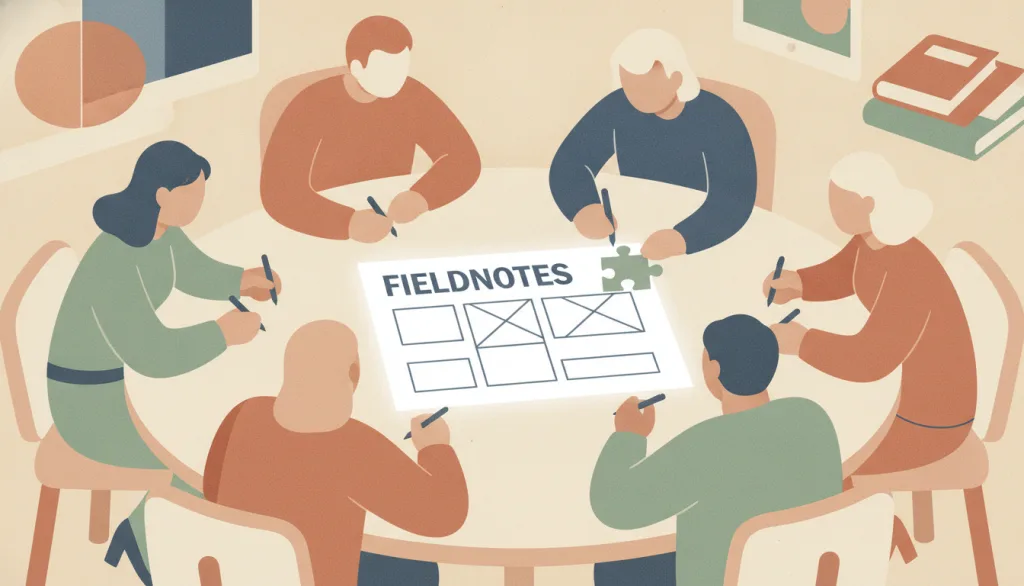
Let the people who will be affected by a design take part as co-designers in the design process and its key decisions, rather than only as subjects who are studied and then designed for by someone else; rooted in the Scandinavian workplace democracy and trade-union traditions of the 1960s-1970s.
Recognizing it
- Before the session, participants are told exactly which decisions they can actually change
- Affected people take part in ideation and evaluation as co-designers, not only as interviewees or test subjects
- Participants are compensated for the time and expertise they contribute
Concept boundary
Different from human-centered design: that approach puts users' needs and context at the center of the process, but the team still makes the final tradeoffs and decisions. Participatory design requires the affected people themselves to hold part of the decision-making power. Also different from inclusive design: inclusive design focuses on recognizing exclusion and differences in ability, while the key distinction here is who holds decision power, not which abilities are covered. If participants' input has no real effect on the outcome, inviting them to a meeting does not by itself make it participatory design.
When to consider it
- A decision will affect a specific group's work or life over the long term and needs their local knowledge
- The team wants to reduce the risk of imposing an outside solution before the design is finalized
- There is real capacity to give participants genuine influence over decisions early on, not just to gather opinions
When to be cautious
- The outcome is already decided and participants are only sought to endorse it
- Presenting a one-off interview or usability test as participatory design
- Asking for deep, repeated participant involvement without any way to compensate their time and expertise
Tradeoff
Giving affected people part of the decision-making power lengthens the cycle and adds coordination and compensation cost, and the outcome may conflict with the team's original plan; this requires weighing efficiency against shared decision-making.
Conditional rules · Editorial advice
Related entries
Both start from real people, but human-centered design still leaves final decisions to the team, while participatory design requires delegating part of that decision power to affected people.
Participatory design that only reaches easy-to-access people can still reproduce exclusion; inclusive design adds the lens of recognizing ability differences and exclusion.
Stating up front which decisions can change and which are already fixed is the basis for participants to calibrate appropriate trust in the process rather than blind trust.
Sources and what they support
Explains that participatory design gives users and stakeholders real influence over design decisions throughout the process, not only during prototype testing, and that end-users are present during ideation.
Retrieved: 2026-09-15 · Snapshot unconfirmedDocuments participatory design's 1960s-1970s origin in Scandinavian trade-union and workplace-democracy traditions, and notes its emancipatory theoretical foundation compared with ordinary user-centered design.
Retrieved: 2026-09-15 · Snapshot unconfirmedDefinitions reference these sources. Digital specimens, selection advice, relationships, and recipes are editorial work and have not been validated through user research.
Type extensions and implementation notes
No operable specimen yet; the illustration is editorial. When applied to a product, still verify that participants were clearly told beforehand which decisions could change, that compensation was actually provided, and that the final design genuinely reflects a shared decision rather than after-the-fact endorsement of a predetermined plan.
{
  "values": [
    "Shared decision-making",
    "Local knowledge",
    "Genuine delegation of authority"
  ],
  "tension": "Inviting people to participate versus genuinely delegating decision power",
  "questions": [
    "Which decisions can participants actually change, and which are already fixed?",
    "Have participants been compensated for the time and expertise they contributed?"
  ]
}
Full Agent entry JSON
{
  "id": "participatory-design",
  "type": "philosophy",
  "name": {
    "zh": "参与式设计",
    "en": "Participatory Design"
  },
  "aliases": [
    "PD",
    "共同设计",
    "Co-Design"
  ],
  "granularity": "experience",
  "intents": [
    "include-users",
    "co-design"
  ],
  "tags": [
    "shared decision-making",
    "stakeholders",
    "workshops",
    "workplace democracy",
    "compensating participants"
  ],
  "definition": "Let the people who will be affected by a design take part as co-designers in the design process and its key decisions, rather than only as subjects who are studied and then designed for by someone else; rooted in the Scandinavian workplace democracy and trade-union traditions of the 1960s-1970s.",
  "boundary": "Different from human-centered design: that approach puts users' needs and context at the center of the process, but the team still makes the final tradeoffs and decisions. Participatory design requires the affected people themselves to hold part of the decision-making power. Also different from inclusive design: inclusive design focuses on recognizing exclusion and differences in ability, while the key distinction here is who holds decision power, not which abilities are covered. If participants' input has no real effect on the outcome, inviting them to a meeting does not by itself make it participatory design.",
  "signature": [
    "Before the session, participants are told exactly which decisions they can actually change",
    "Affected people take part in ideation and evaluation as co-designers, not only as interviewees or test subjects",
    "Participants are compensated for the time and expertise they contribute"
  ],
  "when": [
    "A decision will affect a specific group's work or life over the long term and needs their local knowledge",
    "The team wants to reduce the risk of imposing an outside solution before the design is finalized",
    "There is real capacity to give participants genuine influence over decisions early on, not just to gather opinions"
  ],
  "when_not": [
    "The outcome is already decided and participants are only sought to endorse it",
    "Presenting a one-off interview or usability test as participatory design",
    "Asking for deep, repeated participant involvement without any way to compensate their time and expertise"
  ],
  "tradeoff": "Giving affected people part of the decision-making power lengthens the cycle and adds coordination and compensation cost, and the outcome may conflict with the team's original plan; this requires weighing efficiency against shared decision-making.",
  "comparison": {
    "focus": "Who takes part in design decisions and who holds decision power",
    "mechanism": "Co-design workshops where affected people take part as co-designers in ideation, evaluation, and tradeoffs",
    "cost": "Requires genuine delegation of decision authority, coordination time, and participant compensation"
  },
  "sources": [
    {
      "id": "ixdf-participatory-design",
      "title": "Interaction Design Foundation · Participatory Design",
      "url": "https://ixdf.org/literature/topics/participatory-design",
      "claim": "Explains that participatory design gives users and stakeholders real influence over design decisions throughout the process, not only during prototype testing, and that end-users are present during ideation.",
      "checkedAt": "2026-09-15",
      "archive": {
        "lookupUrl": "https://web.archive.org/web/20260915*/https://ixdf.org/literature/topics/participatory-design",
        "status": "pending",
        "checkedAt": "2026-09-16T05:56:55.140Z",
        "error": "status-request-failed",
        "jobId": "spn2-350af7191c4e5c52330d6248a0e84db965b25832"
      }
    },
    {
      "id": "wikipedia-participatory-design",
      "title": "Wikipedia · Participatory Design",
      "url": "https://en.wikipedia.org/wiki/Participatory_design",
      "claim": "Documents participatory design's 1960s-1970s origin in Scandinavian trade-union and workplace-democracy traditions, and notes its emancipatory theoretical foundation compared with ordinary user-centered design.",
      "checkedAt": "2026-09-15",
      "archive": {
        "lookupUrl": "https://web.archive.org/web/20260915*/https://en.wikipedia.org/wiki/Participatory_design",
        "status": "pending",
        "checkedAt": "2026-09-16T05:57:34.331Z",
        "error": "status-request-failed",
        "jobId": "spn2-bdd0f8c3c9d1a45df37034761c52c1c4c7a4f61a"
      }
    }
  ],
  "relations": [
    {
      "target": "human-centered-design",
      "kind": "related",
      "condition": "Deciding who can change a design decision, not just who is observed and consulted",
      "reason": "Both start from real people, but human-centered design still leaves final decisions to the team, while participatory design requires delegating part of that decision power to affected people.",
      "basis": "editorial"
    },
    {
      "target": "inclusive-design",
      "kind": "composes_with",
      "condition": "Deciding who is invited as a co-designer",
      "reason": "Participatory design that only reaches easy-to-access people can still reproduce exclusion; inclusive design adds the lens of recognizing ability differences and exclusion.",
      "basis": "editorial"
    },
    {
      "target": "trust-calibration",
      "kind": "informs",
      "condition": "Explaining to participants how their input will or will not be adopted",
      "reason": "Stating up front which decisions can change and which are already fixed is the basis for participants to calibrate appropriate trust in the process rather than blind trust.",
      "basis": "editorial"
    }
  ],
  "rules": [
    {
      "when": "Before a workshop, co-design session, or in-depth interview begins",
      "instruction": "State clearly which decisions participants' input can actually change, and which are already fixed and will not change because of this session.",
      "strength": "must",
      "basis": "editorial"
    },
    {
      "when": "Inviting participants to contribute time and expertise",
      "instruction": "Compensate participants for their time and expertise, for example through payment, acknowledgment, or another form of reciprocal value.",
      "strength": "recommend",
      "basis": "editorial"
    },
    {
      "when": "Key tradeoffs in the design have already been settled before the session",
      "instruction": "Do not present such a session as participatory design; if feedback is still being gathered, call it a consultation honestly.",
      "strength": "must",
      "basis": "editorial"
    }
  ],
  "philosophy": {
    "values": [
      "Shared decision-making",
      "Local knowledge",
      "Genuine delegation of authority"
    ],
    "tension": "Inviting people to participate versus genuinely delegating decision power",
    "questions": [
      "Which decisions can participants actually change, and which are already fixed?",
      "Have participants been compensated for the time and expertise they contributed?"
    ]
  },
  "demo": null,
  "version": "0.1.0",
  "editorialStatus": "drafted",
  "requirements": [],
  "demoCapabilities": [],
  "implementationNote": "No operable specimen yet; the illustration is editorial. When applied to a product, still verify that participants were clearly told beforehand which decisions could change, that compensation was actually provided, and that the final design genuinely reflects a shared decision rather than after-the-fact endorsement of a predetermined plan.",
  "image": {
    "src": "/images/participatory-design.webp",
    "alt": "Several differently shaped figures sit around a table with a fictional FIELDNOTES layout sketch, each holding a pen, while one of them places a puzzle piece onto the sketch."
  },
  "searchTerms": [
    "共同决策",
    "利益相关者",
    "工作坊",
    "劳资民主",
    "补偿参与者"
  ]
}