VOCABULARY / ENTRY
Shadow Banning
shadow-banning
A platform narrows the reach of someone’s content or account without telling them: they keep posting and keep seeing their own content, and the interface looks normal to them, but other people see it rarely or not at all.
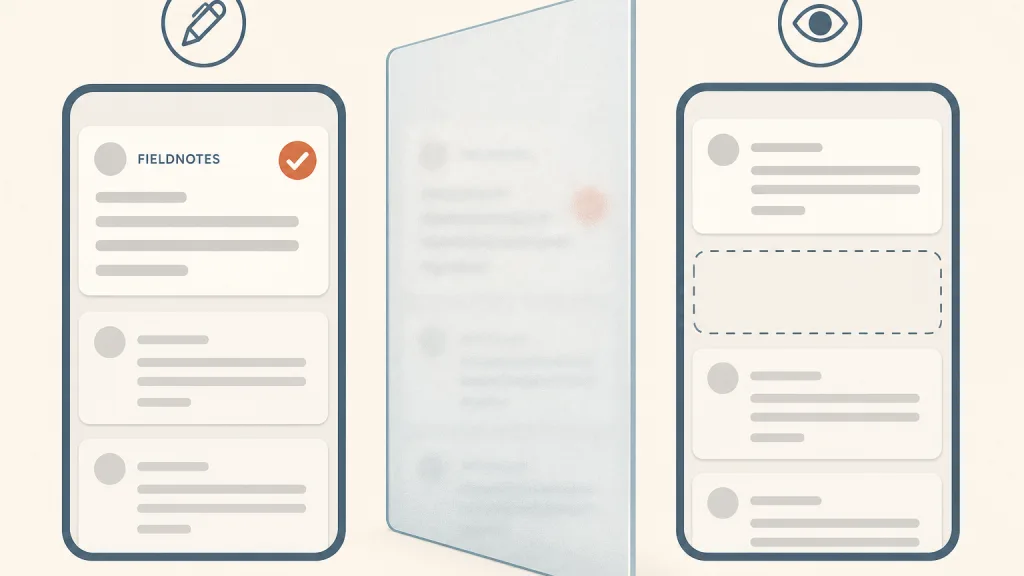
Recognizing it
- Posting reports success, yet from other people’s view the content is invisible or clearly pushed down
- The person affected sees no sign of a restriction and no route to appeal
- The person can only discover the limit indirectly, by switching accounts or asking others to look
Concept boundary
This entry targets limiting visibility without telling the person affected, not content moderation as such: removal, demotion, and reduced distribution can all have legitimate grounds. The difference is notice — a demotion whose type, reason, and appeal route are stated to the person does not belong here. It also differs from the ordinary low reach a ranking algorithm produces: only when a platform has imposed a restriction on a specific user or piece of content while showing that person an unchanged interface does this entry apply. The entry makes no judgment about whether any particular platform does this. For bulk spam and abusive accounts, platforms often argue that notice would help evasion; the entry acknowledges that tension but holds that silence should be a bounded, recorded exception rather than the default.
When to consider it
- Auditing whether a platform’s moderation and distribution apply restrictions without telling the people affected
- Designing the notice, statement of reasons, and appeal flow for content restrictions
When to be cautious
- As the default way to handle ordinary violations
- Withholding explanation for every restriction on the grounds that notice could be evaded
Tradeoff
The repair is to make restrictions visible to the person affected: which content is limited and how, under which rule, for how long, and how to appeal. The cost is that some abusers will adjust their behavior and moderation teams take on more communication and appeals; accounts that really are bulk spam can be handled under separate rules, but those rules belong in published policy rather than in an invisible exception.
Conditional rules · Editorial advice
Related entries
Showing that person an interface where everything looks normal hides the system’s state from precisely the person most affected by it.
Without a statement of reasons they can neither judge whether they broke a rule nor correct it or appeal in a targeted way.
Once a suspicion can be neither confirmed nor ruled out, authors attribute any low reach to hidden limits and lower their trust in the whole platform.
A clear status message telling the person what is restricted, why, and how to appeal is the most direct alternative to doing it invisibly.
Sources and what they support
Article 17(1) of the EU Digital Services Act, adopted on 19 October 2022, requires providers of hosting services to give affected recipients a “clear and specific statement of reasons” for restrictions imposed on the ground that content is illegal or incompatible with their terms and conditions; the restrictions listed include any restriction of the visibility of specific items of information (including removal, disabling access, or demotion), suspension or termination of monetary payments, suspension or termination of the service in whole or in part, and suspension or termination of the account. Article 17(3) sets out the minimum content: the type of decision, the facts and circumstances relied on, whether automated means were used, the legal or contractual ground, and the available redress. Article 17(2) limits the duty to cases where the provider knows the relevant electronic contact details and excludes deceptive high-volume commercial content. This entry cites it to show that, where the Act applies, unannounced demotion conflicts with a statutory duty to give reasons; scope and exceptions remain with the legal text.
Retrieved: 2026-10-20 · Snapshot unconfirmedThe article describes shadow banning (also stealth banning, hellbanning, ghost banning, or comment ghosting) as restricting a user or their content in an online community in a way the user does not readily notice, carried out by people or by algorithms; the user can usually still see their own posts while others cannot. It traces similar features back to 1980s bulletin board systems and states that the statement-of-reasons requirement in DSA Article 17 effectively prohibits the practice, while noting that enforcement often falls short. This entry paraphrases its definition; the view on the DSA’s effect is the article’s, not a legal conclusion.
Retrieved: 2026-10-20 · Snapshot unconfirmedDefinitions reference these sources. Digital specimens, selection advice, relationships, and recipes are editorial work and have not been validated through user research.
Type extensions and implementation notes
This is a warning entry and not a recommendation, and it makes no judgment about whether any particular platform uses the practice; the posts and accounts in the illustration are invented. When auditing a platform, view the same restricted item from the author’s side and from another user’s side, and check whether the difference between the two has been disclosed.
{
  "harm": "People lose their audience without knowing it and cannot appeal or correct anything; authors cannot tell why their reach is low, and trust in the platform falls across the board",
  "repair": "Make restrictions visible to the person affected: state the type, scope, grounds, duration, and appeal route; put any necessary no-notice exception into published policy, record it, and review it."
}
Open the Agent JSON file for this entryThis file repeats every field of this entry verbatim and adds its sources, archive status, and editorial scope.