VOCABULARY / ENTRY
Source Inspection
source-inspection
Check what a specific claim in generated content is based on: open the cited source, see the passage that supports the claim in its original context, and judge whether that passage actually supports the claim.
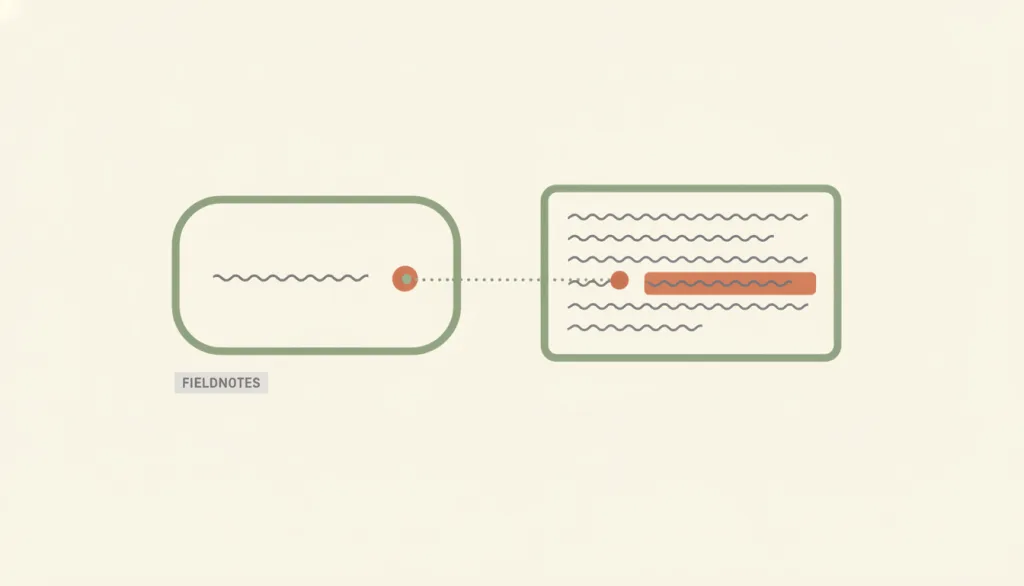
Recognizing it
- A visible citation marker sits next to the claim, pointing to a specific source rather than a general references section
- Opening the source shows the quoted passage itself, not just a title and a link
- The passage shown lets the person judge for themselves whether it actually supports the claim
Concept boundary
Source inspection is a more specific use of progressive disclosure applied to verification: progressive disclosure decides whether to reveal more content at all, while source inspection decides whether the passage revealed can actually support a specific claim. Hover cards and side panels are presentation variants of it, not separate patterns. It also differs from explainability, which answers why the system produced this result — what inputs it used, what reasoning path it followed. Source inspection is about whether the cited external source itself exists and whether its content matches the quoted passage. A system can offer an explanation with no checkable source, and it can also show citation-styled markers it never actually verified against the claim — neither counts as completed source inspection.
When to consider it
- A specific claim in generated content carries a verifiable source that can be opened in one step
- The person is accountable for a decision that follows and needs to judge the evidence themselves rather than accept the system's conclusion outright
When to be cautious
- The citation only points to the source's homepage or a search results page, with no way to find the specific passage cited
- The system shows a citation-styled marker that it never actually checked against the claim
- The claim has no checkable external source, such as a result purely computed internally by the system
Tradeoff
Lets people verify the evidentiary basis of a claim, at the cost of maintaining a reliable link to the specific passage and the attention and time the check itself consumes.
Conditional rules · Editorial advice
Related entries
Progressive disclosure decides what else is available beyond the initial view; source inspection has a narrower goal — judging whether the revealed passage actually supports a specific claim.
Letting people see and judge the evidence itself is one concrete way to calibrate trust and avoid over-reliance.
A supporting-pane layout is a common container for source-inspection content, but the panel itself is not the same concept as the inspection interaction.
Sources and what they support
This January 2026 preprint compares four interface designs for presenting sources and finds that interface design fundamentally changes how people verify evidence: a hover card supports smooth, in-flow verification without disrupting work, while a sidebar layout better sustains critical thinking when there are many citations; the study is a preprint and has not been peer-reviewed.
Retrieved: 2026-09-15 · Archived 2026-09-16Of the 18 human-AI interaction guidelines on this page, Guideline 11 recommends letting people access an explanation of why the system behaved as it did, and Guideline 9 recommends making it easy to edit, refine, or recover when the system is wrong; both are general-purpose guidelines that provide a rationale for checking evidence and revising judgments, but neither is specific to the source-inspection interaction itself.
Retrieved: 2026-09-15 · Archived 2026-09-16Definitions reference these sources. Digital specimens, selection advice, relationships, and recipes are editorial work and have not been validated through user research.
Type extensions and implementation notes
This entry has no operable specimen yet; the illustration is an editorial sketch. Applying it to a product still requires verifying that the citation reaches the specific passage in one step rather than a homepage, that the system never implies it verified a citation it did not actually check, and that the source view is reachable by assistive technology.
{
  "states": [
    "collapsed",
    "loading",
    "open"
  ],
  "a11y": [
    "The citation marker can be focused and activated with a keyboard, and announces that activating it opens the source",
    "Opening it moves focus into the source view, which has an accessible heading identifying it as the cited source",
    "The quoted passage is marked by text or structure in addition to color highlighting, not by color alone"
  ],
  "motion": "Opening the source view does not depend on animation; show it immediately under reduced-motion preference"
}
Full Agent entry JSON
{
  "id": "source-inspection",
  "type": "interaction",
  "name": {
    "zh": "来源核查",
    "en": "Source Inspection"
  },
  "aliases": [
    "来源核实",
    "查看引用来源",
    "Citation Inspection"
  ],
  "granularity": "component",
  "intents": [
    "consult-reference"
  ],
  "tags": [
    "citation",
    "source",
    "verification",
    "evidence",
    "side panel"
  ],
  "definition": "Check what a specific claim in generated content is based on: open the cited source, see the passage that supports the claim in its original context, and judge whether that passage actually supports the claim.",
  "boundary": "Source inspection is a more specific use of progressive disclosure applied to verification: progressive disclosure decides whether to reveal more content at all, while source inspection decides whether the passage revealed can actually support a specific claim. Hover cards and side panels are presentation variants of it, not separate patterns. It also differs from explainability, which answers why the system produced this result — what inputs it used, what reasoning path it followed. Source inspection is about whether the cited external source itself exists and whether its content matches the quoted passage. A system can offer an explanation with no checkable source, and it can also show citation-styled markers it never actually verified against the claim — neither counts as completed source inspection.",
  "signature": [
    "A visible citation marker sits next to the claim, pointing to a specific source rather than a general references section",
    "Opening the source shows the quoted passage itself, not just a title and a link",
    "The passage shown lets the person judge for themselves whether it actually supports the claim"
  ],
  "when": [
    "A specific claim in generated content carries a verifiable source that can be opened in one step",
    "The person is accountable for a decision that follows and needs to judge the evidence themselves rather than accept the system's conclusion outright"
  ],
  "when_not": [
    "The citation only points to the source's homepage or a search results page, with no way to find the specific passage cited",
    "The system shows a citation-styled marker that it never actually checked against the claim",
    "The claim has no checkable external source, such as a result purely computed internally by the system"
  ],
  "tradeoff": "Lets people verify the evidentiary basis of a claim, at the cost of maintaining a reliable link to the specific passage and the attention and time the check itself consumes.",
  "comparison": {
    "focus": "Whether a claim and its cited source can be verified on the spot by the person",
    "mechanism": "Making the citation a one-step entry point that locates the quoted passage inside the source",
    "cost": "Keeping the locator link reliable, plus the attention the check itself consumes"
  },
  "sources": [
    {
      "id": "arxiv-source-presentation",
      "title": "arXiv · Source Presentation in Conversational Interfaces (preprint)",
      "url": "https://arxiv.org/abs/2601.14611",
      "claim": "This January 2026 preprint compares four interface designs for presenting sources and finds that interface design fundamentally changes how people verify evidence: a hover card supports smooth, in-flow verification without disrupting work, while a sidebar layout better sustains critical thinking when there are many citations; the study is a preprint and has not been peer-reviewed.",
      "checkedAt": "2026-09-15",
      "archive": {
        "lookupUrl": "https://web.archive.org/web/20260915*/https://arxiv.org/abs/2601.14611",
        "status": "available",
        "checkedAt": "2026-09-16T04:27:22.464Z",
        "jobId": "spn2-faeadc21fa1a6f55dc59856e2043d40785f16f4b",
        "url": "https://web.archive.org/web/20260916042836/https://arxiv.org/abs/2601.14611",
        "timestamp": "20260916042836"
      }
    },
    {
      "id": "hax-guidelines",
      "title": "Microsoft Research · Guidelines for Human-AI Interaction",
      "url": "https://www.microsoft.com/en-us/research/?p=564561",
      "claim": "Of the 18 human-AI interaction guidelines on this page, Guideline 11 recommends letting people access an explanation of why the system behaved as it did, and Guideline 9 recommends making it easy to edit, refine, or recover when the system is wrong; both are general-purpose guidelines that provide a rationale for checking evidence and revising judgments, but neither is specific to the source-inspection interaction itself.",
      "checkedAt": "2026-09-15",
      "archive": {
        "lookupUrl": "https://web.archive.org/web/20260915*/https://www.microsoft.com/en-us/research/?p=564561",
        "status": "available",
        "checkedAt": "2026-09-16T05:44:04.283Z",
        "jobId": "spn2-60379d38576175de8822ed3e95c9f3cfdfd11517",
        "url": "https://web.archive.org/web/20260916054428/https://www.microsoft.com/en-us/research/blog/guidelines-for-human-ai-interaction-design/",
        "timestamp": "20260916054428"
      }
    }
  ],
  "relations": [
    {
      "target": "progressive-disclosure",
      "kind": "related",
      "condition": "Only about whether to reveal more content at all, not about whether a specific claim can be verified",
      "reason": "Progressive disclosure decides what else is available beyond the initial view; source inspection has a narrower goal — judging whether the revealed passage actually supports a specific claim.",
      "basis": "editorial"
    },
    {
      "target": "trust-calibration",
      "kind": "composes_with",
      "condition": "The person needs to decide how much to rely on the system's conclusion",
      "reason": "Letting people see and judge the evidence itself is one concrete way to calibrate trust and avoid over-reliance.",
      "basis": "editorial"
    },
    {
      "target": "supporting-pane",
      "kind": "realized_by",
      "condition": "Placing the source's original excerpt in a panel next to the main content",
      "reason": "A supporting-pane layout is a common container for source-inspection content, but the panel itself is not the same concept as the inspection interaction.",
      "basis": "editorial"
    }
  ],
  "rules": [
    {
      "when": "Showing a citation marker next to a claim",
      "instruction": "Make sure the marker reaches the specific source location in one step, not the source's homepage or a search results page.",
      "strength": "must",
      "basis": "editorial"
    },
    {
      "when": "After the source is opened",
      "instruction": "Show the quoted passage and its surrounding context in the source's own wording, with enough of it visible to judge whether it supports the claim — not just a title and a link.",
      "strength": "must",
      "basis": "editorial"
    },
    {
      "when": "The system has not actually checked the cited content against the claim",
      "instruction": "Do not use a citation-styled marker to imply the system has verified it; present it only as a link for the person to check themselves.",
      "strength": "must",
      "basis": "editorial"
    }
  ],
  "behavior": {
    "states": [
      "collapsed",
      "loading",
      "open"
    ],
    "a11y": [
      "The citation marker can be focused and activated with a keyboard, and announces that activating it opens the source",
      "Opening it moves focus into the source view, which has an accessible heading identifying it as the cited source",
      "The quoted passage is marked by text or structure in addition to color highlighting, not by color alone"
    ],
    "motion": "Opening the source view does not depend on animation; show it immediately under reduced-motion preference"
  },
  "demo": null,
  "version": "0.1.0",
  "editorialStatus": "drafted",
  "requirements": [],
  "demoCapabilities": [],
  "implementationNote": "This entry has no operable specimen yet; the illustration is an editorial sketch. Applying it to a product still requires verifying that the citation reaches the specific passage in one step rather than a homepage, that the system never implies it verified a citation it did not actually check, and that the source view is reachable by assistive technology.",
  "image": {
    "src": "/images/source-inspection.webp",
    "alt": "A fictional FIELDNOTES answer card: one sentence carries a small citation chip, and an open panel to its right shows a document excerpt with the cited passage highlighted, connected to the chip by a faint line."
  },
  "searchTerms": [
    "引用",
    "来源",
    "核查",
    "证据",
    "侧栏"
  ]
}