VOCABULARY / ENTRY
AI Content Label
ai-label
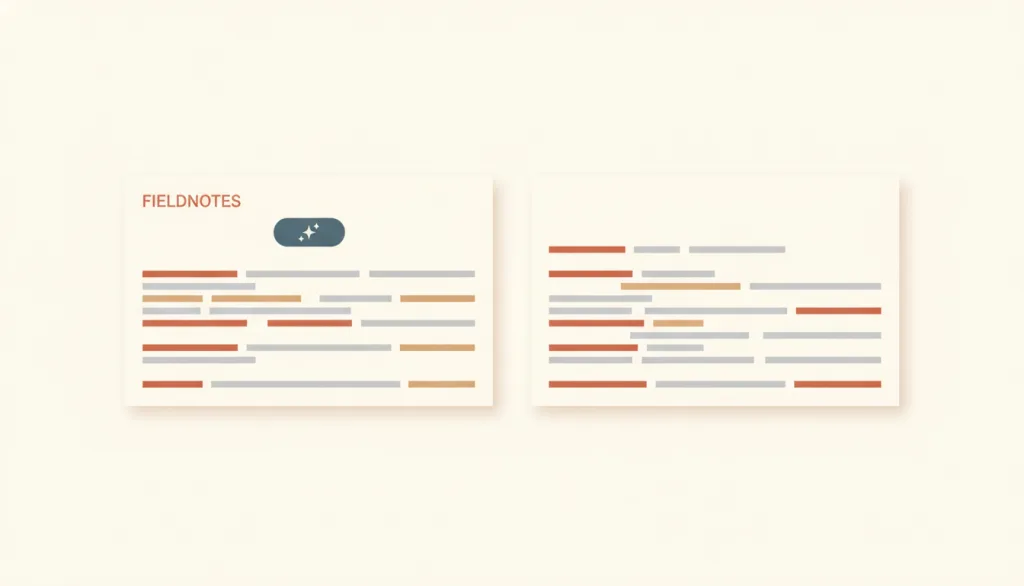
When a piece of content in an interface is generated by a model or substantially modified by one, a visible marker that is also identifiable to assistive technology is placed in the same location as that content, telling people that AI was involved. The label only carries this existence disclosure; it does not mean the content has been verified as accurate or trustworthy.
Recognizing it
- The label appears in the same visual area as the content it marks, not only on a settings page or in footer text
- The label is exposed to assistive technology through programmatic text or a role, not through an icon alone
- Clicking or hovering the label can expand a more detailed explanation layer, but the label itself is already visible when the content appears
Concept boundary
An AI content label only flags the fact that a piece of content was generated by or involved AI. It does not vouch for the content's accuracy or trustworthiness — calibrating a person's trust in the result is the job of trust-calibration. It is also not provenance-metadata infrastructure of the C2PA Content Credentials kind: content credentials record and let people verify a technical chain of how content was made and edited, while an AI content label serves an immediate, human-visible notice at the point where the content appears. The two can sit side by side, but they are not the same layer.
When to consider it
- A piece of content shown to people was generated by or substantially rewritten by a model
- People need to know the content's origin while reading it, not discover it afterward
- The product wants a consistent entry point into a later explainability layer
When to be cautious
- AI involvement is disclosed only on a settings page, in help documentation, or in footer copyright text, not where the content appears
- An icon substitutes for programmatic text, leaving screen reader users unable to perceive the label's presence or meaning
- The label is used as a substitute for accuracy review or source citation
Tradeoff
A label takes up interface space and can make content feel less "authoritative" or add visual noise, but omitting it lets people mistake generated content for human-written work, which damages trust in the product over time.
Conditional rules · Editorial advice
Related entries
An AI content label only discloses where content came from; combining the label with more detailed confidence or limitation notes is what helps people calibrate how much to trust the result.
A status message reports the outcome of an action; an AI content label reports where a piece of content came from. The mechanisms are similar but what they report is different, so they should not be merged into one component.
Attaching an AI content label to a message bubble keeps the origin information visible while people read the message, instead of requiring a trip to a settings page.
Sources and what they support
IBM's Carbon for AI guidelines define the "AI label" as the primary indicator marking the presence of AI-generated content in an interface, requiring every AI-capable component to embed the label together with an explainability popover that alerts people the content is AI-generated and serves as the entry point to further explanation.
Retrieved: 2026-09-15 · Snapshot unconfirmedArticle 50(2) of the EU AI Act requires outputs of AI systems that generate synthetic audio, image, video, or text to be marked in a machine-readable format and detectable as artificially generated or manipulated; Article 50(4) requires deepfake content, and AI-generated text published to inform the public on matters of public interest, to be disclosed in a clear and distinguishable manner at the time of first interaction or exposure, in a way that meets accessibility requirements, with exemptions such as for artistic, creative, or satirical works.
Retrieved: 2026-09-15 · Snapshot unconfirmedThe Content Credentials (C2PA) site describes the "pin" as a visible mark signaling that content carries provenance information; clicking the icon opens an interactive component showing how the content was made and its edit history. This sits adjacent to, but is part of a machine-readable provenance-metadata system distinct from, the visible label this entry defines.
Retrieved: 2026-09-15 · Snapshot unconfirmedDefinitions reference these sources. Digital specimens, selection advice, relationships, and recipes are editorial work and have not been validated through user research.
Type extensions and implementation notes
This entry has no operable specimen yet; the illustration is an editorial sketch. Applying it to a product still requires verifying that the label stays visible and uncropped across every content form (text, image, audio, video), that screen readers actually announce the label's association with its content, and that the label is not being misused as a stand-in for accuracy certification.
{
  "states": [
    "hidden",
    "visible",
    "expanded"
  ],
  "a11y": [
    "The label is exposed to assistive technology through programmatic text or a role, not through an icon alone",
    "The label stays associated with the content it marks so screen reader users can perceive the correspondence"
  ],
  "motion": "The label needs no motion to appear; if the explanation layer has a transition, it should expand immediately under reduced motion instead of transitioning"
}
Full Agent entry JSON
{
  "id": "ai-label",
  "type": "micro",
  "name": {
    "zh": "AI 内容标记",
    "en": "AI Content Label"
  },
  "aliases": [
    "AI Label",
    "AI 标记",
    "AI Slug"
  ],
  "granularity": "state",
  "intents": [
    "calibrate-trust",
    "disclose-ai-origin"
  ],
  "tags": [
    "transparency",
    "label",
    "artificial intelligence",
    "accessibility",
    "generated content"
  ],
  "definition": "When a piece of content in an interface is generated by a model or substantially modified by one, a visible marker that is also identifiable to assistive technology is placed in the same location as that content, telling people that AI was involved. The label only carries this existence disclosure; it does not mean the content has been verified as accurate or trustworthy.",
  "boundary": "An AI content label only flags the fact that a piece of content was generated by or involved AI. It does not vouch for the content's accuracy or trustworthiness — calibrating a person's trust in the result is the job of trust-calibration. It is also not provenance-metadata infrastructure of the C2PA Content Credentials kind: content credentials record and let people verify a technical chain of how content was made and edited, while an AI content label serves an immediate, human-visible notice at the point where the content appears. The two can sit side by side, but they are not the same layer.",
  "signature": [
    "The label appears in the same visual area as the content it marks, not only on a settings page or in footer text",
    "The label is exposed to assistive technology through programmatic text or a role, not through an icon alone",
    "Clicking or hovering the label can expand a more detailed explanation layer, but the label itself is already visible when the content appears"
  ],
  "when": [
    "A piece of content shown to people was generated by or substantially rewritten by a model",
    "People need to know the content's origin while reading it, not discover it afterward",
    "The product wants a consistent entry point into a later explainability layer"
  ],
  "when_not": [
    "AI involvement is disclosed only on a settings page, in help documentation, or in footer copyright text, not where the content appears",
    "An icon substitutes for programmatic text, leaving screen reader users unable to perceive the label's presence or meaning",
    "The label is used as a substitute for accuracy review or source citation"
  ],
  "tradeoff": "A label takes up interface space and can make content feel less \"authoritative\" or add visual noise, but omitting it lets people mistake generated content for human-written work, which damages trust in the product over time.",
  "comparison": {
    "focus": "Telling people whether the content in front of them was generated or modified by a model",
    "mechanism": "A programmatically readable label co-located with the content, usually with an expandable explanation layer",
    "cost": "Requires maintaining the label and its explanatory copy at every place content might be generated, and cannot replace accuracy review"
  },
  "sources": [
    {
      "id": "carbon-ai-label",
      "title": "IBM Carbon Design System · Carbon for AI — AI label",
      "url": "https://carbondesignsystem.com/guidelines/carbon-for-ai/",
      "claim": "IBM's Carbon for AI guidelines define the \"AI label\" as the primary indicator marking the presence of AI-generated content in an interface, requiring every AI-capable component to embed the label together with an explainability popover that alerts people the content is AI-generated and serves as the entry point to further explanation.",
      "checkedAt": "2026-09-15",
      "archive": {
        "lookupUrl": "https://web.archive.org/web/20260915*/https://carbondesignsystem.com/guidelines/carbon-for-ai/",
        "status": "pending",
        "checkedAt": "2026-09-16T05:46:58.912Z",
        "error": "status-request-failed",
        "jobId": "spn2-68672bb1f9445b8a80bc4dbeb2435f555378370f"
      }
    },
    {
      "id": "eu-ai-act-article-50",
      "title": "EU Artificial Intelligence Act · Article 50 — Transparency Obligations",
      "url": "https://www.artificialintelligenceact.eu/article/50/",
      "claim": "Article 50(2) of the EU AI Act requires outputs of AI systems that generate synthetic audio, image, video, or text to be marked in a machine-readable format and detectable as artificially generated or manipulated; Article 50(4) requires deepfake content, and AI-generated text published to inform the public on matters of public interest, to be disclosed in a clear and distinguishable manner at the time of first interaction or exposure, in a way that meets accessibility requirements, with exemptions such as for artistic, creative, or satirical works.",
      "checkedAt": "2026-09-15",
      "archive": {
        "lookupUrl": "https://web.archive.org/web/20260915*/https://www.artificialintelligenceact.eu/article/50/",
        "status": "pending",
        "checkedAt": "2026-09-16T05:47:32.145Z",
        "error": "status-request-failed",
        "jobId": "spn2-e56ff7ed743e63638aec9b77a1e8bd0abfb3ab6a"
      }
    },
    {
      "id": "content-credentials-pin",
      "title": "Content Credentials (C2PA) · Content Credentials pin",
      "url": "https://contentcredentials.org/",
      "claim": "The Content Credentials (C2PA) site describes the \"pin\" as a visible mark signaling that content carries provenance information; clicking the icon opens an interactive component showing how the content was made and its edit history. This sits adjacent to, but is part of a machine-readable provenance-metadata system distinct from, the visible label this entry defines.",
      "checkedAt": "2026-09-15",
      "archive": {
        "lookupUrl": "https://web.archive.org/web/20260915*/https://contentcredentials.org/",
        "status": "unconfirmed",
        "checkedAt": "2026-09-16T05:47:37.592Z",
        "error": "save-request-failed"
      }
    }
  ],
  "relations": [
    {
      "target": "trust-calibration",
      "kind": "composes_with",
      "condition": "The label is shown together with an expandable explanation layer",
      "reason": "An AI content label only discloses where content came from; combining the label with more detailed confidence or limitation notes is what helps people calibrate how much to trust the result.",
      "basis": "editorial"
    },
    {
      "target": "status-message",
      "kind": "related",
      "condition": "Both convey brief, non-blocking metadata alongside content",
      "reason": "A status message reports the outcome of an action; an AI content label reports where a piece of content came from. The mechanisms are similar but what they report is different, so they should not be merged into one component.",
      "basis": "editorial"
    },
    {
      "target": "conversational-interface",
      "kind": "composes_with",
      "condition": "Replies in a conversational interface are generated by a model",
      "reason": "Attaching an AI content label to a message bubble keeps the origin information visible while people read the message, instead of requiring a trip to a settings page.",
      "basis": "editorial"
    }
  ],
  "rules": [
    {
      "when": "Content generated by or substantially modified by a model is shown to people",
      "instruction": "The label must appear in the same visual area as the content itself, not only on a settings page, in help documentation, or in footer copyright text.",
      "strength": "must",
      "basis": "editorial"
    },
    {
      "when": "Implementing the label",
      "instruction": "The label must be exposed to assistive technology through programmatic text, a role, or an attribute, not through an icon alone.",
      "strength": "must",
      "basis": "editorial"
    },
    {
      "when": "The label is shown alongside content",
      "instruction": "Do not use the label as a substitute for accuracy review or source citation; factual content still needs its sources verified through the usual process.",
      "strength": "must",
      "basis": "editorial"
    }
  ],
  "behavior": {
    "states": [
      "hidden",
      "visible",
      "expanded"
    ],
    "a11y": [
      "The label is exposed to assistive technology through programmatic text or a role, not through an icon alone",
      "The label stays associated with the content it marks so screen reader users can perceive the correspondence"
    ],
    "motion": "The label needs no motion to appear; if the explanation layer has a transition, it should expand immediately under reduced motion instead of transitioning"
  },
  "demo": null,
  "version": "0.1.0",
  "editorialStatus": "drafted",
  "requirements": [],
  "demoCapabilities": [],
  "implementationNote": "This entry has no operable specimen yet; the illustration is an editorial sketch. Applying it to a product still requires verifying that the label stays visible and uncropped across every content form (text, image, audio, video), that screen readers actually announce the label's association with its content, and that the label is not being misused as a stand-in for accuracy certification.",
  "image": {
    "src": "/images/ai-label.webp",
    "alt": "On a fictional FIELDNOTES content card, a small pill-shaped marker with a subtle sparkle glyph sits at the top edge; next to it is an unmarked card, both otherwise made only of abstract text bars."
  },
  "searchTerms": [
    "透明度",
    "标记",
    "人工智能",
    "可访问性",
    "生成内容"
  ]
}