VOCABULARY / ENTRY
Art Nouveau
art-nouveau
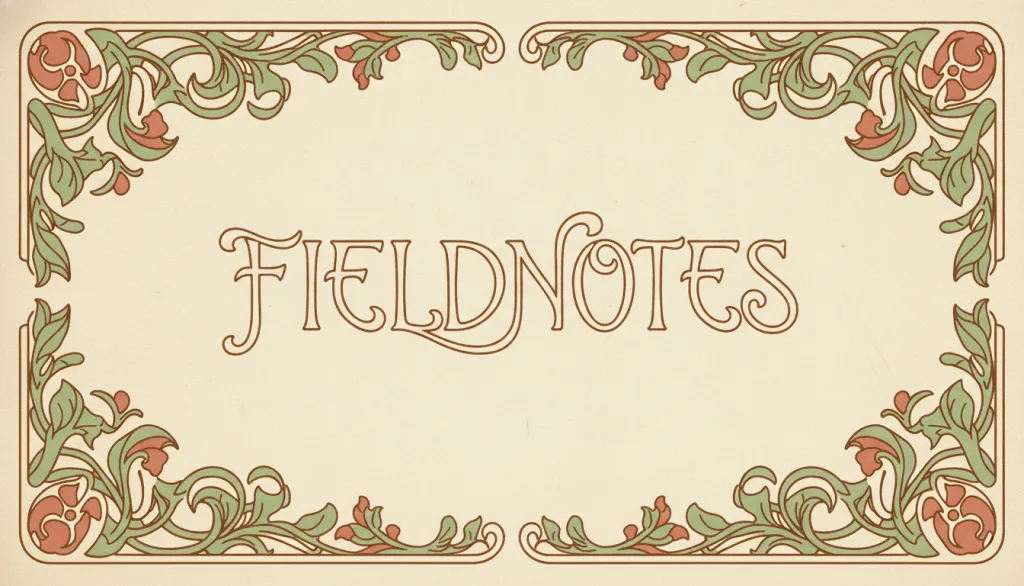
Art Nouveau is a decorative visual style that flourished in Europe and the United States from the early 1890s to the eve of the First World War, marked by flowing, asymmetric "whiplash" curves and plant and floral motifs drawn from nature, with ornament fused into structure rather than applied on top of it.
Recognizing it
- Flowing, asymmetric "whiplash" curves run through both ornament and structure
- Plant and floral motifs such as vines and flowers recur in borders, lettering, and decorative details
- Strongly hand-drawn custom lettering is fused with the surrounding pattern
Concept boundary
This entry covers roughly 1890 to 1910. It differs from the later Art Deco, which arose as a counter-reaction with geometric, symmetric, streamlined forms that express the precision of the machine age rather than Art Nouveau's hand-crafted organic curves; Art Deco is not used as a relation target for this entry. It also differs from skeuomorphism: skeuomorphism borrows the form and operation of a specific real object to explain a digital function, while Art Nouveau's curves and motifs are drawn from natural forms in general to create a decorative, hand-crafted character rather than to imitate one object's function.
When to consider it
- The brand wants to express a handcrafted feel, nature-derived inspiration, or a turn-of-the-century, nostalgic character
- Organic ornament is needed to unify layout, graphics, and lettering into one visual language
- Content volume is low, so the layout can afford to draw attention to pattern and hand-drawn detail
When to be cautious
- The same page also needs a geometric, symmetric, machine-precision decorative language, which is easily confused with or clashes with this style
- Content density is high and needs fast scanning; heavy hand-drawn pattern slows reading and scatters attention
- The goal is simply nostalgia or retro feeling achieved through symmetric, straight-lined ornament, which is Art Deco, not Art Nouveau
Tradeoff
Whiplash curves and hand-drawn custom lettering create a distinctive handcrafted character and recognizability, but without restraint they weaken body-text legibility and raise the cost of keeping curved graphics and custom type consistent across devices and languages.
Conditional rules · Editorial advice
Related entries
Art Nouveau draws its curves and motifs from organic plant forms in general, while skeuomorphism borrows the form and operation of one specific real object to explain a digital function; the source and purpose of the ornament differ.
Minimalism calls for removing elements that do not support the task, while Art Nouveau's expressive power comes precisely from the density of decorative curves and motifs; the two pull in opposite directions.
Art Nouveau conveys handcrafted texture through organic curves and hand-drawn pattern, while glassmorphism conveys front-to-back depth through translucency and background blur; the mechanisms differ but both are highly recognizable surface styles that need to be checked for coherence with the rest of the page.
Sources and what they support
The page states that Art Nouveau emerged as a visual arts style from the early 1890s to the First World War, drawing on the natural world with characteristic motifs of delicate tendrils, organic forms, and swirling curves and eccentric geometry, and notes that the style became established almost simultaneously in several countries between 1893 and 1895 before spreading rapidly as the first international decorative style of the modern age. This entry's date range and plant-motif characteristics paraphrase it.
Retrieved: 2026-09-15 · Archived 2026-09-16The entry states that Art Nouveau is characterized by sinuous lines and flowing organic shapes based on plant forms, emerged in the 1890s, flourished in the first decades of the twentieth century, and was ended by the First World War, and notes that in the work of designers such as Mackintosh these flowing curves sit within severe but eccentric geometry. This entry's date range and description of curves fused with structure paraphrase it.
Retrieved: 2026-09-15 · Archived 2026-09-16Definitions reference these sources. Digital specimens, selection advice, relationships, and recipes are editorial work and have not been validated through user research.
Type extensions and implementation notes
This entry has no operable specimen yet; the illustration is an editorial sketch. When applied to a product, verify that hand-drawn lettering does not obscure the legibility of key information, that decorative curves grow along the layout's structure rather than sitting on top of an unrelated layout, and that custom lettering and curved graphics render consistently across devices.
{
  "tokens": {
    "surface": "#f2ead9",
    "ink": "#2f2a1e",
    "accent": "#b5652d",
    "radiusPx": 12,
    "shadow": "0 3px 10px rgba(47,42,30,0.18)"
  },
  "tokenScope": "A recipe for this specimen: a cream, paper-toned surface, dark brown ink, a terracotta accent, and a soft curved shadow; a real product should derive its own values from its brand character and verify body-text legibility over patterned backgrounds."
}
Full Agent entry JSON
{
  "id": "art-nouveau",
  "type": "visual",
  "name": {
    "zh": "新艺术风格",
    "en": "Art Nouveau"
  },
  "aliases": [
    "Modern Style",
    "Jugendstil",
    "新艺术运动"
  ],
  "granularity": "experience",
  "intents": [
    "express-brand",
    "organize-content"
  ],
  "tags": [
    "whiplash curve",
    "plant motifs",
    "organic ornament",
    "hand-drawn lettering",
    "ornament fused with structure"
  ],
  "definition": "Art Nouveau is a decorative visual style that flourished in Europe and the United States from the early 1890s to the eve of the First World War, marked by flowing, asymmetric \"whiplash\" curves and plant and floral motifs drawn from nature, with ornament fused into structure rather than applied on top of it.",
  "boundary": "This entry covers roughly 1890 to 1910. It differs from the later Art Deco, which arose as a counter-reaction with geometric, symmetric, streamlined forms that express the precision of the machine age rather than Art Nouveau's hand-crafted organic curves; Art Deco is not used as a relation target for this entry. It also differs from skeuomorphism: skeuomorphism borrows the form and operation of a specific real object to explain a digital function, while Art Nouveau's curves and motifs are drawn from natural forms in general to create a decorative, hand-crafted character rather than to imitate one object's function.",
  "signature": [
    "Flowing, asymmetric \"whiplash\" curves run through both ornament and structure",
    "Plant and floral motifs such as vines and flowers recur in borders, lettering, and decorative details",
    "Strongly hand-drawn custom lettering is fused with the surrounding pattern"
  ],
  "when": [
    "The brand wants to express a handcrafted feel, nature-derived inspiration, or a turn-of-the-century, nostalgic character",
    "Organic ornament is needed to unify layout, graphics, and lettering into one visual language",
    "Content volume is low, so the layout can afford to draw attention to pattern and hand-drawn detail"
  ],
  "when_not": [
    "The same page also needs a geometric, symmetric, machine-precision decorative language, which is easily confused with or clashes with this style",
    "Content density is high and needs fast scanning; heavy hand-drawn pattern slows reading and scatters attention",
    "The goal is simply nostalgia or retro feeling achieved through symmetric, straight-lined ornament, which is Art Deco, not Art Nouveau"
  ],
  "tradeoff": "Whiplash curves and hand-drawn custom lettering create a distinctive handcrafted character and recognizability, but without restraint they weaken body-text legibility and raise the cost of keeping curved graphics and custom type consistent across devices and languages.",
  "comparison": {
    "focus": "Nature-derived whiplash curves and organic ornament",
    "mechanism": "Flowing curves, plant motifs, hand-drawn custom lettering, ornament fused with structure",
    "cost": "Hand-drawn detail is expensive to produce and requires extra verification of body-text legibility and cross-device consistency"
  },
  "sources": [
    {
      "id": "art-nouveau-vam-collections",
      "title": "V&A · Art Nouveau",
      "url": "https://www.vam.ac.uk/collections/art-nouveau",
      "claim": "The page states that Art Nouveau emerged as a visual arts style from the early 1890s to the First World War, drawing on the natural world with characteristic motifs of delicate tendrils, organic forms, and swirling curves and eccentric geometry, and notes that the style became established almost simultaneously in several countries between 1893 and 1895 before spreading rapidly as the first international decorative style of the modern age. This entry's date range and plant-motif characteristics paraphrase it.",
      "checkedAt": "2026-09-15",
      "archive": {
        "lookupUrl": "https://web.archive.org/web/20260915*/https://www.vam.ac.uk/collections/art-nouveau",
        "status": "available",
        "checkedAt": "2026-09-16T04:50:47.194Z",
        "jobId": "spn2-2d55f967bd1c4f0ed704650a38907f139fee2fbf",
        "url": "https://web.archive.org/web/20260916045153/https://www.vam.ac.uk/collections/art-nouveau",
        "timestamp": "20260916045153"
      }
    },
    {
      "id": "art-nouveau-tate",
      "title": "Tate · Art Nouveau",
      "url": "https://www.tate.org.uk/art/art-terms/a/art-nouveau",
      "claim": "The entry states that Art Nouveau is characterized by sinuous lines and flowing organic shapes based on plant forms, emerged in the 1890s, flourished in the first decades of the twentieth century, and was ended by the First World War, and notes that in the work of designers such as Mackintosh these flowing curves sit within severe but eccentric geometry. This entry's date range and description of curves fused with structure paraphrase it.",
      "checkedAt": "2026-09-15",
      "archive": {
        "lookupUrl": "https://web.archive.org/web/20260915*/https://www.tate.org.uk/art/art-terms/a/art-nouveau",
        "status": "available",
        "checkedAt": "2026-09-16T05:16:44.449Z",
        "jobId": "spn2-e056e840ba122161af3251a1b8a81fd50364b6f1",
        "url": "https://web.archive.org/web/20260916051651/https://www.tate.org.uk/art/art-terms/a/art-nouveau",
        "timestamp": "20260916051651"
      }
    }
  ],
  "relations": [
    {
      "target": "skeuomorphism",
      "kind": "related",
      "condition": "Both styles may be used to add decorative or material-driven handcrafted character to an interface",
      "reason": "Art Nouveau draws its curves and motifs from organic plant forms in general, while skeuomorphism borrows the form and operation of one specific real object to explain a digital function; the source and purpose of the ornament differ.",
      "basis": "editorial"
    },
    {
      "target": "minimalism",
      "kind": "conflicts_when",
      "condition": "A page both demands reducing elements to the essential minimum and is covered in whiplash curves and plant motifs as ornament",
      "reason": "Minimalism calls for removing elements that do not support the task, while Art Nouveau's expressive power comes precisely from the density of decorative curves and motifs; the two pull in opposite directions.",
      "basis": "editorial"
    },
    {
      "target": "glassmorphism",
      "kind": "related",
      "condition": "Both styles may be used in the same digital interface to express texture or depth through a strong surface treatment",
      "reason": "Art Nouveau conveys handcrafted texture through organic curves and hand-drawn pattern, while glassmorphism conveys front-to-back depth through translucency and background blur; the mechanisms differ but both are highly recognizable surface styles that need to be checked for coherence with the rest of the page.",
      "basis": "editorial"
    }
  ],
  "rules": [
    {
      "when": "Rendering a heading, brand name, or decorative text in hand-drawn custom lettering",
      "instruction": "Key information such as navigation, prices, and button copy must stay in a clearly legible body typeface; it must not be conveyed only through the hand-drawn decorative lettering.",
      "strength": "must",
      "basis": "editorial"
    },
    {
      "when": "Adding plant motifs, borders, or curved ornament to an interface",
      "instruction": "Ornament should grow along the layout's structure, such as page edges, dividers, or card borders, rather than being applied on top of an unrelated grid or layout.",
      "strength": "recommend",
      "basis": "editorial"
    }
  ],
  "visual": {
    "tokens": {
      "surface": "#f2ead9",
      "ink": "#2f2a1e",
      "accent": "#b5652d",
      "radiusPx": 12,
      "shadow": "0 3px 10px rgba(47,42,30,0.18)"
    },
    "tokenScope": "A recipe for this specimen: a cream, paper-toned surface, dark brown ink, a terracotta accent, and a soft curved shadow; a real product should derive its own values from its brand character and verify body-text legibility over patterned backgrounds."
  },
  "demo": null,
  "version": "0.1.0",
  "editorialStatus": "drafted",
  "requirements": [],
  "demoCapabilities": [],
  "implementationNote": "This entry has no operable specimen yet; the illustration is an editorial sketch. When applied to a product, verify that hand-drawn lettering does not obscure the legibility of key information, that decorative curves grow along the layout's structure rather than sitting on top of an unrelated layout, and that custom lettering and curved graphics render consistently across devices.",
  "image": {
    "src": "/images/art-nouveau.webp",
    "alt": "A fictional field-notes page named FIELDNOTES bordered by flowing whiplash vines and stylized leaf and flower forms, with an organic hand-drawn FIELDNOTES wordmark, in a soft warm palette dominated by sage and terracotta, illustrating Art Nouveau."
  },
  "searchTerms": [
    "鞭梢曲线",
    "植物纹样",
    "有机装饰",
    "手绘字体",
    "装饰与结构融合"
  ]
}