VOCABULARY / ENTRY
Collage
collage
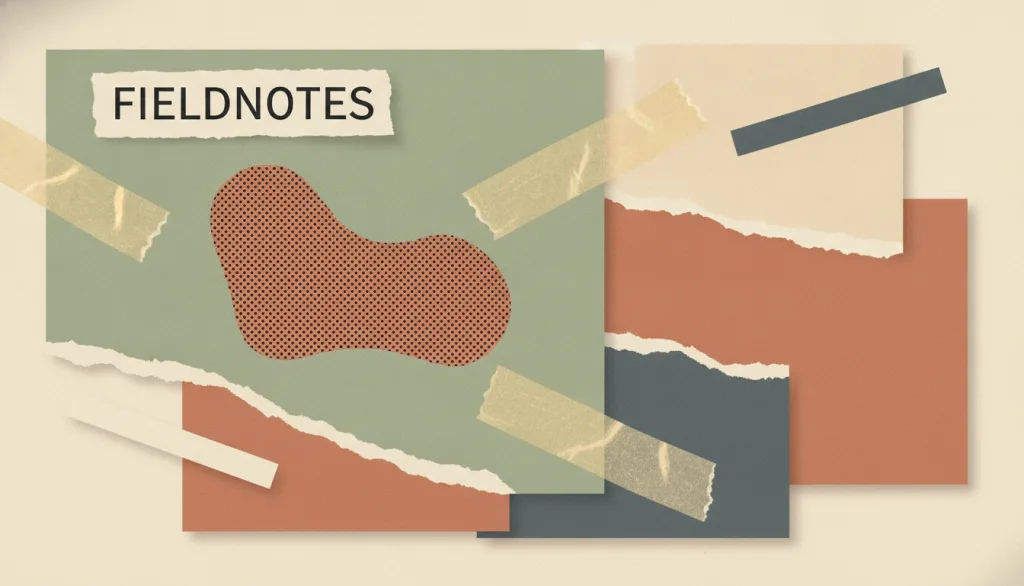
A visual approach that assembles heterogeneous fragments from different sources — cut-out or torn-edge photographs, paper, materials, and type — onto one surface while keeping the seams between them visible; the effect depends on visible joins (torn edges, uneven cuts, a taped look) and abrupt jumps in scale, not on blending the materials into one continuous image.
Recognizing it
- Images, text, and materials from different sources are joined with visible seams (torn edges, uneven cut lines, or a taped look)
- Images often appear as cut-out or silhouetted photographs, with abrupt jumps in scale (a large image next to a tiny label or text strip)
- Typography mixes sizes, weights, and angles, giving a hand-assembled or photocopied zine-like, worn texture
Concept boundary
Collage is defined by heterogeneous fragments being joined with visible seams, not by the number or density of elements on the page — seams, cut edges, and scale jumps are the core signal. It is not the same as maximalism, which is an abundance of ornament that can sit within one continuous material and illustration language without any fragment assembly or visible seams; plain decorative accumulation is not treated as collage here. Photocopy-textured, deliberately rough, mixed-type-size zine collage is treated as a variant of this entry rather than a separate one.
When to consider it
- The goal is a hand-made, improvised feel, or a stance against established visual order — for independent publications, subcultural, or art-adjacent brands
- The content itself draws on multiple source materials (quotes, clippings, multiple pieces of evidence), and collage can honestly show that assembly instead of smoothing it over
- The brand wants tension and memorability from seams, misalignment, and scale jumps rather than a uniform, smooth surface
When to be cautious
- The interface needs a clear, predictable reading order — checkout flows, forms, or long-form text pages — where fragments and scattered layout would obscure the reading path
- A cut-out or silhouetted image in the collage carries information needed to understand the content but has no text alternative
- The page is simply loaded with many decorative elements, colors, and patterns without any fragment feel or visible seams — closer to maximalism than to deliberate fragment assembly
Tradeoff
Collage conveys a hand-made feel and narrative tension, and honestly shows how multi-source materials are assembled, but visible seams, misaligned cuts, and mixed type sizes break up the visual scan path; applying it to an interface needs extra design and verification work to keep the reading order intact and to give text alternatives to cut-out images that carry information.
Conditional rules · Editorial advice
Related entries
Both keep the marks of their own making visible rather than hiding them — neo-brutalism exposes structure and shadow, collage exposes fragments and seams — but their visual signatures and source materials differ.
Collage relies on heterogeneous fragments and visible seams for tension and density; minimalism relies on element reduction and whitespace for restraint. The two compositional logics are opposed, so usually only one leads.
A grid can give collage fragments alignment references and an overall skeleton, keeping scattered cut materials in predictable positions without losing the seam texture of the collage itself.
Sources and what they support
This entry defines collage as the technique and resulting artwork in which pieces of paper, photographs, fabric, and other ephemera are arranged and stuck onto a supporting surface; it traces the term to the French papiers collés and notes the technique was first used by artists in the early twentieth century, listing related variants such as papier collé (closer to drawing) and photomontage (built from photographs). This entry's definition of 'heterogeneous fragments joined with visible seams' paraphrases it.
Retrieved: 2026-09-15 · Archived 2026-09-16This entry defines photomontage as 'a collage constructed from photographs,' states the technique was first used as a wartime protest method by dadaists in 1915 during the First World War, notes surrealists later combined unrelated imagery through free association, and that Soviet constructivist Aleksander Rodchenko began experimenting with it in 1923. This entry's description of cut-out/silhouetted imagery inserted into the composition, and the relationship to a sibling technique, paraphrases it.
Retrieved: 2026-09-15 · Archived 2026-09-16Definitions reference these sources. Digital specimens, selection advice, relationships, and recipes are editorial work and have not been validated through user research.
Type extensions and implementation notes
This entry has no operable specimen yet; the illustration is an editorial sketch. When applied to a product, verify that collage fragments and angle changes do not obscure the reading order of body content, that cut-out images carrying content have text alternatives, and test layout readability with real content across multiple screen sizes.
{
  "tokens": {
    "surface": "#ede4d3",
    "ink": "#2e2a24",
    "accent": "#c1622d",
    "radiusPx": 2,
    "shadow": "1px 2px 0 rgba(0,0,0,0.25)"
  },
  "tokenScope": "A recipe for this specimen: a kraft-paper surface, dark ink text, and a terracotta accent, paired with a minimal corner radius and a hard offset shadow to suggest layered torn paper and tape; a real product should re-derive tokens from its own materials and source imagery, and verify text contrast where fragments overlap."
}
Full Agent entry JSON
{
  "id": "collage",
  "type": "visual",
  "name": {
    "zh": "拼贴风格",
    "en": "Collage"
  },
  "aliases": [
    "Collage Art",
    "拼贴画",
    "剪贴风格"
  ],
  "granularity": "experience",
  "intents": [
    "express-brand",
    "organize-content"
  ],
  "tags": [
    "collage",
    "torn-paper edges",
    "mixed materials",
    "cut-out imagery",
    "layered irregularity"
  ],
  "definition": "A visual approach that assembles heterogeneous fragments from different sources — cut-out or torn-edge photographs, paper, materials, and type — onto one surface while keeping the seams between them visible; the effect depends on visible joins (torn edges, uneven cuts, a taped look) and abrupt jumps in scale, not on blending the materials into one continuous image.",
  "boundary": "Collage is defined by heterogeneous fragments being joined with visible seams, not by the number or density of elements on the page — seams, cut edges, and scale jumps are the core signal. It is not the same as maximalism, which is an abundance of ornament that can sit within one continuous material and illustration language without any fragment assembly or visible seams; plain decorative accumulation is not treated as collage here. Photocopy-textured, deliberately rough, mixed-type-size zine collage is treated as a variant of this entry rather than a separate one.",
  "signature": [
    "Images, text, and materials from different sources are joined with visible seams (torn edges, uneven cut lines, or a taped look)",
    "Images often appear as cut-out or silhouetted photographs, with abrupt jumps in scale (a large image next to a tiny label or text strip)",
    "Typography mixes sizes, weights, and angles, giving a hand-assembled or photocopied zine-like, worn texture"
  ],
  "when": [
    "The goal is a hand-made, improvised feel, or a stance against established visual order — for independent publications, subcultural, or art-adjacent brands",
    "The content itself draws on multiple source materials (quotes, clippings, multiple pieces of evidence), and collage can honestly show that assembly instead of smoothing it over",
    "The brand wants tension and memorability from seams, misalignment, and scale jumps rather than a uniform, smooth surface"
  ],
  "when_not": [
    "The interface needs a clear, predictable reading order — checkout flows, forms, or long-form text pages — where fragments and scattered layout would obscure the reading path",
    "A cut-out or silhouetted image in the collage carries information needed to understand the content but has no text alternative",
    "The page is simply loaded with many decorative elements, colors, and patterns without any fragment feel or visible seams — closer to maximalism than to deliberate fragment assembly"
  ],
  "tradeoff": "Collage conveys a hand-made feel and narrative tension, and honestly shows how multi-source materials are assembled, but visible seams, misaligned cuts, and mixed type sizes break up the visual scan path; applying it to an interface needs extra design and verification work to keep the reading order intact and to give text alternatives to cut-out images that carry information.",
  "comparison": {
    "focus": "Assembling heterogeneous fragments with visible seams to express a hand-made, multi-source assembly",
    "mechanism": "Cut-out or torn-edge imagery, mixed materials and type sizes, deliberate jumps in scale",
    "cost": "Requires extra design work to preserve reading order and text alternatives for cut-out images that carry content"
  },
  "sources": [
    {
      "id": "collage-tate-definition",
      "title": "Tate · Art Term: Collage",
      "url": "https://www.tate.org.uk/art/art-terms/c/collage",
      "claim": "This entry defines collage as the technique and resulting artwork in which pieces of paper, photographs, fabric, and other ephemera are arranged and stuck onto a supporting surface; it traces the term to the French papiers collés and notes the technique was first used by artists in the early twentieth century, listing related variants such as papier collé (closer to drawing) and photomontage (built from photographs). This entry's definition of 'heterogeneous fragments joined with visible seams' paraphrases it.",
      "checkedAt": "2026-09-15",
      "archive": {
        "lookupUrl": "https://web.archive.org/web/20260915*/https://www.tate.org.uk/art/art-terms/c/collage",
        "status": "available",
        "checkedAt": "2026-09-16T05:24:40.981Z",
        "jobId": "spn2-ae1646482f535a8c20f8c487a0c083d65d8a2b66",
        "url": "https://web.archive.org/web/20260916052447/https://www.tate.org.uk/art/art-terms/c/collage",
        "timestamp": "20260916052447"
      }
    },
    {
      "id": "collage-tate-photomontage",
      "title": "Tate · Art Term: Photomontage",
      "url": "https://www.tate.org.uk/art/art-terms/p/photomontage",
      "claim": "This entry defines photomontage as 'a collage constructed from photographs,' states the technique was first used as a wartime protest method by dadaists in 1915 during the First World War, notes surrealists later combined unrelated imagery through free association, and that Soviet constructivist Aleksander Rodchenko began experimenting with it in 1923. This entry's description of cut-out/silhouetted imagery inserted into the composition, and the relationship to a sibling technique, paraphrases it.",
      "checkedAt": "2026-09-15",
      "archive": {
        "lookupUrl": "https://web.archive.org/web/20260915*/https://www.tate.org.uk/art/art-terms/p/photomontage",
        "status": "available",
        "checkedAt": "2026-09-16T05:24:41.015Z",
        "jobId": "spn2-cd8c502fda2211bed9b548f6b1482a3264f8d08b",
        "url": "https://web.archive.org/web/20260916052550/https://www.tate.org.uk/art/art-terms/p/photomontage",
        "timestamp": "20260916052550"
      }
    }
  ],
  "relations": [
    {
      "target": "neo-brutalism",
      "kind": "related",
      "condition": "The interface aims for a direct, visible-construction visual expression",
      "reason": "Both keep the marks of their own making visible rather than hiding them — neo-brutalism exposes structure and shadow, collage exposes fragments and seams — but their visual signatures and source materials differ.",
      "basis": "editorial"
    },
    {
      "target": "minimalism",
      "kind": "alternative",
      "condition": "Choosing the primary visual language for the same page",
      "reason": "Collage relies on heterogeneous fragments and visible seams for tension and density; minimalism relies on element reduction and whitespace for restraint. The two compositional logics are opposed, so usually only one leads.",
      "basis": "editorial"
    },
    {
      "target": "modular-grid",
      "kind": "composes_with",
      "condition": "The collage uses a large number of fragments and risks losing compositional control",
      "reason": "A grid can give collage fragments alignment references and an overall skeleton, keeping scattered cut materials in predictable positions without losing the seam texture of the collage itself.",
      "basis": "editorial"
    }
  ],
  "rules": [
    {
      "when": "Using collage fragments, seams, or angle changes as decoration around body text or functional areas",
      "instruction": "Fragments, seams, and angle changes must not obscure or disrupt the reading order of the body content; key information must keep a clearly discernible sequence, and readers must not have to guess the order.",
      "strength": "must",
      "basis": "editorial"
    },
    {
      "when": "A cut-out, silhouetted, or photocopied image in the collage carries information needed to understand the content",
      "instruction": "Such images need a text alternative (such as alt text) just like any other meaningful image; it must not be omitted just because the image is 'collage decoration.'",
      "strength": "must",
      "basis": "editorial"
    },
    {
      "when": "The collage uses a large number of fragments and risks looking cluttered",
      "instruction": "Anchor the fragments to a grid or alignment guides (can be combined with modular-grid) instead of stacking them purely at random, which risks losing compositional control.",
      "strength": "recommend",
      "basis": "editorial"
    }
  ],
  "visual": {
    "tokens": {
      "surface": "#ede4d3",
      "ink": "#2e2a24",
      "accent": "#c1622d",
      "radiusPx": 2,
      "shadow": "1px 2px 0 rgba(0,0,0,0.25)"
    },
    "tokenScope": "A recipe for this specimen: a kraft-paper surface, dark ink text, and a terracotta accent, paired with a minimal corner radius and a hard offset shadow to suggest layered torn paper and tape; a real product should re-derive tokens from its own materials and source imagery, and verify text contrast where fragments overlap."
  },
  "demo": null,
  "version": "0.1.0",
  "editorialStatus": "drafted",
  "requirements": [],
  "demoCapabilities": [],
  "implementationNote": "This entry has no operable specimen yet; the illustration is an editorial sketch. When applied to a product, verify that collage fragments and angle changes do not obscure the reading order of body content, that cut-out images carrying content have text alternatives, and test layout readability with real content across multiple screen sizes.",
  "image": {
    "src": "/images/collage.webp",
    "alt": "A fictional field-notes page named FIELDNOTES assembled from torn-paper rectangles, a halftone cut-out shape, a few tape strips, and text bars at different angles and sizes, illustrating collage style."
  },
  "searchTerms": [
    "拼贴",
    "撕边纸张",
    "混合材质",
    "剪影图像",
    "错落层次"
  ]
}