VOCABULARY / ENTRY
Consistency and Standards
consistency
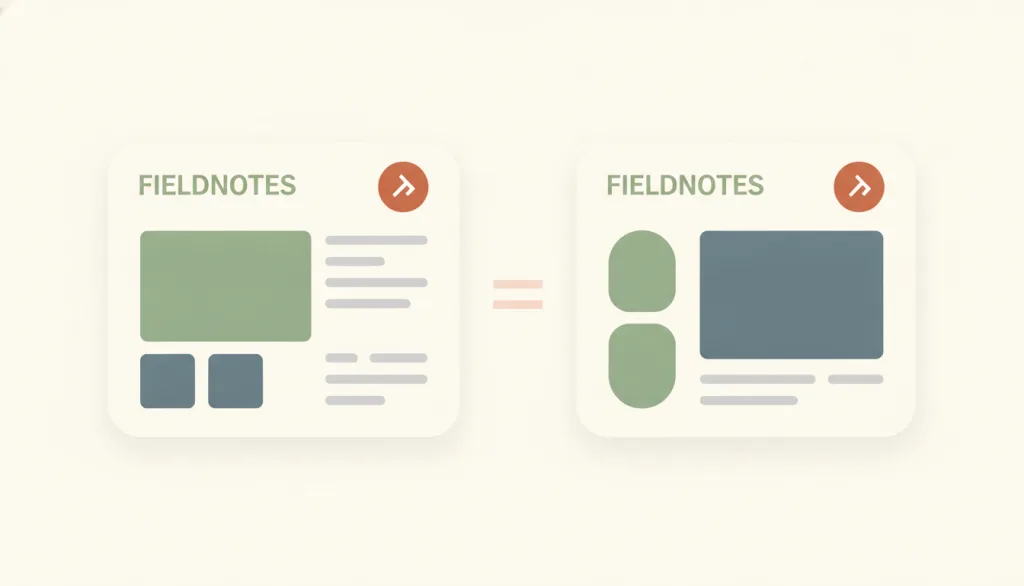
Users should not have to wonder whether different words, situations, or actions mean the same thing; a product should follow platform and industry conventions. Consistency splits into internal consistency (uniformity within one product or product family) and external consistency (following conventions established in the industry or on the web at large), and together they lower learning cost and cognitive load.
Recognizing it
- The same function uses the same name, icon, and placement throughout the product, while different functions look distinguishably different
- Common controls look and behave as the platform and industry conventions lead users to expect, so nothing has to be relearned
- Any departure from convention has a clear task or efficiency reason, and the difference is visible to users
Concept boundary
Consistency and recognition-rather-than-recall support each other but are not the same principle: recognition is about whether information is visible, consistency is about whether the same meaning always appears in the same form. Consistency is not uniformity either: elements with different meanings should be deliberately and visibly different, and that difference is part of consistency (see similarity). It does not ask every product to look alike, only that the same function be identified and placed the same way everywhere.
When to consider it
- The product spans multiple pages, modules, or teams, so the same action can easily get different names or positions in different places
- Target users spend most of their time in other products and bring those expectations with them
- The product must meet WCAG 2.2 Level AA requirements for consistent navigation order and consistent identification of functions
When to be cautious
- Treating consistency as a ban on all difference, so that elements with different meanings look alike and cause confusion
- Keeping a practice that has been shown to hurt efficiency only to stay consistent with an old version or an external convention
- Mechanically reusing the same label or icon in contexts where the meaning genuinely differs, at the expense of accuracy
Tradeoff
Consistency improves learnability and reduces guessing and slips, but it constrains innovation and differentiation; following convention sometimes means keeping a metaphor that no longer fits, while breaking it asks users to learn something new and needs a measurable reason.
Conditional rules · Editorial advice
Related entries
Visible options spare users from recalling, and consistent names and placement make one act of recognition carry everywhere; the two support each other but focus on different things.
Similarity explains why shared visual attributes are perceived as one kind; consistency builds on it by requiring the same function to share attributes while different functions keep a deliberate, visible difference.
When the same function always appears in the same form, slips caused by misreading a button or label become less likely.
Redrawing native platform controls for stylistic unity can sacrifice external consistency and strip users of expectations they already hold.
Sources and what they support
Heuristic #4: users should not have to wonder whether different words, situations, or actions mean the same thing; follow platform and industry conventions; improve learnability by maintaining both internal and external consistency.
Retrieved: 2026-09-15Internal consistency is uniformity within a single product or product family; external consistency refers to established conventions in an industry or on the web at large; conventions should be broken only when necessary to the task or to improve efficiency; advocating consistency does not mean all applications should look and act the same.
Retrieved: 2026-09-15Jakob's Law (attributed to Jakob Nielsen): users spend most of their time on other sites, so they prefer your site to work the same way as the sites they already know; users transfer expectations from familiar products to ones that appear similar.
Retrieved: 2026-09-15WCAG 2.2 Level AA requirement: navigational mechanisms repeated across a set of web pages occur in the same relative order each time unless the user initiates a change; this helps screen-magnifier users and blind users navigating sequentially predict where navigation appears.
Retrieved: 2026-09-15 · Snapshot unconfirmedWCAG 2.2 Level AA requirement: components with the same functionality within a set of web pages are identified consistently (including text alternatives and accessible names for icons); identical functions with different labels make a site considerably harder to use, while components with different functions may use different labels.
Retrieved: 2026-09-15Definitions reference these sources. Digital specimens, selection advice, relationships, and recipes are editorial work and have not been validated through user research.
Type extensions and implementation notes
This entry has no interactive specimen yet; the illustration is an editorial sketch. Product use still requires checking that the same function keeps the same name, accessible name, and placement across pages, that repeated navigation keeps a stable order, and that deliberate differences really correspond to different meanings.
{
  "evidenceType": "A design interpretation of a usability heuristic and an accessibility standard",
  "limit": "This entry does not measure how much consistency affects learning time or error rates, nor prescribe a quantitative threshold for when to break a convention."
}
Full Agent entry JSON
{
  "id": "consistency",
  "type": "principle",
  "name": {
    "zh": "一致性与标准",
    "en": "Consistency and Standards"
  },
  "aliases": [
    "Nielsen Heuristic #4",
    "一致性原则",
    "Consistency & Standards"
  ],
  "granularity": "experience",
  "intents": [
    "organize-content",
    "reduce-complexity"
  ],
  "tags": [
    "heuristics",
    "conventions",
    "platform guidelines",
    "learnability",
    "naming"
  ],
  "definition": "Users should not have to wonder whether different words, situations, or actions mean the same thing; a product should follow platform and industry conventions. Consistency splits into internal consistency (uniformity within one product or product family) and external consistency (following conventions established in the industry or on the web at large), and together they lower learning cost and cognitive load.",
  "boundary": "Consistency and recognition-rather-than-recall support each other but are not the same principle: recognition is about whether information is visible, consistency is about whether the same meaning always appears in the same form. Consistency is not uniformity either: elements with different meanings should be deliberately and visibly different, and that difference is part of consistency (see similarity). It does not ask every product to look alike, only that the same function be identified and placed the same way everywhere.",
  "signature": [
    "The same function uses the same name, icon, and placement throughout the product, while different functions look distinguishably different",
    "Common controls look and behave as the platform and industry conventions lead users to expect, so nothing has to be relearned",
    "Any departure from convention has a clear task or efficiency reason, and the difference is visible to users"
  ],
  "when": [
    "The product spans multiple pages, modules, or teams, so the same action can easily get different names or positions in different places",
    "Target users spend most of their time in other products and bring those expectations with them",
    "The product must meet WCAG 2.2 Level AA requirements for consistent navigation order and consistent identification of functions"
  ],
  "when_not": [
    "Treating consistency as a ban on all difference, so that elements with different meanings look alike and cause confusion",
    "Keeping a practice that has been shown to hurt efficiency only to stay consistent with an old version or an external convention",
    "Mechanically reusing the same label or icon in contexts where the meaning genuinely differs, at the expense of accuracy"
  ],
  "tradeoff": "Consistency improves learnability and reduces guessing and slips, but it constrains innovation and differentiation; following convention sometimes means keeping a metaphor that no longer fits, while breaking it asks users to learn something new and needs a measurable reason.",
  "comparison": {
    "focus": "Whether the same meaning always appears in the same form, and whether different meanings are distinguishable",
    "mechanism": "Stay uniform within the product and follow platform and industry conventions",
    "cost": "Constraints on innovation and differentiation, plus the cross-team cost of maintaining shared naming and guidelines"
  },
  "sources": [
    {
      "id": "nng-heuristics-consistency",
      "title": "NN/g · 10 Usability Heuristics for User Interface Design",
      "url": "https://www.nngroup.com/articles/ten-usability-heuristics/",
      "claim": "Heuristic #4: users should not have to wonder whether different words, situations, or actions mean the same thing; follow platform and industry conventions; improve learnability by maintaining both internal and external consistency.",
      "checkedAt": "2026-09-15",
      "archive": {
        "lookupUrl": "https://web.archive.org/web/20260915*/https://www.nngroup.com/articles/ten-usability-heuristics/",
        "status": "available",
        "checkedAt": "2026-09-15T18:21:57.626Z",
        "jobId": "spn2-c214ca6ca65135f964d23731cb22d3701cb6d598",
        "url": "https://web.archive.org/web/20260915182252/https://www.nngroup.com/articles/ten-usability-heuristics/",
        "timestamp": "20260915182252"
      }
    },
    {
      "id": "nng-consistency-and-standards",
      "title": "NN/g · Maintain Consistency and Adhere to Standards (Usability Heuristic #4)",
      "url": "https://www.nngroup.com/articles/consistency-and-standards/",
      "claim": "Internal consistency is uniformity within a single product or product family; external consistency refers to established conventions in an industry or on the web at large; conventions should be broken only when necessary to the task or to improve efficiency; advocating consistency does not mean all applications should look and act the same.",
      "checkedAt": "2026-09-15",
      "archive": {
        "lookupUrl": "https://web.archive.org/web/20260915*/https://www.nngroup.com/articles/consistency-and-standards/",
        "status": "available",
        "checkedAt": "2026-09-15T18:41:15.406Z",
        "jobId": "spn2-e3f410f567cc1fe157453b0ae1eef4163b73feb5",
        "url": "https://web.archive.org/web/20260915184259/https://www.nngroup.com/articles/consistency-and-standards/",
        "timestamp": "20260915184259"
      }
    },
    {
      "id": "lawsofux-jakobs-law",
      "title": "Laws of UX · Jakob's Law",
      "url": "https://lawsofux.com/jakobs-law/",
      "claim": "Jakob's Law (attributed to Jakob Nielsen): users spend most of their time on other sites, so they prefer your site to work the same way as the sites they already know; users transfer expectations from familiar products to ones that appear similar.",
      "checkedAt": "2026-09-15",
      "archive": {
        "lookupUrl": "https://web.archive.org/web/20260915*/https://lawsofux.com/jakobs-law/",
        "status": "available",
        "checkedAt": "2026-09-15T18:41:15.497Z",
        "jobId": "spn2-0acffca260fc4c8442bd00787d45ba9ce77ec24b",
        "url": "https://web.archive.org/web/20260915184249/https://lawsofux.com/jakobs-law/",
        "timestamp": "20260915184249"
      }
    },
    {
      "id": "wcag22-sc323",
      "title": "W3C · Understanding SC 3.2.3: Consistent Navigation",
      "url": "https://www.w3.org/WAI/WCAG22/Understanding/consistent-navigation.html",
      "claim": "WCAG 2.2 Level AA requirement: navigational mechanisms repeated across a set of web pages occur in the same relative order each time unless the user initiates a change; this helps screen-magnifier users and blind users navigating sequentially predict where navigation appears.",
      "checkedAt": "2026-09-15",
      "archive": {
        "lookupUrl": "https://web.archive.org/web/20260915*/https://www.w3.org/WAI/WCAG22/Understanding/consistent-navigation.html",
        "status": "pending",
        "checkedAt": "2026-09-15T18:41:49.126Z",
        "error": "status-request-failed",
        "jobId": "spn2-ceed33c8c56f64be5d9561e22a143b237798c724"
      }
    },
    {
      "id": "wcag22-sc324",
      "title": "W3C · Understanding SC 3.2.4: Consistent Identification",
      "url": "https://www.w3.org/WAI/WCAG22/Understanding/consistent-identification.html",
      "claim": "WCAG 2.2 Level AA requirement: components with the same functionality within a set of web pages are identified consistently (including text alternatives and accessible names for icons); identical functions with different labels make a site considerably harder to use, while components with different functions may use different labels.",
      "checkedAt": "2026-09-15",
      "archive": {
        "lookupUrl": "https://web.archive.org/web/20260915*/https://www.w3.org/WAI/WCAG22/Understanding/consistent-identification.html",
        "status": "available",
        "checkedAt": "2026-09-15T18:41:54.663Z",
        "jobId": "spn2-8f2e78a75e41d0725294fbf50fddb9ea5b3a969d",
        "url": "https://web.archive.org/web/20260915184313/https://www.w3.org/WAI/WCAG22/Understanding/consistent-identification.html",
        "timestamp": "20260915184313"
      }
    }
  ],
  "relations": [
    {
      "target": "recognition",
      "kind": "composes_with",
      "condition": "Users need to find the same action across several pages",
      "reason": "Visible options spare users from recalling, and consistent names and placement make one act of recognition carry everywhere; the two support each other but focus on different things.",
      "basis": "editorial"
    },
    {
      "target": "similarity",
      "kind": "informs",
      "condition": "Elements of one kind should read as a group and elements of different kinds should be told apart",
      "reason": "Similarity explains why shared visual attributes are perceived as one kind; consistency builds on it by requiring the same function to share attributes while different functions keep a deliberate, visible difference.",
      "basis": "editorial"
    },
    {
      "target": "error-prevention",
      "kind": "composes_with",
      "condition": "Users perform similar actions on different pages",
      "reason": "When the same function always appears in the same form, slips caused by misreading a button or label become less likely.",
      "basis": "editorial"
    },
    {
      "target": "flat-design",
      "kind": "conflicts_when",
      "condition": "A unified visual style overrides the platform's own control conventions",
      "reason": "Redrawing native platform controls for stylistic unity can sacrifice external consistency and strip users of expectations they already hold.",
      "basis": "editorial"
    }
  ],
  "rules": [
    {
      "when": "The same function recurs across a set of pages",
      "instruction": "Use the same name (including the accessible name of any icon) and the same icon, and keep repeated navigation in the same relative order.",
      "strength": "must",
      "basis": "editorial"
    },
    {
      "when": "Designing common controls or interaction patterns",
      "instruction": "Follow the conventions of the platform and industry unless there is a measurable task or efficiency reason not to.",
      "strength": "recommend",
      "basis": "editorial"
    },
    {
      "when": "Deciding to break a convention or make an element stand apart",
      "instruction": "Make the difference visible to users and make sure it corresponds to a genuinely different meaning or function.",
      "strength": "recommend",
      "basis": "editorial"
    }
  ],
  "principle": {
    "evidenceType": "A design interpretation of a usability heuristic and an accessibility standard",
    "limit": "This entry does not measure how much consistency affects learning time or error rates, nor prescribe a quantitative threshold for when to break a convention."
  },
  "demo": null,
  "version": "0.1.0",
  "editorialStatus": "drafted",
  "requirements": [],
  "demoCapabilities": [],
  "implementationNote": "This entry has no interactive specimen yet; the illustration is an editorial sketch. Product use still requires checking that the same function keeps the same name, accessible name, and placement across pages, that repeated navigation keeps a stable order, and that deliberate differences really correspond to different meanings.",
  "image": {
    "src": "/images/consistency.webp",
    "alt": "Two fictional interface screens side by side, where the same action button sits in the same corner with the same icon and color on both, joined by a faint equals sign."
  },
  "searchTerms": [
    "启发式",
    "惯例",
    "平台规范",
    "可学习性",
    "命名"
  ]
}