VOCABULARY / ENTRY
Landing Page
landing-page
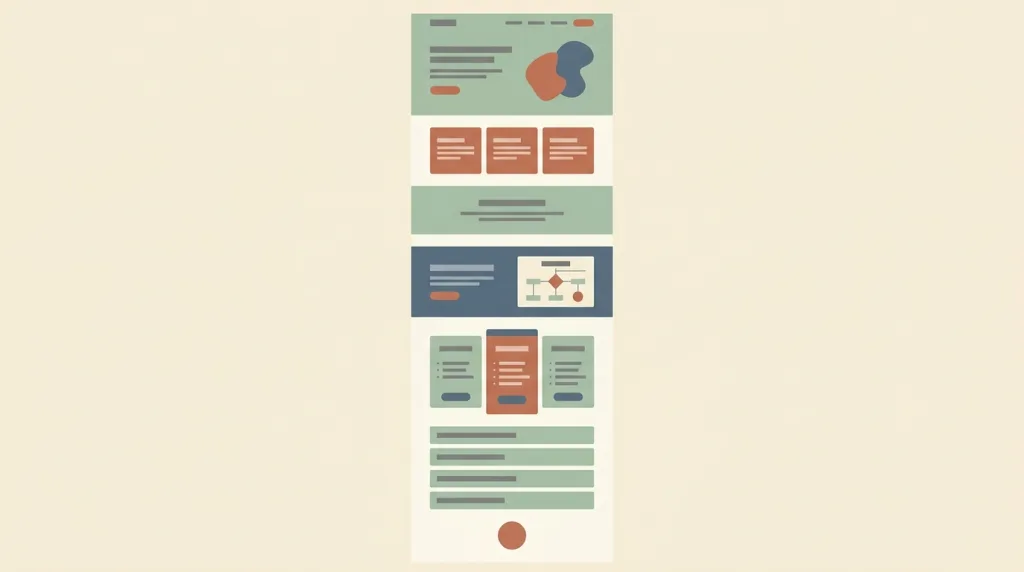
A long page arranged around a single conversion goal: the first screen states the claim, then evidence, feature explanation, pricing, and frequently asked questions follow in order, each paving the way for the same action, which is offered again at the end.
Recognizing it
- The page has one primary action, repeated at several points
- Sections run in the order claim, evidence, detail, price, objections
- Global navigation is reduced or removed so visitors are not led off the path
Concept boundary
The test is that the whole page has one goal and its sections run in a persuasive order — not that it is "the first page someone reaches from an ad", which is a traffic definition under which any page can be a landing spot. It is not a home page: a home page serves existing users and new visitors at once and leads in many directions, while a landing page serves one. It is not a product detail page either: a detail page covers every attribute of one item, while a landing page covers only what this conversion needs. The evidence on the page must be real; fabricated reviews, figures, or urgency are anti-patterns and are not part of this entry’s practice.
When to consider it
- Visitors arriving from outside need to be led to one clear action
- The product needs explaining and cannot be conveyed in a single line
- One product needs several tailored versions whose results are assessed separately
When to be cautious
- Visitors are already users and come to do a task rather than be persuaded
- The evidence cannot be verified and only manufactured urgency would move people
- The content needs to be searched, compared, and revisited, where a linear order gets in the way
Tradeoff
A linear order makes persuasion controllable and comparable, at the cost of assuming every visitor has the same questions in the same order: someone who already knows the product must scroll past all the build-up to reach what they actually need.
Conditional rules · Editorial advice
Related entries
The landing page defines the order of the whole sequence and the hero section realises its first segment.
A comparison table puts the same attribute of several plans on one row, which reaches a conclusion faster than describing each in turn.
A landing page’s persuasion should come from verifiable evidence; inventing a deadline that does not exist turns it into a deceptive pattern.
Sources and what they support
The template gives the section skeleton of a government landing page: a top block followed by segmented content areas and one explicit call to action, serving a single goal. This entry paraphrases the section order from it; the exact sequence and the trade-offs are editorial judgement.
Retrieved: 2026-09-16 · Snapshot unconfirmedThe article explains that a landing page is the single page a visitor reaches after clicking an advertisement or a search result, usually designed for one conversion goal, and distinguishes a home page from a page made for a campaign. This entry uses it to separate "wherever traffic lands" from "a page arranged around one goal".
Retrieved: 2026-09-16 · Snapshot unconfirmedDefinitions reference these sources. Digital specimens, selection advice, relationships, and recipes are editorial work and have not been validated through user research.
Type extensions and implementation notes
This entry has no runnable specimen; the illustration is an editorial sketch of the section order, not a verified implementation. Before shipping, confirm every piece of evidence on the page can be verified and check that the order still holds on narrow screens.
{
  "states": [
    "wide",
    "compact"
  ],
  "a11y": [
    "Each section has a heading, and the heading levels are continuous and usable for skimming",
    "The repeated primary action uses the same accessible name each time"
  ],
  "motion": "Scroll-triggered entrances are optional and content is visible directly under a reduced-motion preference"
}
Full Agent entry JSON
{
  "id": "landing-page",
  "type": "layout",
  "name": {
    "zh": "着陆页",
    "en": "Landing Page"
  },
  "aliases": [
    "Conversion Page",
    "落地页",
    "转化页"
  ],
  "granularity": "page",
  "intents": [
    "express-brand",
    "organize-content"
  ],
  "tags": [
    "conversion",
    "section order",
    "proof",
    "pricing",
    "FAQ"
  ],
  "definition": "A long page arranged around a single conversion goal: the first screen states the claim, then evidence, feature explanation, pricing, and frequently asked questions follow in order, each paving the way for the same action, which is offered again at the end.",
  "boundary": "The test is that the whole page has one goal and its sections run in a persuasive order — not that it is \"the first page someone reaches from an ad\", which is a traffic definition under which any page can be a landing spot. It is not a home page: a home page serves existing users and new visitors at once and leads in many directions, while a landing page serves one. It is not a product detail page either: a detail page covers every attribute of one item, while a landing page covers only what this conversion needs. The evidence on the page must be real; fabricated reviews, figures, or urgency are anti-patterns and are not part of this entry’s practice.",
  "signature": [
    "The page has one primary action, repeated at several points",
    "Sections run in the order claim, evidence, detail, price, objections",
    "Global navigation is reduced or removed so visitors are not led off the path"
  ],
  "when": [
    "Visitors arriving from outside need to be led to one clear action",
    "The product needs explaining and cannot be conveyed in a single line",
    "One product needs several tailored versions whose results are assessed separately"
  ],
  "when_not": [
    "Visitors are already users and come to do a task rather than be persuaded",
    "The evidence cannot be verified and only manufactured urgency would move people",
    "The content needs to be searched, compared, and revisited, where a linear order gets in the way"
  ],
  "tradeoff": "A linear order makes persuasion controllable and comparable, at the cost of assuming every visitor has the same questions in the same order: someone who already knows the product must scroll past all the build-up to reach what they actually need.",
  "comparison": {
    "focus": "Narrowing one visit down to one action",
    "mechanism": "Sections in persuasive order, offering the same entry point repeatedly",
    "cost": "It assumes everyone has the same questions in the same order"
  },
  "sources": [
    {
      "id": "landing-uswds",
      "title": "U.S. Web Design System · Landing page template",
      "url": "https://designsystem.digital.gov/templates/landing-page/",
      "claim": "The template gives the section skeleton of a government landing page: a top block followed by segmented content areas and one explicit call to action, serving a single goal. This entry paraphrases the section order from it; the exact sequence and the trade-offs are editorial judgement.",
      "checkedAt": "2026-09-16",
      "archive": {
        "lookupUrl": "https://web.archive.org/web/20260916*/https://designsystem.digital.gov/templates/landing-page/",
        "status": "pending",
        "checkedAt": "2026-09-16T13:31:07.749Z",
        "error": "status-request-failed",
        "jobId": "spn2-68fe1fa76daa3ba305fbc4c47abd026c294facce"
      }
    },
    {
      "id": "landing-wikipedia",
      "title": "Wikipedia · Landing page",
      "url": "https://en.wikipedia.org/wiki/Landing_page",
      "claim": "The article explains that a landing page is the single page a visitor reaches after clicking an advertisement or a search result, usually designed for one conversion goal, and distinguishes a home page from a page made for a campaign. This entry uses it to separate \"wherever traffic lands\" from \"a page arranged around one goal\".",
      "checkedAt": "2026-09-16",
      "archive": {
        "lookupUrl": "https://web.archive.org/web/20260916*/https://en.wikipedia.org/wiki/Landing_page",
        "status": "unconfirmed",
        "checkedAt": "2026-09-16T13:24:55.948Z",
        "error": "status-request-failed",
        "jobId": "spn2-7ecefad1a5cc06ddbd77bd0819348698ed3a988d"
      }
    }
  ],
  "relations": [
    {
      "target": "hero-section",
      "kind": "composes_with",
      "condition": "The first section of the landing page has to state the claim and offer the entry point",
      "reason": "The landing page defines the order of the whole sequence and the hero section realises its first segment.",
      "basis": "editorial"
    },
    {
      "target": "comparison-table",
      "kind": "composes_with",
      "condition": "The pricing or plan section needs visitors to compare item by item",
      "reason": "A comparison table puts the same attribute of several plans on one row, which reaches a conclusion faster than describing each in turn.",
      "basis": "editorial"
    },
    {
      "target": "false-urgency",
      "kind": "conflicts_when",
      "condition": "Conversion pressure is manufactured with a fake countdown or stock figure",
      "reason": "A landing page’s persuasion should come from verifiable evidence; inventing a deadline that does not exist turns it into a deceptive pattern.",
      "basis": "editorial"
    }
  ],
  "rules": [
    {
      "when": "The page shows testimonials, figures, or adoption numbers",
      "instruction": "Show only what can be verified and state the basis and date of each figure; leave unsourced numbers off the page.",
      "strength": "must",
      "basis": "editorial"
    },
    {
      "when": "Global navigation is removed on the landing page",
      "instruction": "Keep links to legal information, the privacy notice, and contact details, usually in the footer.",
      "strength": "must",
      "basis": "editorial"
    }
  ],
  "behavior": {
    "states": [
      "wide",
      "compact"
    ],
    "a11y": [
      "Each section has a heading, and the heading levels are continuous and usable for skimming",
      "The repeated primary action uses the same accessible name each time"
    ],
    "motion": "Scroll-triggered entrances are optional and content is visible directly under a reduced-motion preference"
  },
  "demo": null,
  "version": "0.1.0",
  "editorialStatus": "drafted",
  "requirements": [],
  "demoCapabilities": [],
  "implementationNote": "This entry has no runnable specimen; the illustration is an editorial sketch of the section order, not a verified implementation. Before shipping, confirm every piece of evidence on the page can be verified and check that the order still holds on narrow screens.",
  "image": {
    "src": "/images/landing-page.webp",
    "alt": "A thumbnail sketch of a fictional long page: a hero block, three side-by-side proof cards, two full-width feature bands, three pricing plan cards with the middle one emphasised, and four rows of frequently asked questions from top to bottom, with the same round primary button repeated every few sections and every piece of text drawn as a grey placeholder bar."
  },
  "searchTerms": [
    "转化",
    "段落顺序",
    "证据",
    "价格",
    "常见问题"
  ]
}