VOCABULARY / ENTRY
Systems Thinking
systems-thinking
Treat a product as embedded in a larger system of people, incentives, and feedback loops rather than a set of isolated screens or features; before making a change, ask how it will ripple through the system's structure and feedback loops, not only what it does for the immediate task.
Recognizing it
- Before a change ships, name at least one second-order effect and who bears it
- When assessing impact, include people who don't use the product but are affected by it
- Ask what other goals in the system a metric being optimized might be displacing
Concept boundary
Systems thinking is not a design system (a component library and style guide) — the two names are easily confused in both Chinese and English, but they discuss entirely different things: a design system is about interface consistency, while systems thinking is about how a change will shift the people, incentives, and feedback structures a product sits inside. It is also not finished once a stakeholder map is drawn; it requires continuing to ask about downstream consequences, not a one-time mapping exercise.
When to consider it
- The change may trigger a feedback loop or affect a team, a platform ecosystem, or people who don't directly use the product
- The team is asked to optimize a single metric (next-day retention, click-through rate, conversion) without discussing side effects
- The consequences of a decision will show up over a longer time horizon than a short usability test can cover
When to be cautious
- Using systems thinking as an excuse to indefinitely delay a small, local, directly testable change
- Declaring systems-thinking analysis complete after drawing one stakeholder map, then never tracking downstream consequences again
- Citing systemic complexity as a reason to avoid accountability for a specific decision's direct consequences
Tradeoff
Tracing feedback loops, second-order effects, and effects on non-users takes more analysis time and cross-team coordination, lengthening the decision cycle; even so, it cannot guarantee every long-term consequence is foreseen, since systems can behave counterintuitively.
Conditional rules · Editorial advice
Related entries
Human-centered design asks teams to understand users and their context; systems thinking extends that understanding to the people, incentives, and feedback loops beyond the product.
Systems thinking is a reminder that a misleading trust signal doesn't only affect a single task — it feeds back into the whole trust relationship through user behavior, which needs to be weighed at the system level.
Both push evaluation beyond the typical user, but universal design asks whether one solution can be used directly by people of different abilities, while systems thinking asks how a change ripples through a larger system that includes non-users.
Sources and what they support
Ranks intervention points in a system by how much leverage they carry and notes that people often push in the wrong direction; pursuing a single goal such as growth without counting its costs recreates the very problems it was meant to solve, supporting this entry's points on second-order effects and metric displacement.
Retrieved: 2026-09-15 · Snapshot unconfirmedDefines systems thinking as analyzing the whole context a product sits in: traditional practice optimizes specific touchpoints (buttons, flows), while systems thinking examines how the product, users, and environment interact across platforms, policies, and social context, and explicitly widens the stakeholder scope to community members, cross-functional teams, back-end systems, and policy — not only direct users — supporting this entry's point on non-user impact.
Retrieved: 2026-09-15 · Snapshot unconfirmedUses the iceberg model to argue that a visible event should be understood through the system's underlying structures, patterns, and mental models, and advocates changing the structure rather than reacting to a single part in isolation, supporting this entry's boundary about not optimizing one part alone.
Retrieved: 2026-09-15 · Snapshot unconfirmedDefinitions reference these sources. Digital specimens, selection advice, relationships, and recipes are editorial work and have not been validated through user research.
Type extensions and implementation notes
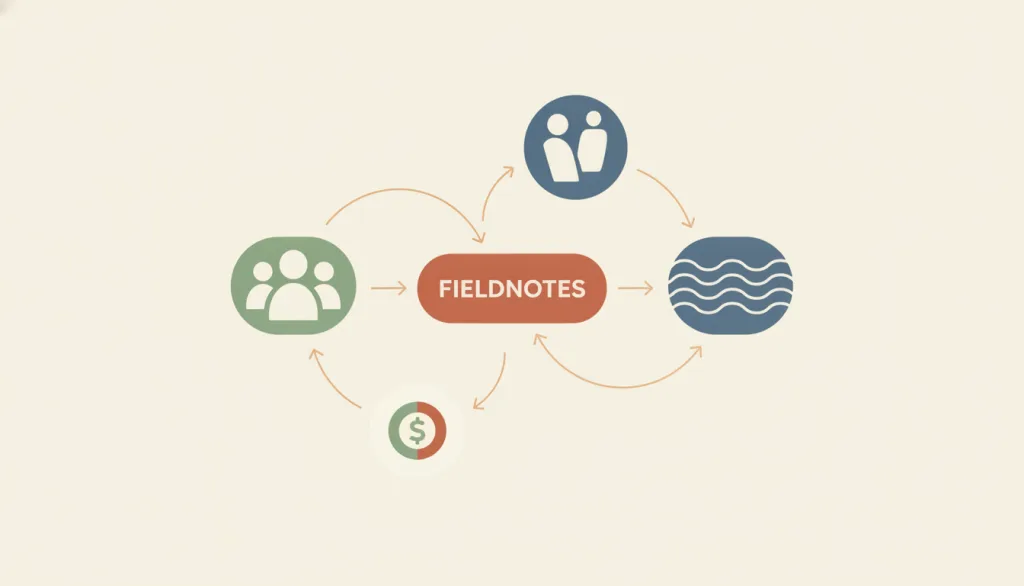
No operable specimen yet; the illustration is editorial, and its feedback arrows are a conceptual sketch rather than a real system's actual structure. When applied to a product, still verify that the team actually named a concrete second-order effect and its bearer for the change, that a decision to optimize a single metric recorded what it displaces, and that non-user impact was built into the real evaluation process rather than stated only as a line in a document.
{
  "values": [
    "The whole over the part",
    "Accountability for second-order effects",
    "Visible bearers of consequences"
  ],
  "tension": "System-level consideration versus the speed of local, quickly testable iteration",
  "questions": [
    "Which feedback loops will this change travel through to reach the rest of the system?",
    "Who pays the cost of the metric being optimized?"
  ]
}
Full Agent entry JSON
{
  "id": "systems-thinking",
  "type": "philosophy",
  "name": {
    "zh": "系统思维",
    "en": "Systems Thinking"
  },
  "aliases": [
    "系统性思维",
    "Systems Approach",
    "Systemic Thinking"
  ],
  "granularity": "experience",
  "intents": [
    "assess-impact",
    "consider-non-users"
  ],
  "tags": [
    "systems thinking",
    "feedback loops",
    "second-order effects",
    "stakeholders",
    "metric optimization"
  ],
  "definition": "Treat a product as embedded in a larger system of people, incentives, and feedback loops rather than a set of isolated screens or features; before making a change, ask how it will ripple through the system's structure and feedback loops, not only what it does for the immediate task.",
  "boundary": "Systems thinking is not a design system (a component library and style guide) — the two names are easily confused in both Chinese and English, but they discuss entirely different things: a design system is about interface consistency, while systems thinking is about how a change will shift the people, incentives, and feedback structures a product sits inside. It is also not finished once a stakeholder map is drawn; it requires continuing to ask about downstream consequences, not a one-time mapping exercise.",
  "signature": [
    "Before a change ships, name at least one second-order effect and who bears it",
    "When assessing impact, include people who don't use the product but are affected by it",
    "Ask what other goals in the system a metric being optimized might be displacing"
  ],
  "when": [
    "The change may trigger a feedback loop or affect a team, a platform ecosystem, or people who don't directly use the product",
    "The team is asked to optimize a single metric (next-day retention, click-through rate, conversion) without discussing side effects",
    "The consequences of a decision will show up over a longer time horizon than a short usability test can cover"
  ],
  "when_not": [
    "Using systems thinking as an excuse to indefinitely delay a small, local, directly testable change",
    "Declaring systems-thinking analysis complete after drawing one stakeholder map, then never tracking downstream consequences again",
    "Citing systemic complexity as a reason to avoid accountability for a specific decision's direct consequences"
  ],
  "tradeoff": "Tracing feedback loops, second-order effects, and effects on non-users takes more analysis time and cross-team coordination, lengthening the decision cycle; even so, it cannot guarantee every long-term consequence is foreseen, since systems can behave counterintuitively.",
  "comparison": {
    "focus": "How a change ripples through the people, incentives, and feedback loops around the product, not just its direct effect on the current task screen",
    "mechanism": "Identifying the system's variables, feedback loops, and leverage points, then asking where an intervention will cause ripple effects",
    "cost": "Requires cross-functional coordination and a longer analysis cycle, and the counterintuitive nature of systems means the analysis can still miss consequences"
  },
  "sources": [
    {
      "id": "meadows-leverage-points",
      "title": "Donella Meadows · Leverage Points: Places to Intervene in a System",
      "url": "https://donellameadows.org/archives/leverage-points-places-to-intervene-in-a-system/",
      "claim": "Ranks intervention points in a system by how much leverage they carry and notes that people often push in the wrong direction; pursuing a single goal such as growth without counting its costs recreates the very problems it was meant to solve, supporting this entry's points on second-order effects and metric displacement.",
      "checkedAt": "2026-09-15",
      "archive": {
        "lookupUrl": "https://web.archive.org/web/20260915*/https://donellameadows.org/archives/leverage-points-places-to-intervene-in-a-system/",
        "status": "unconfirmed",
        "checkedAt": "2026-09-16T05:53:32.278Z",
        "error": "save-request-failed"
      }
    },
    {
      "id": "ixdf-systems-thinking",
      "title": "Interaction Design Foundation · Systems Thinking",
      "url": "https://ixdf.org/literature/topics/systems-thinking",
      "claim": "Defines systems thinking as analyzing the whole context a product sits in: traditional practice optimizes specific touchpoints (buttons, flows), while systems thinking examines how the product, users, and environment interact across platforms, policies, and social context, and explicitly widens the stakeholder scope to community members, cross-functional teams, back-end systems, and policy — not only direct users — supporting this entry's point on non-user impact.",
      "checkedAt": "2026-09-15",
      "archive": {
        "lookupUrl": "https://web.archive.org/web/20260915*/https://ixdf.org/literature/topics/systems-thinking",
        "status": "unconfirmed",
        "checkedAt": "2026-09-16T05:53:53.206Z",
        "error": "status-request-failed",
        "jobId": "spn2-61a9b0e78c3dbd2c6d1d65bbf540a2ee947c7910"
      }
    },
    {
      "id": "meadows-systems-thinking-resources",
      "title": "Donella Meadows Project · Systems Thinking Resources",
      "url": "https://donellameadows.org/systems-thinking-resources/",
      "claim": "Uses the iceberg model to argue that a visible event should be understood through the system's underlying structures, patterns, and mental models, and advocates changing the structure rather than reacting to a single part in isolation, supporting this entry's boundary about not optimizing one part alone.",
      "checkedAt": "2026-09-15",
      "archive": {
        "lookupUrl": "https://web.archive.org/web/20260915*/https://donellameadows.org/systems-thinking-resources/",
        "status": "pending",
        "checkedAt": "2026-09-16T05:54:10.839Z",
        "error": "status-request-failed",
        "jobId": "spn2-f5b69789cdbeaa037ca75b296477ff1af1555f97"
      }
    }
  ],
  "relations": [
    {
      "target": "human-centered-design",
      "kind": "composes_with",
      "condition": "Defining who is affected by a change and what context needs to be understood",
      "reason": "Human-centered design asks teams to understand users and their context; systems thinking extends that understanding to the people, incentives, and feedback loops beyond the product.",
      "basis": "editorial"
    },
    {
      "target": "trust-calibration",
      "kind": "informs",
      "condition": "Deciding how a confidence signal for an automated feature should be presented",
      "reason": "Systems thinking is a reminder that a misleading trust signal doesn't only affect a single task — it feeds back into the whole trust relationship through user behavior, which needs to be weighed at the system level.",
      "basis": "editorial"
    },
    {
      "target": "universal-design",
      "kind": "related",
      "condition": "Deciding whether design coverage should be judged only against typical users",
      "reason": "Both push evaluation beyond the typical user, but universal design asks whether one solution can be used directly by people of different abilities, while systems thinking asks how a change ripples through a larger system that includes non-users.",
      "basis": "editorial"
    }
  ],
  "rules": [
    {
      "when": "A change is about to ship",
      "instruction": "State at least one second-order effect and who mainly bears it; if you can't, do that analysis before deciding whether to ship.",
      "strength": "recommend",
      "basis": "editorial"
    },
    {
      "when": "Deciding to optimize a single metric",
      "instruction": "Do not optimize the metric without stating which other goals or groups' interests it might displace.",
      "strength": "must",
      "basis": "editorial"
    },
    {
      "when": "Assessing the impact of a design decision",
      "instruction": "Include people who don't directly use the product but are affected by its existence or operation in the assessment.",
      "strength": "recommend",
      "basis": "editorial"
    }
  ],
  "philosophy": {
    "values": [
      "The whole over the part",
      "Accountability for second-order effects",
      "Visible bearers of consequences"
    ],
    "tension": "System-level consideration versus the speed of local, quickly testable iteration",
    "questions": [
      "Which feedback loops will this change travel through to reach the rest of the system?",
      "Who pays the cost of the metric being optimized?"
    ]
  },
  "demo": null,
  "version": "0.1.0",
  "editorialStatus": "drafted",
  "requirements": [],
  "demoCapabilities": [],
  "implementationNote": "No operable specimen yet; the illustration is editorial, and its feedback arrows are a conceptual sketch rather than a real system's actual structure. When applied to a product, still verify that the team actually named a concrete second-order effect and its bearer for the change, that a decision to optimize a single metric recorded what it displaces, and that non-user impact was built into the real evaluation process rather than stated only as a line in a document.",
  "image": {
    "src": "/images/systems-thinking.webp",
    "alt": "A fictional FIELDNOTES product node connected by feedback arrows to surrounding nodes representing people, incentives, and downstream effects, with one arrow looping back on itself."
  },
  "searchTerms": [
    "系统思维",
    "反馈回路",
    "二阶效应",
    "利益相关方",
    "指标优化"
  ]
}