VOCABULARY / ENTRY
Voice Message
voice-message
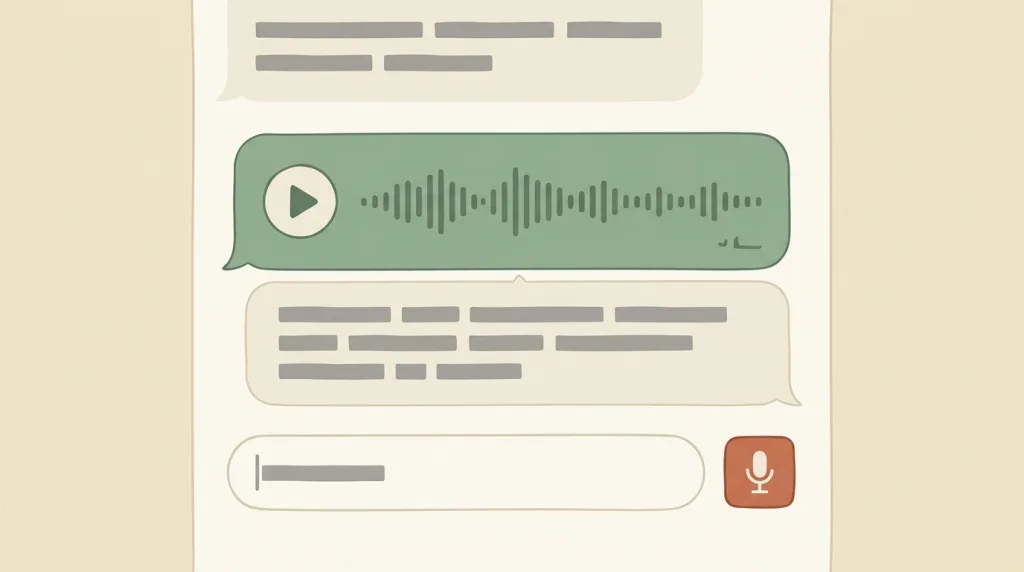
Recording and sending a short audio clip inside a conversation for the recipient to play whenever they like: it carries tone and detail asynchronously, usually shows its duration, and can offer a transcript as an equivalent.
Recognizing it
- Recording and sending happen in one step inside the conversation
- The message shows its duration and waveform and can be paused and scrubbed
- The recipient decides when to listen, with no need for both to be present
Concept boundary
A voice message is asynchronous: the sender records and moves on while the recipient decides when to listen, unlike a call that needs both present. It is also not voice input — voice input turns speech into text before sending, while a voice message sends the audio itself. The pattern shifts cost from sender to recipient: speaking is faster than typing, but listening to a minute of audio is slower than glancing at text and cannot be searched. This entry therefore treats a text equivalent as necessary rather than a nicety: in noisy places, where audio cannot be played aloud, and for deaf and hard-of-hearing recipients, audio without a transcript is simply unreachable content.
When to consider it
- The content depends on tone, feeling, or spoken detail that text conveys poorly
- The sender cannot type comfortably — moving, or with both hands busy
- The message is long and loosely structured, where speaking is more natural than typing
When to be cautious
- It contains addresses, amounts, or times that need to be transcribed exactly
- No transcript is offered, so the content is unreachable in noisy settings or for a recipient who cannot hear
- The information needs to be searched, quoted, or forwarded for others to read later
Tradeoff
Recording pushes the cost of sending to a minimum, at the cost of a higher and asymmetric cost of receiving: audio plays in real time, cannot be skimmed or searched, and in many settings cannot be played at all.
Conditional rules · Editorial advice
Related entries
A transcript is this pattern’s text equivalent; without it the content is entirely unreachable for some recipients.
A conversational interface provides the timeline and context, and a voice clip is one message form within it.
Automatic transcription makes mistakes, especially on names and numbers; it should be marked as machine-generated with the original audio kept for checking.
Sources and what they support
The article records that WhatsApp allows users to send text messages, voice messages, and video messages, and its timeline notes that the service introduced voice messaging in August 2013. This entry cites it to establish that the pattern exists in mainstream messaging and roughly when it arrived; it does not rely on the article’s market figures.
Retrieved: 2026-09-16 · Snapshot unconfirmedThe success criterion summarises its goal as making audio-only and video-only content understandable to more people, and what to do as providing an alternative when content is perceivable with only one sense. This entry takes from it the requirement that a voice message needs a text equivalent; the precise conformance requirements remain with the specification.
Retrieved: 2026-09-16 · Snapshot unconfirmedDefinitions reference these sources. Digital specimens, selection advice, relationships, and recipes are editorial work and have not been validated through user research.
Type extensions and implementation notes
This entry has no runnable specimen; the conversation content in the illustration is fictional. Before shipping, confirm that every clip has a usable text equivalent and test the flow where audio cannot be played aloud.
{
  "states": [
    "idle",
    "recording",
    "sent",
    "playing",
    "transcribed"
  ],
  "a11y": [
    "Recording and sending have an equivalent that does not require press-and-hold",
    "Playback controls are keyboard-operable and duration and progress are readable as text"
  ],
  "motion": "The waveform is state feedback; under a reduced-motion preference it is replaced by static duration and progress text"
}
Full Agent entry JSON
{
  "id": "voice-message",
  "type": "interaction",
  "name": {
    "zh": "语音消息",
    "en": "Voice Message"
  },
  "aliases": [
    "Voice Note",
    "Audio Message",
    "语音条",
    "语音留言"
  ],
  "granularity": "flow",
  "intents": [
    "state-intent",
    "provide-alternative"
  ],
  "tags": [
    "voice",
    "chat",
    "recording",
    "transcript",
    "asynchronous"
  ],
  "definition": "Recording and sending a short audio clip inside a conversation for the recipient to play whenever they like: it carries tone and detail asynchronously, usually shows its duration, and can offer a transcript as an equivalent.",
  "boundary": "A voice message is asynchronous: the sender records and moves on while the recipient decides when to listen, unlike a call that needs both present. It is also not voice input — voice input turns speech into text before sending, while a voice message sends the audio itself. The pattern shifts cost from sender to recipient: speaking is faster than typing, but listening to a minute of audio is slower than glancing at text and cannot be searched. This entry therefore treats a text equivalent as necessary rather than a nicety: in noisy places, where audio cannot be played aloud, and for deaf and hard-of-hearing recipients, audio without a transcript is simply unreachable content.",
  "signature": [
    "Recording and sending happen in one step inside the conversation",
    "The message shows its duration and waveform and can be paused and scrubbed",
    "The recipient decides when to listen, with no need for both to be present"
  ],
  "when": [
    "The content depends on tone, feeling, or spoken detail that text conveys poorly",
    "The sender cannot type comfortably — moving, or with both hands busy",
    "The message is long and loosely structured, where speaking is more natural than typing"
  ],
  "when_not": [
    "It contains addresses, amounts, or times that need to be transcribed exactly",
    "No transcript is offered, so the content is unreachable in noisy settings or for a recipient who cannot hear",
    "The information needs to be searched, quoted, or forwarded for others to read later"
  ],
  "tradeoff": "Recording pushes the cost of sending to a minimum, at the cost of a higher and asymmetric cost of receiving: audio plays in real time, cannot be skimmed or searched, and in many settings cannot be played at all.",
  "comparison": {
    "focus": "Carrying tone and spoken detail through an asynchronous conversation",
    "mechanism": "One-step recording inside the conversation, played back at the recipient’s convenience",
    "cost": "Receiving costs more, and without a transcript the content is unreachable"
  },
  "sources": [
    {
      "id": "voice-message-whatsapp",
      "title": "Wikipedia · WhatsApp",
      "url": "https://en.wikipedia.org/wiki/WhatsApp",
      "claim": "The article records that WhatsApp allows users to send text messages, voice messages, and video messages, and its timeline notes that the service introduced voice messaging in August 2013. This entry cites it to establish that the pattern exists in mainstream messaging and roughly when it arrived; it does not rely on the article’s market figures.",
      "checkedAt": "2026-09-16",
      "archive": {
        "lookupUrl": "https://web.archive.org/web/20260916*/https://en.wikipedia.org/wiki/WhatsApp",
        "status": "pending",
        "checkedAt": "2026-09-16T17:35:01.950Z",
        "error": "status-request-failed",
        "jobId": "spn2-1296901c4e7a4f0d1af8d9d95d72212043034eb8"
      }
    },
    {
      "id": "voice-message-w3c-1-2-1",
      "title": "W3C · Understanding SC 1.2.1: Audio-only and Video-only (Prerecorded) (WCAG 2.2, Level A)",
      "url": "https://www.w3.org/WAI/WCAG22/Understanding/audio-only-and-video-only-prerecorded.html",
      "claim": "The success criterion summarises its goal as making audio-only and video-only content understandable to more people, and what to do as providing an alternative when content is perceivable with only one sense. This entry takes from it the requirement that a voice message needs a text equivalent; the precise conformance requirements remain with the specification.",
      "checkedAt": "2026-09-16",
      "archive": {
        "lookupUrl": "https://web.archive.org/web/20260916*/https://www.w3.org/WAI/WCAG22/Understanding/audio-only-and-video-only-prerecorded.html",
        "status": "pending",
        "checkedAt": "2026-09-16T17:35:04.265Z",
        "error": "status-request-failed",
        "jobId": "spn2-ba5b38af5115ea58e85affcae13f986354907ac7"
      }
    }
  ],
  "relations": [
    {
      "target": "perceivable-alternatives",
      "kind": "realized_by",
      "condition": "The message exists only as audio",
      "reason": "A transcript is this pattern’s text equivalent; without it the content is entirely unreachable for some recipients.",
      "basis": "editorial"
    },
    {
      "target": "conversational-interface",
      "kind": "composes_with",
      "condition": "Voice messages sit inside an interface organised as a conversation",
      "reason": "A conversational interface provides the timeline and context, and a voice clip is one message form within it.",
      "basis": "editorial"
    },
    {
      "target": "ai-label",
      "kind": "composes_with",
      "condition": "The transcript is produced by automatic speech recognition",
      "reason": "Automatic transcription makes mistakes, especially on names and numbers; it should be marked as machine-generated with the original audio kept for checking.",
      "basis": "editorial"
    }
  ],
  "rules": [
    {
      "when": "The product supports sending voice messages",
      "instruction": "Give every clip a transcript or equivalent so the recipient can learn its content without playing it.",
      "strength": "must",
      "basis": "editorial"
    },
    {
      "when": "The transcript comes from automatic recognition",
      "instruction": "Mark it as machine-generated and possibly wrong, keep the original audio for checking, and do not present it as an accurate record.",
      "strength": "must",
      "basis": "editorial"
    }
  ],
  "behavior": {
    "states": [
      "idle",
      "recording",
      "sent",
      "playing",
      "transcribed"
    ],
    "a11y": [
      "Recording and sending have an equivalent that does not require press-and-hold",
      "Playback controls are keyboard-operable and duration and progress are readable as text"
    ],
    "motion": "The waveform is state feedback; under a reduced-motion preference it is replaced by static duration and progress text"
  },
  "demo": null,
  "version": "0.1.0",
  "editorialStatus": "drafted",
  "requirements": [],
  "demoCapabilities": [],
  "implementationNote": "This entry has no runnable specimen; the conversation content in the illustration is fictional. Before shipping, confirm that every clip has a usable text equivalent and test the flow where audio cannot be played aloud.",
  "image": {
    "src": "/images/voice-message.webp",
    "alt": "A fictional chat interface sketch: a voice message bubble holding a play button, a waveform, and a duration mark, a grey placeholder text run labelled as a transcript beneath it, and a microphone button at the right of the input bar."
  },
  "searchTerms": [
    "语音",
    "聊天",
    "录音",
    "转写",
    "异步"
  ]
}