VOCABULARY / ENTRY
Wayfinding
wayfinding
The process by which people establish where they are, judge where they can go, and find the way back. Interfaces borrow it: on any screen a person should be able to answer where am I, where can I go, and how do I get back.
Recognizing it
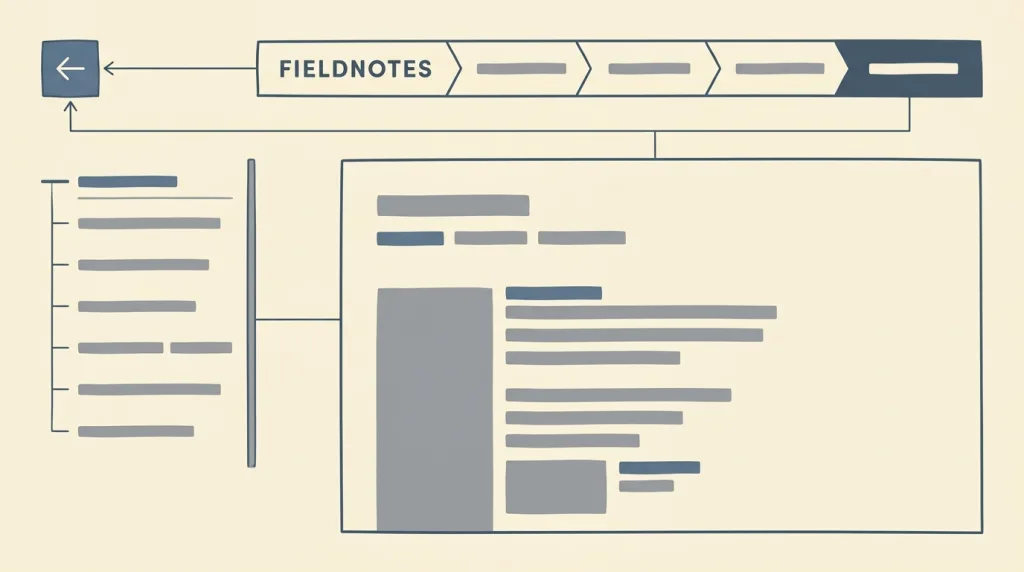
- Every screen marks where you are rather than only showing content
- The available directions are stated rather than guessed at
- There is always a predictable way back that does not depend on the browser’s back button
Concept boundary
Wayfinding is about orientation, not about navigation controls: breadcrumbs, sidebars, and tab bars are means, while wayfinding is the state they are meant to produce. It is not information architecture either — architecture settles the structural relations between content, while wayfinding settles whether a person can place themselves inside that structure right now. This entry carries a concept from physical space into interfaces; that carry-over is long established in the design literature but it is an analogy rather than an identity: an interface has no continuous space and a link can drop someone onto any screen at all, which often makes going back harder than it is in a building.
When to consider it
- The hierarchy runs deep and people lose their bearings partway
- Users may arrive at any screen directly from a search result or an external link
- Several parallel paths exist in one product and people need to tell which one they are on
When to be cautious
- The flow is one or two linear steps, where extra orientation is only noise
- Breadcrumbs stand in for a hierarchy whose path does not match where the user actually came from
- Going back is left to the browser’s back button or a system gesture alone
Tradeoff
Showing position and direction continuously keeps people from getting lost, at the cost of space on screen and of upkeep in step with the content: once the hierarchy changes and the orientation does not, it points the wrong way.
Conditional rules · Editorial advice
Related entries
Hierarchical navigation turns where am I and where can I go into a visible path and branches, one of the commonest ways wayfinding is realised.
Position is one kind of state, and wayfinding fills in the dimension of where you stand in the whole structure.
A hub-and-spoke structure naturally supplies one stable way back — return to the hub — which is exactly wayfinding’s third answer.
How do I get back is part of wayfinding; hiding it is not a layout problem but a deliberate obstacle on the way out.
Sources and what they support
The article explains that wayfinding encompasses all the ways in which people and animals orient themselves in physical space and navigate from place to place, records that Kevin A. Lynch used the term in his 1960 book The Image of the City where he defined it as "a consistent use and organization of definite sensory cues from the external environment", and notes that the environmental psychologist Romedi Passini expanded the concept in 1984 to include signage and other graphic communication. This entry takes the definition and lineage from it; carrying it into interfaces is editorial judgement.
Retrieved: 2026-09-16 · Snapshot unconfirmedDefinitions reference these sources. Digital specimens, selection advice, relationships, and recipes are editorial work and have not been validated through user research.
Type extensions and implementation notes
This entry has no runnable specimen; the illustration is an editorial sketch of how the position marker, the available directions, and the way back relate, not a verified implementation. Before shipping, enter a deep page directly from an external link and check that all three answers are present.
{
  "evidenceType": "A concept from environmental psychology and urban design (Lynch 1960, Passini 1984), carried into interfaces as an analogy in design practice",
  "limit": "This entry offers no measurement of how often users get lost and prescribes no particular navigation control; it only states the three questions any screen should be able to answer."
}
Full Agent entry JSON
{
  "id": "wayfinding",
  "type": "principle",
  "name": {
    "zh": "寻路",
    "en": "Wayfinding"
  },
  "aliases": [
    "Way-finding",
    "Orientation",
    "导向",
    "方位识别"
  ],
  "granularity": "experience",
  "intents": [
    "navigate-sections",
    "find-option"
  ],
  "tags": [
    "orientation",
    "navigation",
    "route",
    "signage",
    "going back"
  ],
  "definition": "The process by which people establish where they are, judge where they can go, and find the way back. Interfaces borrow it: on any screen a person should be able to answer where am I, where can I go, and how do I get back.",
  "boundary": "Wayfinding is about orientation, not about navigation controls: breadcrumbs, sidebars, and tab bars are means, while wayfinding is the state they are meant to produce. It is not information architecture either — architecture settles the structural relations between content, while wayfinding settles whether a person can place themselves inside that structure right now. This entry carries a concept from physical space into interfaces; that carry-over is long established in the design literature but it is an analogy rather than an identity: an interface has no continuous space and a link can drop someone onto any screen at all, which often makes going back harder than it is in a building.",
  "signature": [
    "Every screen marks where you are rather than only showing content",
    "The available directions are stated rather than guessed at",
    "There is always a predictable way back that does not depend on the browser’s back button"
  ],
  "when": [
    "The hierarchy runs deep and people lose their bearings partway",
    "Users may arrive at any screen directly from a search result or an external link",
    "Several parallel paths exist in one product and people need to tell which one they are on"
  ],
  "when_not": [
    "The flow is one or two linear steps, where extra orientation is only noise",
    "Breadcrumbs stand in for a hierarchy whose path does not match where the user actually came from",
    "Going back is left to the browser’s back button or a system gesture alone"
  ],
  "tradeoff": "Showing position and direction continuously keeps people from getting lost, at the cost of space on screen and of upkeep in step with the content: once the hierarchy changes and the orientation does not, it points the wrong way.",
  "comparison": {
    "focus": "Letting a person know at any moment where they are, where they can go, and how to get back",
    "mechanism": "Position, available directions, and a way back given continuously on every screen",
    "cost": "It takes space and must be maintained in step with structural change"
  },
  "sources": [
    {
      "id": "wayfinding-wikipedia",
      "title": "Wikipedia · Wayfinding",
      "url": "https://en.wikipedia.org/wiki/Wayfinding",
      "claim": "The article explains that wayfinding encompasses all the ways in which people and animals orient themselves in physical space and navigate from place to place, records that Kevin A. Lynch used the term in his 1960 book The Image of the City where he defined it as \"a consistent use and organization of definite sensory cues from the external environment\", and notes that the environmental psychologist Romedi Passini expanded the concept in 1984 to include signage and other graphic communication. This entry takes the definition and lineage from it; carrying it into interfaces is editorial judgement.",
      "checkedAt": "2026-09-16",
      "archive": {
        "lookupUrl": "https://web.archive.org/web/20260916*/https://en.wikipedia.org/wiki/Wayfinding",
        "status": "pending",
        "checkedAt": "2026-09-16T17:38:41.759Z",
        "error": "status-request-failed",
        "jobId": "spn2-a12962b9dcc8651d51ec3c35a771b571eff015b0"
      }
    }
  ],
  "relations": [
    {
      "target": "hierarchical-navigation",
      "kind": "realized_by",
      "condition": "The content has an explicit hierarchical structure",
      "reason": "Hierarchical navigation turns where am I and where can I go into a visible path and branches, one of the commonest ways wayfinding is realised.",
      "basis": "editorial"
    },
    {
      "target": "visibility-of-system-status",
      "kind": "composes_with",
      "condition": "Users need to know the system’s current state and place",
      "reason": "Position is one kind of state, and wayfinding fills in the dimension of where you stand in the whole structure.",
      "basis": "editorial"
    },
    {
      "target": "hub-and-spoke",
      "kind": "composes_with",
      "condition": "The product dispatches from one hub to several independent tasks",
      "reason": "A hub-and-spoke structure naturally supplies one stable way back — return to the hub — which is exactly wayfinding’s third answer.",
      "basis": "editorial"
    },
    {
      "target": "obstruction",
      "kind": "conflicts_when",
      "condition": "A product deliberately makes the path back or out hard to find",
      "reason": "How do I get back is part of wayfinding; hiding it is not a layout problem but a deliberate obstacle on the way out.",
      "basis": "editorial"
    }
  ],
  "rules": [
    {
      "when": "Users may enter a deep page directly from an external link",
      "instruction": "Give that page its own paths to the level above and to its siblings; do not assume the user clicked their way in.",
      "strength": "must",
      "basis": "editorial"
    },
    {
      "when": "The content hierarchy changes",
      "instruction": "Update breadcrumbs and position markers with it, so they reflect the real structure rather than the old one.",
      "strength": "must",
      "basis": "editorial"
    }
  ],
  "principle": {
    "evidenceType": "A concept from environmental psychology and urban design (Lynch 1960, Passini 1984), carried into interfaces as an analogy in design practice",
    "limit": "This entry offers no measurement of how often users get lost and prescribes no particular navigation control; it only states the three questions any screen should be able to answer."
  },
  "demo": null,
  "version": "0.1.0",
  "editorialStatus": "drafted",
  "requirements": [],
  "demoCapabilities": [],
  "implementationNote": "This entry has no runnable specimen; the illustration is an editorial sketch of how the position marker, the available directions, and the way back relate, not a verified implementation. Before shipping, enter a deep page directly from an external link and check that all three answers are present.",
  "image": {
    "src": "/images/wayfinding.webp",
    "alt": "A fictional FIELDNOTES interface sketch: a breadcrumb across the top marking the current position with the current level darkened, a list of sibling branches down the left, and an explicit control back to the level above at the top left, each joined by a thin line to the content area at the centre."
  },
  "searchTerms": [
    "定位",
    "导航",
    "路径",
    "标识",
    "返回"
  ]
}