VOCABULARY / ENTRY
Wireframe (3D Mesh)
wireframe-3d
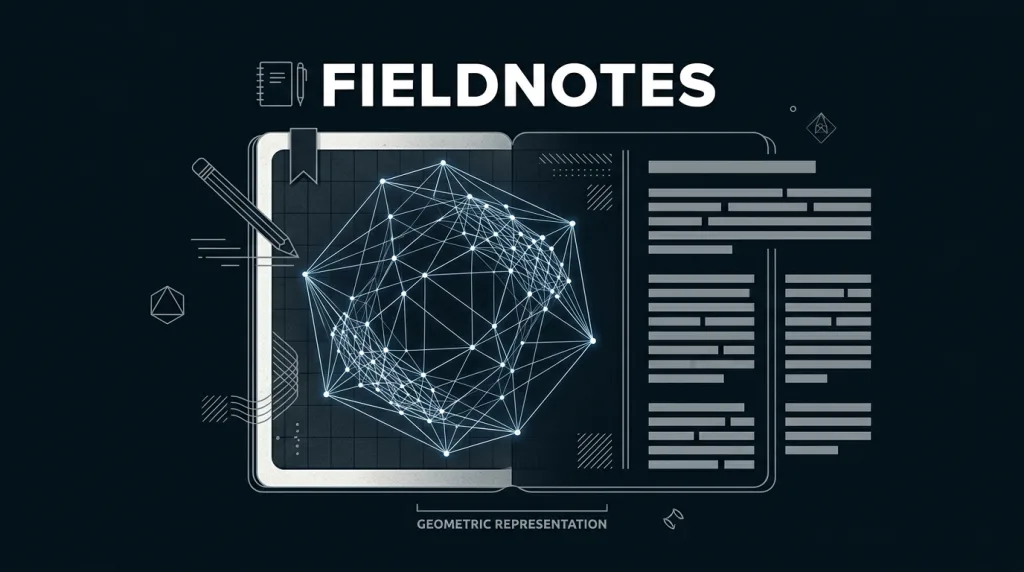
A visual language that shows a three-dimensional model as vertices and edges only, with no filled surfaces: the object’s silhouette and its internal structure are visible at the same time, the image is built from a fine line mesh, and it reads like a technical drawing placed into a composition.
Recognizing it
- Only vertices and edges are drawn, surfaces stay unfilled, and rear edges remain visible
- Mesh density carries tone: lines crowd where curvature is high
- Single- or two-color fine lines on a dark ground build the whole image
Concept boundary
This entry means the style that uses a 3D wireframe as the final visual, not the low-fidelity layout sketches of the interface design process — those are also called wireframes, but they are a process artefact rather than a visual language. The test is that the edges of a polygon mesh stay visible as lines and the surfaces are not filled — not "uses lines" or "looks technical". It is adjacent to but distinct from the blueprint look, which imitates orthographic engineering drawings with dimension marks, while the wireframe style keeps the three-dimensional perspective and the density of the mesh itself as its expressive material.
When to consider it
- Both outer form and internal structure must be shown, as when explaining assembly or spatial relationships
- The brand wants to read as engineering, computation, or work still under construction
- The asset must stay light and scalable in a dark theme
When to be cautious
- A product rendering needs real materials, lighting, or color
- Line density is so high that the whole image degrades into grey noise when scaled down
- A low-fidelity process wireframe is shipped as if it were the finished visual
Tradeoff
A wireframe conveys form and structure at once, stays tiny in size, and recolors easily, at the cost of losing material and lighting information — and slightly too much line density turns into a grey mass at small sizes or low resolution.
Conditional rules · Editorial advice
Related entries
Early graphics hardware could draw only wireframes, so the technique carries a period association — though the style itself need not be nostalgic.
A wireframe is inherently a subtractive presentation, aligned with a layout direction that removes redundancy, and the two can share one restrained palette.
Fine lines create a continuously varying background lightness behind text, so the real contrast is set by the worst line.
Sources and what they support
The article explains that a wire-frame model is a visual presentation of a three-dimensional object using only points and line segments (edges), without surface information, so lines behind and inside the object remain visible. This entry paraphrases the definition from it.
Retrieved: 2026-09-16 · Snapshot unconfirmedThe documentation explains that the Wireframe modifier converts a mesh’s edges into thickened geometry, turning the wireframe itself into renderable solid material. This entry cites it to show how the look is actually produced; the documentation itself makes no stylistic claim.
Retrieved: 2026-09-16Definitions reference these sources. Digital specimens, selection advice, relationships, and recipes are editorial work and have not been validated through user research.
Type extensions and implementation notes
This entry has no runnable specimen; the illustration is an editorial sketch of how a wireframe keeps structure visible, not a verified implementation. Before shipping, confirm at the target size that mesh density does not collapse into a grey mass and measure text contrast over the lines.
{
  "tokens": {
    "surface": "#11151c",
    "ink": "#dfe6ef",
    "accent": "#4fd1c5",
    "radiusPx": 0,
    "shadow": "none"
  },
  "tokenScope": "This sample recipe — deep blue-black ground, cool white ink, cyan accent lines — is one common reading; a light-ground wireframe works equally well. Real work should re-pick colors for its context and verify text contrast over the lines."
}
Full Agent entry JSON
{
  "id": "wireframe-3d",
  "type": "visual",
  "name": {
    "zh": "线框风格",
    "en": "Wireframe (3D Mesh)"
  },
  "aliases": [
    "Wireframe Aesthetic",
    "3D Mesh Style",
    "网格线框风格",
    "多边形线框"
  ],
  "granularity": "experience",
  "intents": [
    "express-brand",
    "organize-content"
  ],
  "tags": [
    "wireframe",
    "three-dimensional",
    "mesh",
    "technical",
    "perspective"
  ],
  "definition": "A visual language that shows a three-dimensional model as vertices and edges only, with no filled surfaces: the object’s silhouette and its internal structure are visible at the same time, the image is built from a fine line mesh, and it reads like a technical drawing placed into a composition.",
  "boundary": "This entry means the style that uses a 3D wireframe as the final visual, not the low-fidelity layout sketches of the interface design process — those are also called wireframes, but they are a process artefact rather than a visual language. The test is that the edges of a polygon mesh stay visible as lines and the surfaces are not filled — not \"uses lines\" or \"looks technical\". It is adjacent to but distinct from the blueprint look, which imitates orthographic engineering drawings with dimension marks, while the wireframe style keeps the three-dimensional perspective and the density of the mesh itself as its expressive material.",
  "signature": [
    "Only vertices and edges are drawn, surfaces stay unfilled, and rear edges remain visible",
    "Mesh density carries tone: lines crowd where curvature is high",
    "Single- or two-color fine lines on a dark ground build the whole image"
  ],
  "when": [
    "Both outer form and internal structure must be shown, as when explaining assembly or spatial relationships",
    "The brand wants to read as engineering, computation, or work still under construction",
    "The asset must stay light and scalable in a dark theme"
  ],
  "when_not": [
    "A product rendering needs real materials, lighting, or color",
    "Line density is so high that the whole image degrades into grey noise when scaled down",
    "A low-fidelity process wireframe is shipped as if it were the finished visual"
  ],
  "tradeoff": "A wireframe conveys form and structure at once, stays tiny in size, and recolors easily, at the cost of losing material and lighting information — and slightly too much line density turns into a grey mass at small sizes or low resolution.",
  "comparison": {
    "focus": "Showing outer form and internal structure at the same time",
    "mechanism": "Drawing only the vertices and edges of a polygon mesh, leaving surfaces unfilled",
    "cost": "No material or lighting, and excess density collapses into a grey mass"
  },
  "sources": [
    {
      "id": "wireframe-wikipedia",
      "title": "Wikipedia · Wire-frame model",
      "url": "https://en.wikipedia.org/wiki/Wire-frame_model",
      "claim": "The article explains that a wire-frame model is a visual presentation of a three-dimensional object using only points and line segments (edges), without surface information, so lines behind and inside the object remain visible. This entry paraphrases the definition from it.",
      "checkedAt": "2026-09-16",
      "archive": {
        "lookupUrl": "https://web.archive.org/web/20260916*/https://en.wikipedia.org/wiki/Wire-frame_model",
        "status": "unconfirmed",
        "checkedAt": "2026-09-16T13:05:23.426Z",
        "error": "status-request-failed",
        "jobId": "spn2-0d622a2160d5a41d99fd5544ae91c22e467a7a3a"
      }
    },
    {
      "id": "wireframe-blender",
      "title": "Blender Manual · Wireframe Modifier",
      "url": "https://docs.blender.org/manual/en/latest/modeling/modifiers/generate/wireframe.html",
      "claim": "The documentation explains that the Wireframe modifier converts a mesh’s edges into thickened geometry, turning the wireframe itself into renderable solid material. This entry cites it to show how the look is actually produced; the documentation itself makes no stylistic claim.",
      "checkedAt": "2026-09-16",
      "archive": {
        "lookupUrl": "https://web.archive.org/web/20260916*/https://docs.blender.org/manual/en/latest/modeling/modifiers/generate/wireframe.html",
        "status": "available",
        "checkedAt": "2026-09-16T13:30:00.725Z",
        "jobId": "spn2-8d9a1c0477e4a599845af7fce8ee3f0d45ced5f9",
        "url": "https://web.archive.org/web/20260916133024/https://docs.blender.org/manual/en/latest/modeling/modifiers/generate/wireframe.html",
        "timestamp": "20260916133024"
      }
    }
  ],
  "relations": [
    {
      "target": "retro-computing",
      "kind": "related",
      "condition": "The wireframe is used to evoke early computer graphics",
      "reason": "Early graphics hardware could draw only wireframes, so the technique carries a period association — though the style itself need not be nostalgic.",
      "basis": "editorial"
    },
    {
      "target": "minimalism",
      "kind": "composes_with",
      "condition": "The image keeps only structural information and drops material and ornament",
      "reason": "A wireframe is inherently a subtractive presentation, aligned with a layout direction that removes redundancy, and the two can share one restrained palette.",
      "basis": "editorial"
    },
    {
      "target": "contrast-legibility",
      "kind": "conflicts_when",
      "condition": "Text is placed directly over a high-density wireframe",
      "reason": "Fine lines create a continuously varying background lightness behind text, so the real contrast is set by the worst line.",
      "basis": "editorial"
    }
  ],
  "rules": [
    {
      "when": "The wireframe has to shrink to card or icon size",
      "instruction": "Reduce the mesh density before scaling and confirm the structure is still readable at the target size, instead of scaling the original.",
      "strength": "must",
      "basis": "editorial"
    },
    {
      "when": "The wireframe serves as a background with text on top",
      "instruction": "Lower the lines’ opacity in the text area or add a ground layer, and verify contrast against the brightest line.",
      "strength": "recommend",
      "basis": "editorial"
    }
  ],
  "visual": {
    "tokens": {
      "surface": "#11151c",
      "ink": "#dfe6ef",
      "accent": "#4fd1c5",
      "radiusPx": 0,
      "shadow": "none"
    },
    "tokenScope": "This sample recipe — deep blue-black ground, cool white ink, cyan accent lines — is one common reading; a light-ground wireframe works equally well. Real work should re-pick colors for its context and verify text contrast over the lines."
  },
  "demo": null,
  "version": "0.1.0",
  "editorialStatus": "drafted",
  "requirements": [],
  "demoCapabilities": [],
  "implementationNote": "This entry has no runnable specimen; the illustration is an editorial sketch of how a wireframe keeps structure visible, not a verified implementation. Before shipping, confirm at the target size that mesh density does not collapse into a grey mass and measure text contrast over the lines.",
  "image": {
    "src": "/images/wireframe-3d.webp",
    "alt": "A fictional FIELDNOTES page on a dark ground: at the centre a three-dimensional form built only from vertices and edges, its rear lines equally visible and the mesh crowding where curvature is high, with cool white placeholder text bars to the right."
  },
  "searchTerms": [
    "线框",
    "三维",
    "网格",
    "技术感",
    "透视"
  ]
}