VOCABULARY / ENTRY
Craftsmanship
craftsmanship
A stance toward work whose aim is to do the job well for its own sake: the standard comes from the quality measures inside the craft rather than from outside rewards, so it attends to the skill and judgement in the process, not only to whether the deliverable passed review.
Recognizing it
- The standard of quality comes from the work itself rather than from review or reward
- The judgements made along the way are recorded so whoever comes later knows why
- A willingness to redo one part to get it right rather than route around it
Concept boundary
Craftsmanship is a stance about what one works toward, not a set of acceptance criteria, and it is not the same as polishing details: perfecting an animation while the core flow stays unusable is misplaced attention rather than craft. It is not a synonym for slowness either — doing a job well and delivering on time do not conflict by nature, though they do compete for the same hours, which is precisely what needs saying out loud. This entry does not treat it as a value that overrides others: refusing to compromise, delaying delivery, or disparaging other people’s work in the name of craft is equally a misuse of the stance.
When to consider it
- The artefact will be maintained for a long time and early roughness keeps costing
- A team needs a shared understanding of what counts as done well
- The quality of the work is hard to observe from outside and only an internal standard holds it up
When to be cautious
- It is used to justify open-ended polishing while delivery is deferred indefinitely
- Attention lands on details nobody cares about while the core problem stays unsolved
- Other people’s work is disparaged, or a necessary trade-off refused, in the name of craft
Tradeoff
Holding oneself to an internal standard preserves quality where nobody is watching and lets experience accumulate; the cost is that the standard competes with delivery pressure for the same hours, and being self-set, without outside calibration it can just as easily spend effort where nobody benefits.
Conditional rules · Editorial advice
Related entries
Craft supplies the will to do well and systems thinking supplies the judgement of where doing well matters; without the second, the first lands on details nobody benefits from.
Making something that stands up to long maintenance is itself a reduction in the resources spent redoing and replacing it.
Craft’s measure comes from inside the craft and may have nothing to do with what users need; where they disagree, users settle it and the measure is recalibrated.
A self-set standard has no outside reference, and bringing users into the judgement is one concrete way to calibrate it.
Sources and what they support
The article records that Richard Sennett’s The Craftsman, published in 2008, is about craftsmanship and its importance to individuals and society, and summarises its core claim that the spirit of craftsmanship involves the desire to do a job well for its own sake, adding that people motivated purely by material rewards or competition do not tend to produce as good work as those motivated by that desire. This entry paraphrases its definition from this.
Retrieved: 2026-09-16 · Snapshot unconfirmedThe article defines workmanship as a human attribute relating to knowledge and skill at performing a task and also as a quality imparted to a product; it notes that workmanship and craftsmanship are sometimes treated as synonyms while many draw a distinction, or at least take craftsmanship to mean workmanship of the better sort, and records that David Pye wrote that no one can definitively state where workmanship ends and craftsmanship begins. Its reference list records the title of chapter 2 of Pye’s 1968 book as "The workmanship of risk and the workmanship of certainty"; this entry cites that only to note the distinction exists and does not paraphrase its content.
Retrieved: 2026-09-16 · Snapshot unconfirmedDefinitions reference these sources. Digital specimens, selection advice, relationships, and recipes are editorial work and have not been validated through user research.
Type extensions and implementation notes
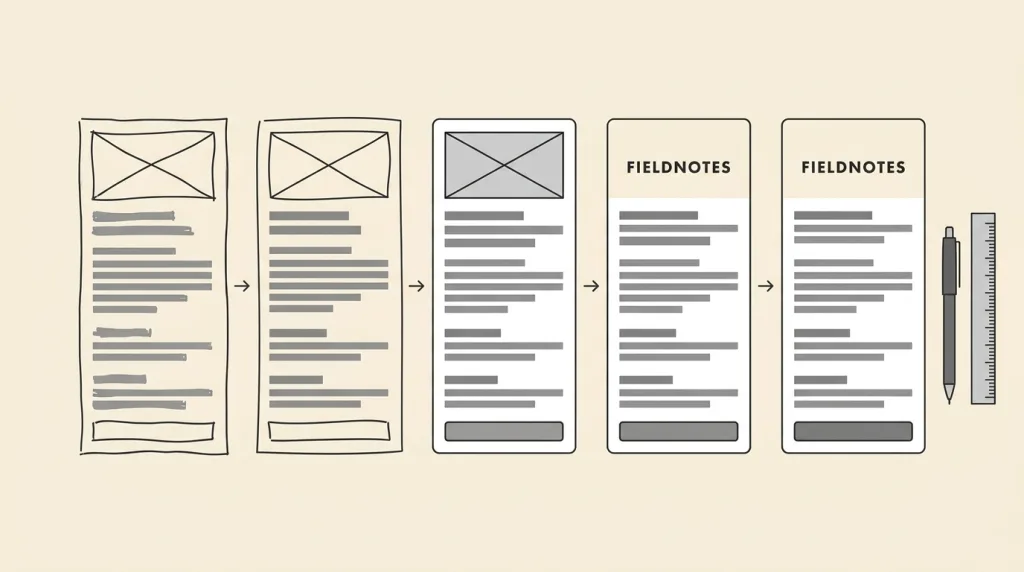
This entry has no runnable specimen; the illustration is an editorial sketch expressing the stance as one component reworked again and again, and represents no particular working method. Before adopting it in a team, write down what counts as done well in terms others can check.
{
  "values": [
    "Doing the work well rather than only satisfying review",
    "Skill and judgement are worth accumulating and passing on"
  ],
  "tension": "Between an internal standard of quality and both outside delivery pressure and what users actually need",
  "questions": [
    "If this part is done well, who benefits?",
    "Whose standard is it when we say done well?",
    "If it is not made right now, who pays for it and when?"
  ]
}
Full Agent entry JSON
{
  "id": "craftsmanship",
  "type": "philosophy",
  "name": {
    "zh": "匠艺",
    "en": "Craftsmanship"
  },
  "aliases": [
    "Craft",
    "Workmanship",
    "手艺",
    "工艺精神"
  ],
  "granularity": "experience",
  "intents": [
    "assess-impact",
    "understand-users"
  ],
  "tags": [
    "skill",
    "refinement",
    "quality",
    "process",
    "long term"
  ],
  "definition": "A stance toward work whose aim is to do the job well for its own sake: the standard comes from the quality measures inside the craft rather than from outside rewards, so it attends to the skill and judgement in the process, not only to whether the deliverable passed review.",
  "boundary": "Craftsmanship is a stance about what one works toward, not a set of acceptance criteria, and it is not the same as polishing details: perfecting an animation while the core flow stays unusable is misplaced attention rather than craft. It is not a synonym for slowness either — doing a job well and delivering on time do not conflict by nature, though they do compete for the same hours, which is precisely what needs saying out loud. This entry does not treat it as a value that overrides others: refusing to compromise, delaying delivery, or disparaging other people’s work in the name of craft is equally a misuse of the stance.",
  "signature": [
    "The standard of quality comes from the work itself rather than from review or reward",
    "The judgements made along the way are recorded so whoever comes later knows why",
    "A willingness to redo one part to get it right rather than route around it"
  ],
  "when": [
    "The artefact will be maintained for a long time and early roughness keeps costing",
    "A team needs a shared understanding of what counts as done well",
    "The quality of the work is hard to observe from outside and only an internal standard holds it up"
  ],
  "when_not": [
    "It is used to justify open-ended polishing while delivery is deferred indefinitely",
    "Attention lands on details nobody cares about while the core problem stays unsolved",
    "Other people’s work is disparaged, or a necessary trade-off refused, in the name of craft"
  ],
  "tradeoff": "Holding oneself to an internal standard preserves quality where nobody is watching and lets experience accumulate; the cost is that the standard competes with delivery pressure for the same hours, and being self-set, without outside calibration it can just as easily spend effort where nobody benefits.",
  "comparison": {
    "focus": "Organising work around doing the job well for its own sake",
    "mechanism": "Adopting quality measures from inside the craft and recording the judgements made",
    "cost": "It competes with delivery for time and its standard lacks outside calibration"
  },
  "sources": [
    {
      "id": "craftsmanship-sennett",
      "title": "Wikipedia · The Craftsman (book)",
      "url": "https://en.wikipedia.org/wiki/The_Craftsman_(book)",
      "claim": "The article records that Richard Sennett’s The Craftsman, published in 2008, is about craftsmanship and its importance to individuals and society, and summarises its core claim that the spirit of craftsmanship involves the desire to do a job well for its own sake, adding that people motivated purely by material rewards or competition do not tend to produce as good work as those motivated by that desire. This entry paraphrases its definition from this.",
      "checkedAt": "2026-09-16",
      "archive": {
        "lookupUrl": "https://web.archive.org/web/20260916*/https://en.wikipedia.org/wiki/The_Craftsman_(book)",
        "status": "pending",
        "checkedAt": "2026-09-22T11:57:48.995Z",
        "error": "status-request-failed",
        "jobId": "spn2-423387b1881f30fb0b17c9597d0d1338d79cae23"
      }
    },
    {
      "id": "craftsmanship-workmanship",
      "title": "Wikipedia · Workmanship",
      "url": "https://en.wikipedia.org/wiki/Workmanship",
      "claim": "The article defines workmanship as a human attribute relating to knowledge and skill at performing a task and also as a quality imparted to a product; it notes that workmanship and craftsmanship are sometimes treated as synonyms while many draw a distinction, or at least take craftsmanship to mean workmanship of the better sort, and records that David Pye wrote that no one can definitively state where workmanship ends and craftsmanship begins. Its reference list records the title of chapter 2 of Pye’s 1968 book as \"The workmanship of risk and the workmanship of certainty\"; this entry cites that only to note the distinction exists and does not paraphrase its content.",
      "checkedAt": "2026-09-16",
      "archive": {
        "lookupUrl": "https://web.archive.org/web/20260916*/https://en.wikipedia.org/wiki/Workmanship",
        "status": "pending",
        "checkedAt": "2026-09-16T17:41:07.847Z",
        "error": "status-request-failed",
        "jobId": "spn2-286326004561362d7befcc8c63938b7bcc2e8883"
      }
    }
  ],
  "relations": [
    {
      "target": "systems-thinking",
      "kind": "composes_with",
      "condition": "It has to be judged where effort actually improves the whole",
      "reason": "Craft supplies the will to do well and systems thinking supplies the judgement of where doing well matters; without the second, the first lands on details nobody benefits from.",
      "basis": "editorial"
    },
    {
      "target": "sustainable-design",
      "kind": "composes_with",
      "condition": "The artefact will be used and maintained over a long time",
      "reason": "Making something that stands up to long maintenance is itself a reduction in the resources spent redoing and replacing it.",
      "basis": "editorial"
    },
    {
      "target": "human-centered-design",
      "kind": "conflicts_when",
      "condition": "The internal standard of quality and the problems users actually hit do not agree",
      "reason": "Craft’s measure comes from inside the craft and may have nothing to do with what users need; where they disagree, users settle it and the measure is recalibrated.",
      "basis": "editorial"
    },
    {
      "target": "participatory-design",
      "kind": "related",
      "condition": "The standard of quality needs calibrating from outside",
      "reason": "A self-set standard has no outside reference, and bringing users into the judgement is one concrete way to calibrate it.",
      "basis": "editorial"
    }
  ],
  "rules": [
    {
      "when": "Delivery is deferred for the sake of quality",
      "instruction": "Name which part is being held and why it must be right now, rather than appealing generally to not good enough.",
      "strength": "must",
      "basis": "editorial"
    },
    {
      "when": "A team says it values craft",
      "instruction": "Write down what counts as done well as something concrete that others can check, and recalibrate it regularly against real use.",
      "strength": "recommend",
      "basis": "editorial"
    }
  ],
  "philosophy": {
    "values": [
      "Doing the work well rather than only satisfying review",
      "Skill and judgement are worth accumulating and passing on"
    ],
    "tension": "Between an internal standard of quality and both outside delivery pressure and what users actually need",
    "questions": [
      "If this part is done well, who benefits?",
      "Whose standard is it when we say done well?",
      "If it is not made right now, who pays for it and when?"
    ]
  },
  "demo": null,
  "version": "0.1.0",
  "editorialStatus": "drafted",
  "requirements": [],
  "demoCapabilities": [],
  "implementationNote": "This entry has no runnable specimen; the illustration is an editorial sketch expressing the stance as one component reworked again and again, and represents no particular working method. Before adopting it in a team, write down what counts as done well in terms others can check.",
  "image": {
    "src": "/images/craftsmanship.webp",
    "alt": "A sketch: one fictional interface layout shown across five iterations from left to right, moving from a hand-drawn, slightly crooked draft to something resolved — lines straightened, spacing aligned, levels distinct — each joined to the next by a small arrow, with a ruler standing beside the last."
  },
  "searchTerms": [
    "技艺",
    "打磨",
    "质量",
    "过程",
    "长期"
  ]
}