VOCABULARY / ENTRY
Double Diamond
double-diamond
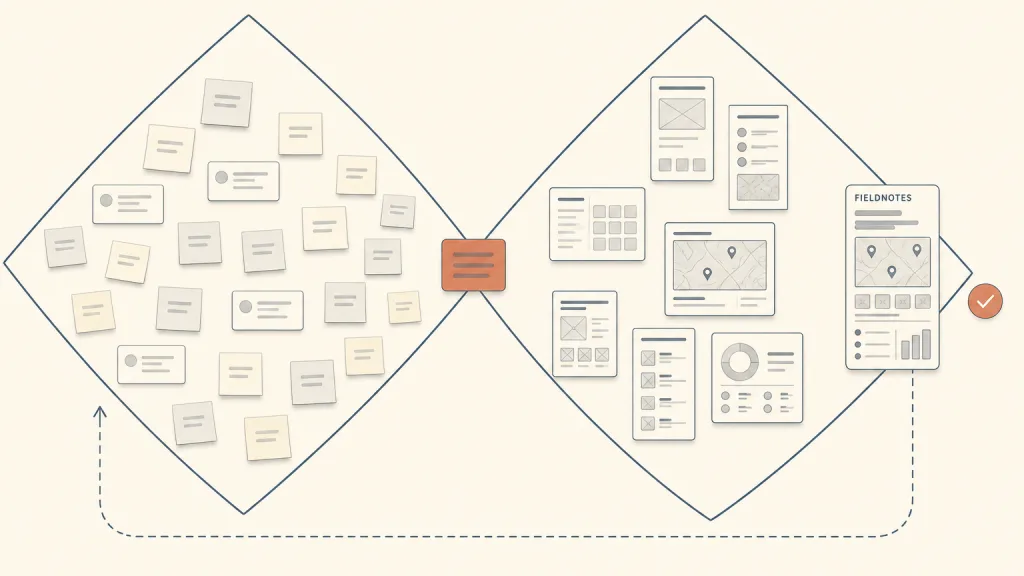
The UK Design Council's two-diamond depiction of the design process: the first diamond explores the problem divergently and then converges on a reframed problem (Discover, Define), and the second generates many solutions divergently and then converges on ones tested at small scale (Develop, Deliver). Its point is to make sure the right problem is being solved before solving it well.
Recognizing it
- The project plan clearly separates understanding the problem from solving it
- Each half begins with deliberately widened exploration and ends with an explicit converging decision
- The output of the Define phase is a restated problem, not a solution
Concept boundary
The Double Diamond describes the design process; it is not a manual to execute in order. The Design Council itself says it works irrespective of methods and tools, and its later Framework for Innovation explicitly draws in going back to the start after discovery and testing rough ideas very early. It is not human-centred design: that is a set of principles and a mindset that put people's needs and contexts at the centre, while the Double Diamond is a diagram for organising phases of work; the two are often used together, but completing the four phases does not guarantee that people were actually understood. Nor is it the five-stage design-thinking model; the two divide the stages differently, and this entry does not treat them as one process.
When to consider it
- The team does not yet agree on what problem it is actually solving
- Collaborators without a design background need to see what the steps of design work are and what each one produces
- The project has time to explore first rather than fixing a solution from the outset
When to be cautious
- The four phases are run once as a waterfall, with no going back when a new problem surfaces
- A neatly drawn diamond diagram stands in for actual user research and testing
- The problem is already clear and only a small change is needed, so forcing all four phases only adds overhead
Tradeoff
The two diamonds turn diverge-then-converge and define-before-solving into a picture anyone can read, which helps cross-functional teams align on phases and outputs; the cost is that the picture is so tidy it is easily read as a linear process — real projects often move back and forth between phases, and the diagram itself does not say how to do any phase.
Conditional rules · Editorial advice
Related entries
Human-centred design supplies the principles and mindset, the Double Diamond supplies the division into phases and outputs; with the diagram but without repeated contact with real users, the four phases are only a formality.
The Design Council lists co-design among the practices of the Develop phase; participatory design goes further and requires those people to hold real decision power over the tradeoffs.
Divergent exploration in Discover can miss the structure behind a problem if it looks only at individual users; systems thinking helps frame the problem more accurately in Define.
The Double Diamond stresses fully defining the problem before solving it, while Lean UX stresses turning assumptions into small experiments early; both call for iteration, but the former suits stages where the problem is still unclear and the latter suits stages where the direction is set and needs quick validation.
Sources and what they support
This Design Council page calls the Double Diamond a universally accepted depiction of the design process and lists four phases: Discover (spend time with the people affected to understand the real problem rather than assume it), Define (use the insight from discovery to frame the challenge differently), Develop (draw on other sources and co-design with a range of people to produce varied answers), and Deliver (test solutions at small scale, reject those that will not work, and improve those that will). It states that the model works irrespective of the methods and tools used, and describes the Framework for Innovation as an expanded version that covers returning to the start after discovery and testing ideas very early. This entry takes its definition, the four phases, and the not-a-manual boundary from it.
Retrieved: 2026-10-20 · Snapshot unconfirmedThe page records that in 2003 Richard Eisermann, then the Design Council's Director of Design and Innovation, asked his team how the design process could be described, which began work on the model; that kite-shaped process diagrams had been referenced since the 1960s; and that from 2004 the Design Council used the Double Diamond publicly at conferences, in presentations, and with clients, with its 2007 report 11 Lessons on Managing Design structured around it. This entry takes the model's origin and dates from it and does not adopt other years the page does not give.
Retrieved: 2026-10-20 · Snapshot unconfirmedIn this article of 3 September 2019, Cat Drew, the Design Council's Chief Design Officer, marks fifteen years of the Double Diamond, says it took shape at the Design Council between 2002 and 2004, and releases the new Framework for Innovation for download. This entry takes the statement that the Framework for Innovation extended the Double Diamond in 2019 from it.
Retrieved: 2026-10-20 · Snapshot unconfirmedDefinitions reference these sources. Digital specimens, selection advice, relationships, and recipes are editorial work and have not been validated through user research.
Type extensions and implementation notes
This entry has no runnable specimen; the illustration is an editorial sketch using two joined diamonds to show divergence and convergence, and does not reproduce the Design Council's original diagram. Before applying it to a project, choose concrete research and testing methods for each phase.
{
  "values": [
    "Make sure it is the right problem before solving it well",
    "Exploring and deciding should happen separately"
  ],
  "tension": "Between the clarity a process diagram brings and the back-and-forth of real projects",
  "questions": [
    "Are we diverging right now, or converging?",
    "Which findings does the problem we defined rest on?",
    "What kind of finding would send us back to the start?"
  ]
}
Open the Agent JSON file for this entryThis file repeats every field of this entry verbatim and adds its sources, archive status, and editorial scope.