VOCABULARY / ENTRY
Fibonacci Sequence
fibonacci-sequence
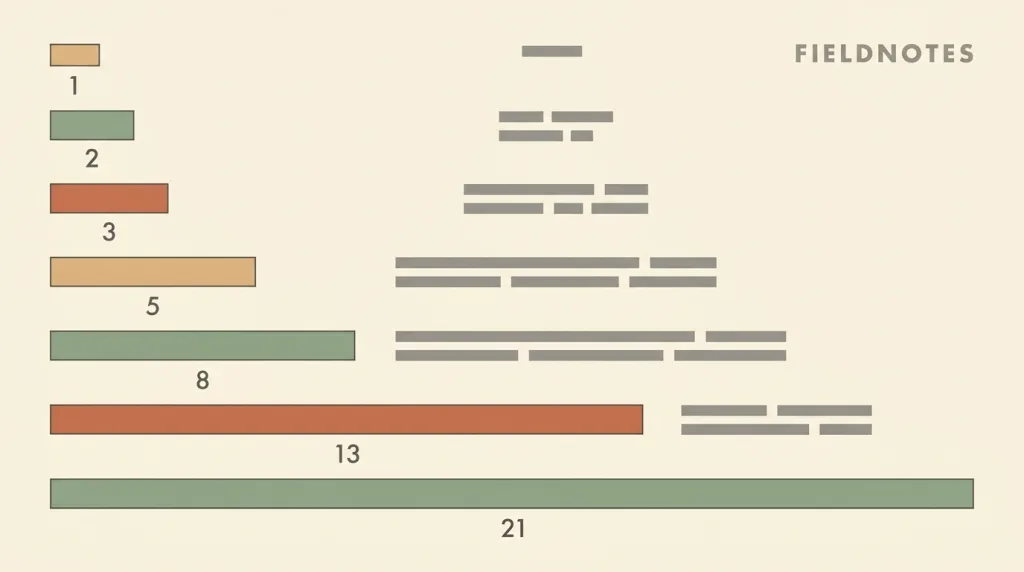
A whole-number sequence in which each term is the sum of the two before it (1, 2, 3, 5, 8, 13, 21…). In design it serves as a ready-made scale for spacing and type sizes: the gap between neighbouring terms widens as the values grow, so the steps are fine at small sizes and coarse at large ones.
Recognizing it
- Spacing and type sizes come from one set of whole numbers, with nothing outside it
- The gap between neighbouring values widens as the sizes grow
- The whole set can be memorised and restated out loud
Concept boundary
This entry covers using these whole numbers as a scale, not the mathematics of the sequence itself, and it does not summarise its appearances in nature. It is related to but not the same as the golden ratio: successive terms approach about 1.618, so the sequence is often used as its whole-number approximation, but approaching a ratio does not make it inherit any aesthetic claim — the psychological evidence about whether the golden ratio is more pleasing conflicts with itself. The real reason to use the sequence as a scale is that it is simple, memorable, and grows its steps with size, not that it comes from nature.
When to consider it
- A simple, memorable spacing scale is needed to keep several people consistent
- Fine steps are wanted at small sizes and clear jumps at large ones
- Values must be whole numbers so they survive intact across implementations
When to be cautious
- The scale is argued to be more beautiful because it comes from nature or matches the golden ratio
- The steps are too fine at the small end, where 1 and 2 are indistinguishable on screen
- The size the content needs falls between two terms and is forced to the nearer one
Tradeoff
A fixed set of whole numbers removes the arbitrariness of picking a number on the spot and makes spacing discussable and reusable, at the cost of working badly at both ends: neighbouring terms are too close at the small end and the jumps may be too large at the big one.
Conditional rules · Editorial advice
Related entries
Successive terms approach about 1.618, so the sequence is often taken as the golden ratio’s whole-number approximation; but that ratio’s aesthetic claim is contested and should not be carried over as a reason.
A fixed scale turns picking a value from a per-case judgement into a one-time agreement, which is how consistency lands on the dimension of size.
The grid governs columns and gutters across while the scale governs spacing and type down; each owns one direction and they do not collide.
Sources and what they support
The article defines the Fibonacci sequence as one in which each number is the sum of the two preceding ones and explains that the ratio of successive terms approaches the golden ratio as the sequence grows. This entry takes the definition and the whole-number-approximation point from it; using it as a spacing scale is editorial judgement.
Retrieved: 2026-09-16 · Snapshot unconfirmedThe article reviews the psychological experiments testing the golden ratio’s aesthetic claim and notes that after Fechner’s rectangle-preference experiments in the 1860s many psychologists repeated similar work and obtained rather conflicting results. This entry cites it to show that approaching the golden ratio does not let the sequence inherit a claim of being more beautiful.
Retrieved: 2026-09-16 · Snapshot unconfirmedDefinitions reference these sources. Digital specimens, selection advice, relationships, and recipes are editorial work and have not been validated through user research.
Type extensions and implementation notes
This entry has no runnable specimen; the illustration is an editorial sketch of these whole numbers used as a spacing scale, not a verified implementation. Before shipping, confirm at real type sizes and screen densities that neighbouring values at the small end really are distinguishable.
{
  "evidenceType": "A settled mathematical definition; using it as a design scale is an engineering and collaboration convention, not an empirical finding",
  "limit": "This entry does not claim the scale is more beautiful than others and does not verify claims about how often the sequence occurs in nature; it only records that it is a set of whole numbers that is easy to remember and reuse."
}
Full Agent entry JSON
{
  "id": "fibonacci-sequence",
  "type": "principle",
  "name": {
    "zh": "斐波那契数列",
    "en": "Fibonacci Sequence"
  },
  "aliases": [
    "Fibonacci Numbers",
    "Fibonacci Scale",
    "斐波那契序列",
    "斐波那契刻度"
  ],
  "granularity": "component",
  "intents": [
    "organize-content",
    "reduce-complexity"
  ],
  "tags": [
    "sequence",
    "spacing",
    "type scale",
    "proportion",
    "whole numbers"
  ],
  "definition": "A whole-number sequence in which each term is the sum of the two before it (1, 2, 3, 5, 8, 13, 21…). In design it serves as a ready-made scale for spacing and type sizes: the gap between neighbouring terms widens as the values grow, so the steps are fine at small sizes and coarse at large ones.",
  "boundary": "This entry covers using these whole numbers as a scale, not the mathematics of the sequence itself, and it does not summarise its appearances in nature. It is related to but not the same as the golden ratio: successive terms approach about 1.618, so the sequence is often used as its whole-number approximation, but approaching a ratio does not make it inherit any aesthetic claim — the psychological evidence about whether the golden ratio is more pleasing conflicts with itself. The real reason to use the sequence as a scale is that it is simple, memorable, and grows its steps with size, not that it comes from nature.",
  "signature": [
    "Spacing and type sizes come from one set of whole numbers, with nothing outside it",
    "The gap between neighbouring values widens as the sizes grow",
    "The whole set can be memorised and restated out loud"
  ],
  "when": [
    "A simple, memorable spacing scale is needed to keep several people consistent",
    "Fine steps are wanted at small sizes and clear jumps at large ones",
    "Values must be whole numbers so they survive intact across implementations"
  ],
  "when_not": [
    "The scale is argued to be more beautiful because it comes from nature or matches the golden ratio",
    "The steps are too fine at the small end, where 1 and 2 are indistinguishable on screen",
    "The size the content needs falls between two terms and is forced to the nearer one"
  ],
  "tradeoff": "A fixed set of whole numbers removes the arbitrariness of picking a number on the spot and makes spacing discussable and reusable, at the cost of working badly at both ends: neighbouring terms are too close at the small end and the jumps may be too large at the big one.",
  "comparison": {
    "focus": "Unifying spacing and type sizes with one memorable set of whole numbers",
    "mechanism": "Each term is the sum of the two before it, so steps grow with size",
    "cost": "Steps are too fine at the small end and may jump too far at the large one"
  },
  "sources": [
    {
      "id": "fibonacci-wikipedia",
      "title": "Wikipedia · Fibonacci sequence",
      "url": "https://en.wikipedia.org/wiki/Fibonacci_sequence",
      "claim": "The article defines the Fibonacci sequence as one in which each number is the sum of the two preceding ones and explains that the ratio of successive terms approaches the golden ratio as the sequence grows. This entry takes the definition and the whole-number-approximation point from it; using it as a spacing scale is editorial judgement.",
      "checkedAt": "2026-09-16",
      "archive": {
        "lookupUrl": "https://web.archive.org/web/20260916*/https://en.wikipedia.org/wiki/Fibonacci_sequence",
        "status": "pending",
        "checkedAt": "2026-09-16T17:39:47.086Z",
        "error": "status-request-failed",
        "jobId": "spn2-b07a9eb0fecb1651ca98f3abf3edd65b5d35a8ae"
      }
    },
    {
      "id": "fibonacci-livio-plus",
      "title": "Plus Magazine · The golden ratio and aesthetics (Mario Livio)",
      "url": "https://plus.maths.org/content/os/issue22/features/golden/index",
      "claim": "The article reviews the psychological experiments testing the golden ratio’s aesthetic claim and notes that after Fechner’s rectangle-preference experiments in the 1860s many psychologists repeated similar work and obtained rather conflicting results. This entry cites it to show that approaching the golden ratio does not let the sequence inherit a claim of being more beautiful.",
      "checkedAt": "2026-09-16",
      "archive": {
        "lookupUrl": "https://web.archive.org/web/20260916*/https://plus.maths.org/content/os/issue22/features/golden/index",
        "status": "pending",
        "checkedAt": "2026-09-16T17:38:19.335Z",
        "error": "status-request-failed",
        "jobId": "spn2-3c76ba2de5558383abe0c616817a7fa16160dff7"
      }
    }
  ],
  "relations": [
    {
      "target": "golden-ratio",
      "kind": "related",
      "condition": "Discussing why this scale was chosen",
      "reason": "Successive terms approach about 1.618, so the sequence is often taken as the golden ratio’s whole-number approximation; but that ratio’s aesthetic claim is contested and should not be carried over as a reason.",
      "basis": "editorial"
    },
    {
      "target": "consistency",
      "kind": "realized_by",
      "condition": "Several people need spacing and type sizes to stay consistent",
      "reason": "A fixed scale turns picking a value from a per-case judgement into a one-time agreement, which is how consistency lands on the dimension of size.",
      "basis": "editorial"
    },
    {
      "target": "modular-grid",
      "kind": "composes_with",
      "condition": "A layout needs both a horizontal grid and a vertical spacing scale",
      "reason": "The grid governs columns and gutters across while the scale governs spacing and type down; each owns one direction and they do not collide.",
      "basis": "editorial"
    }
  ],
  "rules": [
    {
      "when": "The scale is used for spacing at small sizes",
      "instruction": "Merge or skip neighbouring terms whose difference is invisible at the small end, rather than adopting every value because the sequence contains it.",
      "strength": "recommend",
      "basis": "editorial"
    },
    {
      "when": "Explaining to the team why this scale was adopted",
      "instruction": "Give the reasons as simple, memorable, and steps that grow with size — not that it comes from nature or is more beautiful.",
      "strength": "must",
      "basis": "editorial"
    }
  ],
  "principle": {
    "evidenceType": "A settled mathematical definition; using it as a design scale is an engineering and collaboration convention, not an empirical finding",
    "limit": "This entry does not claim the scale is more beautiful than others and does not verify claims about how often the sequence occurs in nature; it only records that it is a set of whole numbers that is easy to remember and reuse."
  },
  "demo": null,
  "version": "0.1.0",
  "editorialStatus": "drafted",
  "requirements": [],
  "demoCapabilities": [],
  "implementationNote": "This entry has no runnable specimen; the illustration is an editorial sketch of these whole numbers used as a spacing scale, not a verified implementation. Before shipping, confirm at real type sizes and screen densities that neighbouring values at the small end really are distinguishable.",
  "image": {
    "src": "/images/fibonacci-sequence.webp",
    "alt": "A scale sketch: a column of horizontal bars running from narrow to wide, their widths stepping through 1, 2, 3, 5, 8, 13, and 21 with the matching number under each, and a type-size ladder on the right built from the same values."
  },
  "searchTerms": [
    "数列",
    "间距",
    "字号阶梯",
    "比例",
    "整数"
  ]
}