VOCABULARY / ENTRY
Golden Ratio
golden-ratio
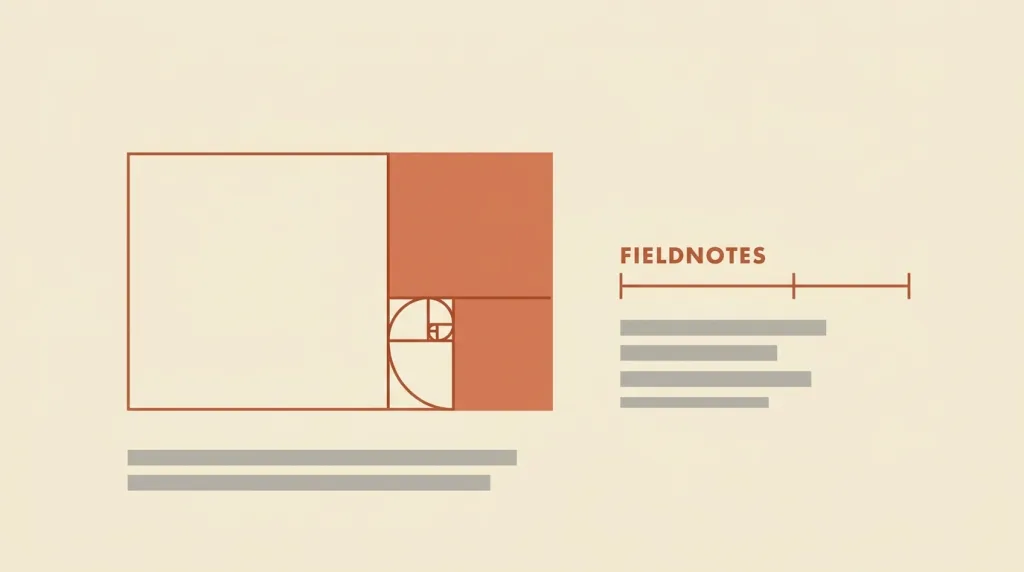
A mathematical ratio of about 1.618: a line is divided so that the whole is to the longer part as the longer part is to the shorter. In design it is often taken as a ready-made proportion for deciding sizes, spacing, and the relationship between formats.
Recognizing it
- A ratio of about 1.618 recurs between sizes, spacing, or formats
- The ratio is used as a basis for choosing beforehand, not as an explanation afterwards
- One proportional scheme is applied consistently across the work
Concept boundary
The ratio itself is a settled mathematical fact, but the claim that it is aesthetically superior to other ratios is contested rather than established: the psychological experiments conflict with one another, and many assertions that historical buildings and artworks use it lack supporting measurement. This entry therefore treats it as one usable ready-made proportion, not a law to follow. It is also not the only proportional system available — 2:3, 3:4, and 1:√2 are equally mature, and choosing among them is editorial judgement. Using it as an after-the-fact explanation ("this looks good because it follows the golden ratio") should be avoided in particular.
When to consider it
- A ready-made starting proportion is wanted instead of picking values by feel each time
- Sizes need a restatable relationship so a team can reuse and discuss them
- The work has an explicit cultural or thematic link to the ratio
When to be cautious
- It is offered as evidence of beauty to persuade others, while the actual evidence conflicts
- The real length and hierarchy of the content conflict with the ratio yet are bent to fit
- It is used to endorse a design that was already finished
Tradeoff
A ready-made proportion makes size decisions faster and more consistent, at the cost of saying nothing about what the content needs: the ratio supplies formal echo, while readability, information hierarchy, and target size still have to be checked separately.
Conditional rules · Editorial advice
Related entries
Successive Fibonacci terms approach the golden ratio, so the sequence is often used as its whole-number approximation for spacing and type sizes.
A modular grid derives sizes from content and columns while the golden ratio starts from one fixed value; the former accommodates real, variable-length content more easily.
The ratio only guarantees the relationship between sizes, not that any one of them is legible.
Sources and what they support
The article gives the mathematical definition of the golden ratio and records its approximate value of 1.618, and also records the doubts about its aesthetic claims: it quotes the mathematician Keith Devlin saying that the often-repeated assertion that the Parthenon in Athens is based on the golden ratio is not supported by actual measurements. This entry takes both the mathematical definition and the contested standing from it.
Retrieved: 2026-09-16 · Snapshot unconfirmedThe article reviews the psychological experiments that tested whether the golden ratio is more pleasing: in the 1860s Gustav Fechner asked subjects to choose the most pleasing of ten rectangles of varying length-to-width ratios, and 76% of all choices centred on the three with ratios 1.75, 1.62, and 1.50, peaking at the golden rectangle at 1.62. It also notes that many psychologists have repeated similar experiments since and obtained rather conflicting results, and cites Michael Godkewitsch pointing out that average group preferences often do not reflect individual choices. This entry takes its conflicting-evidence judgement from this.
Retrieved: 2026-09-16 · Snapshot unconfirmedDefinitions reference these sources. Digital specimens, selection advice, relationships, and recipes are editorial work and have not been validated through user research.
Type extensions and implementation notes
This entry has no runnable specimen; the illustration is an editorial sketch of the ratio’s geometric construction and represents no measurement of any historical work. Before shipping, correct derived values against the real requirements for readability and target size.
{
  "evidenceType": "A settled mathematical relationship, with conflicting psychological evidence about any aesthetic superiority",
  "limit": "This entry does not claim the ratio is more beautiful than others and does not verify particular assertions that historical works used it; it only records that it is a usable and restatable proportional convention."
}
Full Agent entry JSON
{
  "id": "golden-ratio",
  "type": "principle",
  "name": {
    "zh": "黄金比例",
    "en": "Golden Ratio"
  },
  "aliases": [
    "Golden Section",
    "Divine Proportion",
    "Phi",
    "黄金分割"
  ],
  "granularity": "component",
  "intents": [
    "organize-content",
    "express-brand"
  ],
  "tags": [
    "proportion",
    "composition",
    "grid",
    "mathematics",
    "contested"
  ],
  "definition": "A mathematical ratio of about 1.618: a line is divided so that the whole is to the longer part as the longer part is to the shorter. In design it is often taken as a ready-made proportion for deciding sizes, spacing, and the relationship between formats.",
  "boundary": "The ratio itself is a settled mathematical fact, but the claim that it is aesthetically superior to other ratios is contested rather than established: the psychological experiments conflict with one another, and many assertions that historical buildings and artworks use it lack supporting measurement. This entry therefore treats it as one usable ready-made proportion, not a law to follow. It is also not the only proportional system available — 2:3, 3:4, and 1:√2 are equally mature, and choosing among them is editorial judgement. Using it as an after-the-fact explanation (\"this looks good because it follows the golden ratio\") should be avoided in particular.",
  "signature": [
    "A ratio of about 1.618 recurs between sizes, spacing, or formats",
    "The ratio is used as a basis for choosing beforehand, not as an explanation afterwards",
    "One proportional scheme is applied consistently across the work"
  ],
  "when": [
    "A ready-made starting proportion is wanted instead of picking values by feel each time",
    "Sizes need a restatable relationship so a team can reuse and discuss them",
    "The work has an explicit cultural or thematic link to the ratio"
  ],
  "when_not": [
    "It is offered as evidence of beauty to persuade others, while the actual evidence conflicts",
    "The real length and hierarchy of the content conflict with the ratio yet are bent to fit",
    "It is used to endorse a design that was already finished"
  ],
  "tradeoff": "A ready-made proportion makes size decisions faster and more consistent, at the cost of saying nothing about what the content needs: the ratio supplies formal echo, while readability, information hierarchy, and target size still have to be checked separately.",
  "comparison": {
    "focus": "Giving sizes and spacing a restatable starting proportion",
    "mechanism": "The whole is to the longer part as the longer is to the shorter, about 1.618",
    "cost": "It offers no basis from the content, and its aesthetic superiority is contested"
  },
  "sources": [
    {
      "id": "goldenratio-wikipedia",
      "title": "Wikipedia · Golden ratio",
      "url": "https://en.wikipedia.org/wiki/Golden_ratio",
      "claim": "The article gives the mathematical definition of the golden ratio and records its approximate value of 1.618, and also records the doubts about its aesthetic claims: it quotes the mathematician Keith Devlin saying that the often-repeated assertion that the Parthenon in Athens is based on the golden ratio is not supported by actual measurements. This entry takes both the mathematical definition and the contested standing from it.",
      "checkedAt": "2026-09-16",
      "archive": {
        "lookupUrl": "https://web.archive.org/web/20260916*/https://en.wikipedia.org/wiki/Golden_ratio",
        "status": "unconfirmed",
        "checkedAt": "2026-09-16T17:37:58.347Z",
        "error": "status-request-failed",
        "jobId": "spn2-578a9fde414625e64e70274629605c211919934f"
      }
    },
    {
      "id": "goldenratio-livio-plus",
      "title": "Plus Magazine · The golden ratio and aesthetics (Mario Livio)",
      "url": "https://plus.maths.org/content/os/issue22/features/golden/index",
      "claim": "The article reviews the psychological experiments that tested whether the golden ratio is more pleasing: in the 1860s Gustav Fechner asked subjects to choose the most pleasing of ten rectangles of varying length-to-width ratios, and 76% of all choices centred on the three with ratios 1.75, 1.62, and 1.50, peaking at the golden rectangle at 1.62. It also notes that many psychologists have repeated similar experiments since and obtained rather conflicting results, and cites Michael Godkewitsch pointing out that average group preferences often do not reflect individual choices. This entry takes its conflicting-evidence judgement from this.",
      "checkedAt": "2026-09-16",
      "archive": {
        "lookupUrl": "https://web.archive.org/web/20260916*/https://plus.maths.org/content/os/issue22/features/golden/index",
        "status": "pending",
        "checkedAt": "2026-09-16T17:38:19.335Z",
        "error": "status-request-failed",
        "jobId": "spn2-3c76ba2de5558383abe0c616817a7fa16160dff7"
      }
    }
  ],
  "relations": [
    {
      "target": "fibonacci-sequence",
      "kind": "related",
      "condition": "A set of whole-number values is needed to realise the proportion",
      "reason": "Successive Fibonacci terms approach the golden ratio, so the sequence is often used as its whole-number approximation for spacing and type sizes.",
      "basis": "editorial"
    },
    {
      "target": "modular-grid",
      "kind": "alternative",
      "condition": "Choosing one rule set to decide size relationships in a layout",
      "reason": "A modular grid derives sizes from content and columns while the golden ratio starts from one fixed value; the former accommodates real, variable-length content more easily.",
      "basis": "editorial"
    },
    {
      "target": "contrast-legibility",
      "kind": "conflicts_when",
      "condition": "Type sizes are derived from the ratio without checking them at the real reading distance and typeface",
      "reason": "The ratio only guarantees the relationship between sizes, not that any one of them is legible.",
      "basis": "editorial"
    }
  ],
  "rules": [
    {
      "when": "Explaining to others why a proportion was chosen",
      "instruction": "Present it as a chosen convention rather than as an established fact of beauty; the experiments do not agree.",
      "strength": "must",
      "basis": "editorial"
    },
    {
      "when": "Ratio-derived sizes are used for body text or tappable targets",
      "instruction": "Correct the values against the real requirements for readability and target size, letting the ratio yield to those floors rather than the other way round.",
      "strength": "must",
      "basis": "editorial"
    }
  ],
  "principle": {
    "evidenceType": "A settled mathematical relationship, with conflicting psychological evidence about any aesthetic superiority",
    "limit": "This entry does not claim the ratio is more beautiful than others and does not verify particular assertions that historical works used it; it only records that it is a usable and restatable proportional convention."
  },
  "demo": null,
  "version": "0.1.0",
  "editorialStatus": "drafted",
  "requirements": [],
  "demoCapabilities": [],
  "implementationNote": "This entry has no runnable specimen; the illustration is an editorial sketch of the ratio’s geometric construction and represents no measurement of any historical work. Before shipping, correct derived values against the real requirements for readability and target size.",
  "image": {
    "src": "/images/golden-ratio.webp",
    "alt": "A geometric sketch: a rectangle divided by a vertical line into a larger and a smaller part, the smaller part divided again by a horizontal line, nested several times, with a line segment beside it marking the whole, the longer part, and the shorter part against one another."
  },
  "searchTerms": [
    "比例",
    "构图",
    "网格",
    "数学",
    "有争议"
  ]
}