VOCABULARY / ENTRY
Mandala
mandala
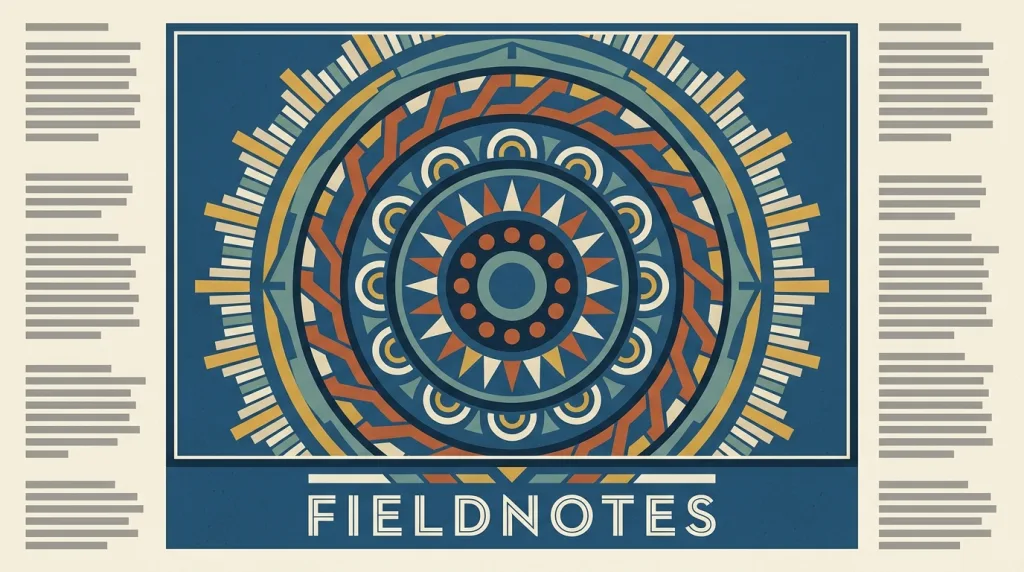
A geometric pattern that radiates from a single centre through concentric circles and squares, each ring repeating symmetrically within itself. It comes from the mandala of Indian religious traditions and is borrowed in graphic design as a highly symmetrical, endlessly subdividable decorative structure.
Recognizing it
- Every element is organised around one single centre
- Concentric rings or squares divide the pattern into distinct layers
- Within each layer one motif repeats a fixed number of times
Concept boundary
This entry covers only how the radial-symmetric geometric structure is used in graphic and interface work; it does not cover the meaning, ritual, or correct making of a mandala as a religious object. In Hinduism, Buddhism, and Jainism the mandala is a symbol with a specific religious function, and treating it as pure decoration can offend those traditions; this entry offers no guidance on religious use. The test is the structure — one centre, concentric layers, symmetrical repetition within each layer — not "looks intricate" or "is a round pattern". It differs from a circular emblem, which arranges elements around a centre without requiring symmetrical subdivision layer by layer.
When to consider it
- A static, symmetrical, endlessly subdividable decorative centrepiece is needed
- The graphic must keep one composition across square, circular, and other frames
- The content itself concerns meditation, focus, or cycles
When to be cautious
- A mandala with a religious function is treated as decorative material that can be freely rewritten
- The graphic must carry an information hierarchy, which radial symmetry flattens by making every branch equal
- The output size is small, where fine layers collapse into a grey blur
Tradeoff
Radial symmetry establishes order and a visual centre quickly, at the cost of flattening hierarchy: every branch is equally important, so it cannot express what comes first.
Conditional rules · Editorial advice
Related entries
Art Nouveau motifs spread along asymmetric curves, while a mandala is strictly symmetrical around one centre; both fill the surface with ornament but organise it in opposite ways.
Fine pattern weakens the separation of figure from ground, so an added ground or clearing is needed to lift the foreground out.
Continuously varying high-frequency texture hides control boundaries and makes targets hard to identify.
Sources and what they support
The article explains that a mandala (Sanskrit for “circle”) is a geometric configuration of symbols originating in Indian religions, used in Hinduism, Buddhism, and Jainism as a map of deities, to establish sacred space, and as an aid to meditation, with a basic form of a circle containing a centre point set in a square with four gates, and often radial balance. This entry paraphrases the structure from it; the decorative guidance is editorial.
Retrieved: 2026-09-16 · Snapshot unconfirmedThe article records that the sand mandala is a largely geometric image made from coloured grains following a drawn pattern, that making it is itself a religious act, and that its impermanence is part of the teaching — it is swept away after a few days on display. This entry cites it to show that such patterns carry religious function and are not free decorative material.
Retrieved: 2026-09-16 · Snapshot unconfirmedDefinitions reference these sources. Digital specimens, selection advice, relationships, and recipes are editorial work and have not been validated through user research.
Type extensions and implementation notes
This entry has no runnable specimen; the illustration is an editorial sketch whose pattern is invented geometry made to explain the structure, not a reproduction of any specific religious mandala. Before shipping, confirm the provenance and permission of real material and measure contrast for text and controls over the pattern.
{
  "tokens": {
    "surface": "#f6efe2",
    "ink": "#2c2a3a",
    "accent": "#9a5a3c",
    "radiusPx": 0,
    "shadow": "none"
  },
  "tokenScope": "This sample recipe — warm cream ground, deep indigo ink, ochre-red accent — sketches one set of values and is not prescribed by any tradition. Real work should re-pick colors for its context and verify text contrast over the pattern separately."
}
Full Agent entry JSON
{
  "id": "mandala",
  "type": "visual",
  "name": {
    "zh": "曼陀罗纹样",
    "en": "Mandala"
  },
  "aliases": [
    "Mandala Pattern",
    "坛城纹样",
    "放射对称纹样"
  ],
  "granularity": "experience",
  "intents": [
    "express-brand",
    "organize-content"
  ],
  "tags": [
    "radial symmetry",
    "geometric pattern",
    "concentric rings",
    "ornament",
    "meditation"
  ],
  "definition": "A geometric pattern that radiates from a single centre through concentric circles and squares, each ring repeating symmetrically within itself. It comes from the mandala of Indian religious traditions and is borrowed in graphic design as a highly symmetrical, endlessly subdividable decorative structure.",
  "boundary": "This entry covers only how the radial-symmetric geometric structure is used in graphic and interface work; it does not cover the meaning, ritual, or correct making of a mandala as a religious object. In Hinduism, Buddhism, and Jainism the mandala is a symbol with a specific religious function, and treating it as pure decoration can offend those traditions; this entry offers no guidance on religious use. The test is the structure — one centre, concentric layers, symmetrical repetition within each layer — not \"looks intricate\" or \"is a round pattern\". It differs from a circular emblem, which arranges elements around a centre without requiring symmetrical subdivision layer by layer.",
  "signature": [
    "Every element is organised around one single centre",
    "Concentric rings or squares divide the pattern into distinct layers",
    "Within each layer one motif repeats a fixed number of times"
  ],
  "when": [
    "A static, symmetrical, endlessly subdividable decorative centrepiece is needed",
    "The graphic must keep one composition across square, circular, and other frames",
    "The content itself concerns meditation, focus, or cycles"
  ],
  "when_not": [
    "A mandala with a religious function is treated as decorative material that can be freely rewritten",
    "The graphic must carry an information hierarchy, which radial symmetry flattens by making every branch equal",
    "The output size is small, where fine layers collapse into a grey blur"
  ],
  "tradeoff": "Radial symmetry establishes order and a visual centre quickly, at the cost of flattening hierarchy: every branch is equally important, so it cannot express what comes first.",
  "comparison": {
    "focus": "Building symmetrical decorative order around a single centre",
    "mechanism": "Concentric layering plus fixed-count repetition inside each layer",
    "cost": "It flattens hierarchy, and its religious meaning demands careful use"
  },
  "sources": [
    {
      "id": "mandala-wikipedia",
      "title": "Wikipedia · Mandala",
      "url": "https://en.wikipedia.org/wiki/Mandala",
      "claim": "The article explains that a mandala (Sanskrit for “circle”) is a geometric configuration of symbols originating in Indian religions, used in Hinduism, Buddhism, and Jainism as a map of deities, to establish sacred space, and as an aid to meditation, with a basic form of a circle containing a centre point set in a square with four gates, and often radial balance. This entry paraphrases the structure from it; the decorative guidance is editorial.",
      "checkedAt": "2026-09-16",
      "archive": {
        "lookupUrl": "https://web.archive.org/web/20260916*/https://en.wikipedia.org/wiki/Mandala",
        "status": "unconfirmed",
        "checkedAt": "2026-09-16T13:02:48.392Z",
        "error": "status-request-failed",
        "jobId": "spn2-740eb8c0d2682f4bc6176b7f1a06614de6c50677"
      }
    },
    {
      "id": "mandala-tibetan-art",
      "title": "Wikipedia · Tibetan art",
      "url": "https://en.wikipedia.org/wiki/Tibetan_art",
      "claim": "The article records that the sand mandala is a largely geometric image made from coloured grains following a drawn pattern, that making it is itself a religious act, and that its impermanence is part of the teaching — it is swept away after a few days on display. This entry cites it to show that such patterns carry religious function and are not free decorative material.",
      "checkedAt": "2026-09-16",
      "archive": {
        "lookupUrl": "https://web.archive.org/web/20260916*/https://en.wikipedia.org/wiki/Tibetan_art",
        "status": "unconfirmed",
        "checkedAt": "2026-09-16T13:03:12.083Z",
        "error": "status-request-failed",
        "jobId": "spn2-cafbf4110cfa25be5e0a19e64c76e5429e71f8bb"
      }
    }
  ],
  "relations": [
    {
      "target": "art-nouveau",
      "kind": "related",
      "condition": "Full-surface ornament built from organic or geometric motifs is needed",
      "reason": "Art Nouveau motifs spread along asymmetric curves, while a mandala is strictly symmetrical around one centre; both fill the surface with ornament but organise it in opposite ways.",
      "basis": "editorial"
    },
    {
      "target": "figure-ground",
      "kind": "composes_with",
      "condition": "The pattern serves as background while text or controls sit on top of it",
      "reason": "Fine pattern weakens the separation of figure from ground, so an added ground or clearing is needed to lift the foreground out.",
      "basis": "editorial"
    },
    {
      "target": "visual-interference",
      "kind": "conflicts_when",
      "condition": "A high-contrast radial pattern lies directly beneath interactive regions",
      "reason": "Continuously varying high-frequency texture hides control boundaries and makes targets hard to identify.",
      "basis": "editorial"
    }
  ],
  "rules": [
    {
      "when": "The pattern is taken from a mandala belonging to a specific religious tradition",
      "instruction": "Confirm the source and permission and credit it; do not rewrite religiously meaningful components to fit a layout.",
      "strength": "must",
      "basis": "editorial"
    },
    {
      "when": "The pattern is used as an interface background",
      "instruction": "Lower the pattern’s contrast or add an opaque layer, and verify foreground text contrast against both its lightest and darkest areas.",
      "strength": "must",
      "basis": "editorial"
    }
  ],
  "visual": {
    "tokens": {
      "surface": "#f6efe2",
      "ink": "#2c2a3a",
      "accent": "#9a5a3c",
      "radiusPx": 0,
      "shadow": "none"
    },
    "tokenScope": "This sample recipe — warm cream ground, deep indigo ink, ochre-red accent — sketches one set of values and is not prescribed by any tradition. Real work should re-pick colors for its context and verify text contrast over the pattern separately."
  },
  "demo": null,
  "version": "0.1.0",
  "editorialStatus": "drafted",
  "requirements": [],
  "demoCapabilities": [],
  "implementationNote": "This entry has no runnable specimen; the illustration is an editorial sketch whose pattern is invented geometry made to explain the structure, not a reproduction of any specific religious mandala. Before shipping, confirm the provenance and permission of real material and measure contrast for text and controls over the pattern.",
  "image": {
    "src": "/images/mandala.webp",
    "alt": "A fictional FIELDNOTES poster with an invented radial-symmetric geometric pattern at its centre: concentric rings nested layer by layer, each repeating one motif a fixed number of times, with cream margins around it holding grey placeholder text bars."
  },
  "searchTerms": [
    "放射对称",
    "几何纹样",
    "同心圆",
    "装饰",
    "冥想"
  ]
}