VOCABULARY / ENTRY
Uncanny Valley
uncanny-valley
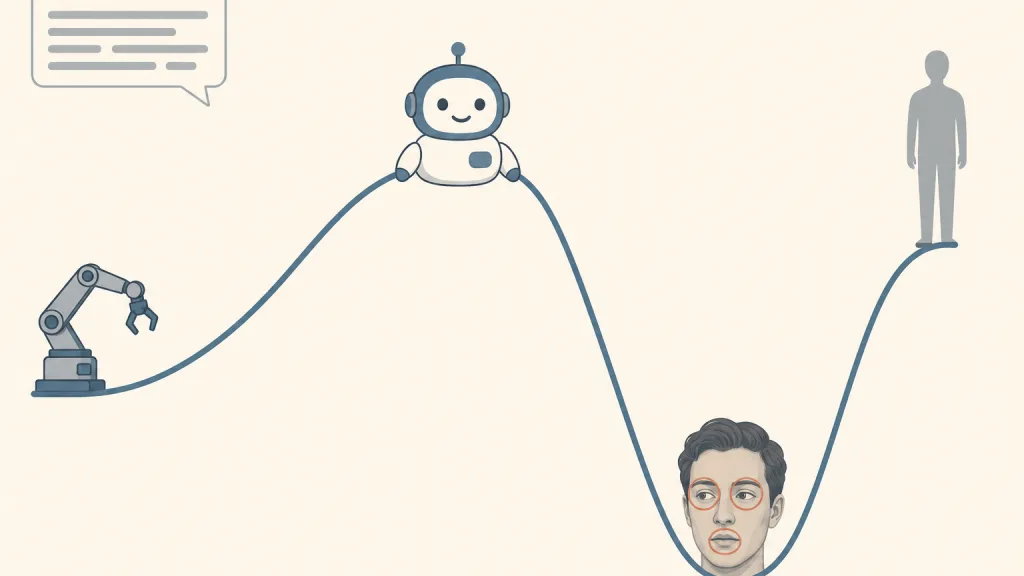
A hypothesis proposed by Masahiro Mori in 1970: as a robot or artificial figure becomes more humanlike, people’s affinity for it first rises, then drops sharply into revulsion or eeriness in the range where it is very nearly but not quite human, and recovers only when it is almost indistinguishable from a real person; that dip in the curve is the “uncanny valley”. In design it is often invoked as a reminder that pursuing a realistic human form, face, or voice can be more unsettling than openly stylizing.
Recognizing it
- A figure or voice clearly imitates a real person, yet something in the details still feels off
- Parts of it are realistic to different degrees, such as lifelike skin with a stiff gaze, or speech with an unnatural rhythm
- Redesigning the same figure in an obviously stylized form makes the aversion fade
Concept boundary
The uncanny valley is a hypothesis, not a universally confirmed law: a 2015 review of the empirical evidence found no consistent support for the naive version — that any increase in human likeness leads into the valley — and concluded that the valley appears only under specific conditions, with perceptual mismatch the best-supported explanation: different parts of the same figure being realistic to different degrees (for example, artificial eyes on a realistic face). Mori’s essay also held that movement deepens the valley, and the same review found no consistent support for that either. This entry is about the discomfort caused by near-human figures and voices, which differs from trust calibration: that concerns whether a system’s confidence signals match its real capability, while the uncanny valley concerns an emotional reaction to how humanlike an appearance or voice is. An unsettling avatar may be perfectly accurate, and a likeable one may still mislead. Nor does it settle whether AI content should be labelled — that is a separate question, though the two often meet in the same product decision.
When to consider it
- Designing an avatar, digital human, or synthetic voice for an AI assistant, support agent, or teaching product
- Judging how far the realism of an anthropomorphic character should be pushed
- Users say a character or voice feels strange without being able to say why
When to be cautious
- Treating the uncanny valley as a quantitatively validated curve and using it to predict how many users a figure will unsettle
- Using “avoiding the uncanny valley” as a reason to make a synthetic voice that ought to be disclosed more realistic so it goes unnoticed
- Attributing every aversion to robots or AI to appearance, while ignoring reasons of content, capability, or privacy
Tradeoff
Deliberately choosing a stylized figure and voice sidesteps the discomfort of near-human likeness and is more candid that the other party is not a person; the cost is giving up the expressiveness a realistic figure might offer, and the choice rests on a hypothesis whose evidence is conditional, so it still has to be tested with real users.
Conditional rules · Editorial advice
Related entries
An anthropomorphic appearance affects people’s feelings about and trust in a system, but that trust has nothing to do with the system’s real capability; the uncanny valley warns that appearance can cause aversion, and trust calibration warns that appearance should not be taken as a signal of capability.
Stylization can ease discomfort but cannot replace disclosure; clearly marking the other party as AI-generated or AI-driven is a decision independent of how realistic it looks, and both should be made together.
Clearly stylized figures such as chibi characters sit near what Mori called the first peak: moderately humanlike and never mistaken for a real person, so they avoid the valley.
Conversation already raises humanlike expectations; adding a realistic face or voice makes inconsistencies in the details more likely to read as eerie.
Sources and what they support
On 12 June 2012 IEEE Spectrum published an English translation of Masahiro Mori’s essay, first published in 1970 in the Japanese journal Energy, translated by Karl F. MacDorman and Norri Kageki; the page calls it the first English translation authorized by Mori. The essay describes affinity rising with human likeness and falling into a valley near full human likeness, uses a prosthetic hand to show that a realistic hand becomes eerie once it is recognized as artificial, holds that movement makes the peaks and valleys steeper, and advises designers to aim for the first peak — moderate human likeness rather than near-human realism. This entry draws its definition and the origin of its “stylize first” advice from it.
Retrieved: 2026-10-20 · Snapshot unconfirmedThis review by Kätsyri, Förger, Mäkäräinen, and Takala, published in April 2015, finds the empirical evidence for the uncanny valley hypothesis inconsistent: the literature failed to provide consistent support for the naive hypothesis or for the modulating effect of movement, evidence for the categorization-ambiguity hypothesis remained too scarce, and the perceptual-mismatch hypothesis received good support; the authors conclude that the uncanny valley exists only under specific conditions. This entry uses it to set the evidence scope and to name perceptual mismatch as the best-supported explanation.
Retrieved: 2026-10-20 · Snapshot unconfirmedDefinitions reference these sources. Digital specimens, selection advice, relationships, and recipes are editorial work and have not been validated through user research.
Type extensions and implementation notes
This entry has no runnable specimen; the illustration is an editorial sketch that uses an affinity curve and four fictional figures to explain the hypothesis, and represents no measured data. Before shipping, assess how real users feel about the figure and voice, and decide separately how to disclose AI identity.
{
  "evidenceType": "A hypothesis proposed in 1970; empirical research supports it only under specific conditions, with perceptual mismatch the best-supported explanation",
  "limit": "This entry gives no value for the degree of human likeness at which the valley appears, does not restate effect sizes from individual experiments, and does not claim that movement necessarily deepens the discomfort; it only explains that near-human figures and voices can cause discomfort and how far current evidence supports this."
}
Open the Agent JSON file for this entryThis file repeats every field of this entry verbatim and adds its sources, archive status, and editorial scope.