VOCABULARY / ENTRY
Bait and Switch
bait-and-switch
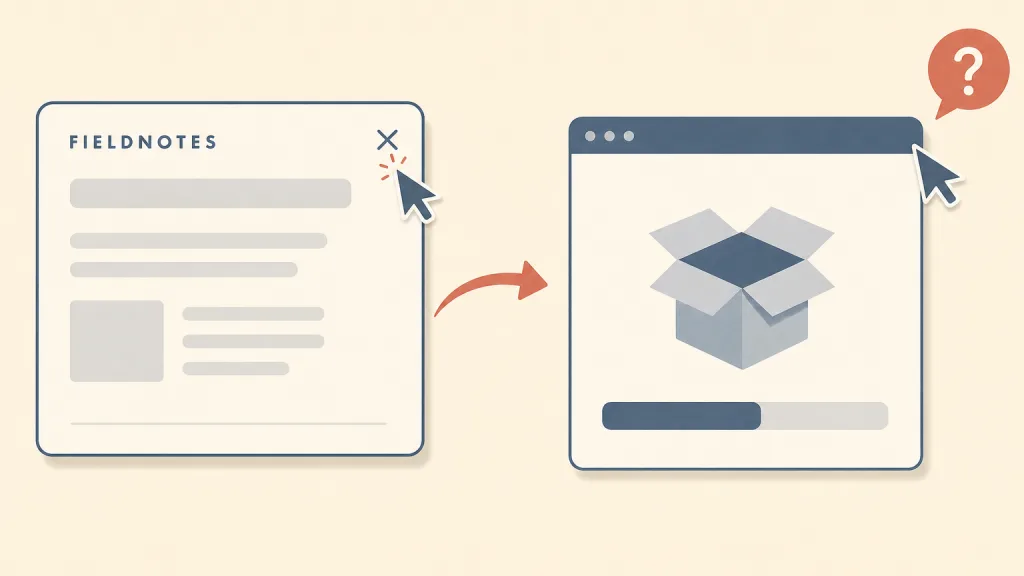
A person acts to do one thing and something else, something they did not want, happens instead: a button, link, or offer looks like one thing before they act and turns into another afterward.
Recognizing it
- A conventional control, such as a close button, is given an opposite or unrelated outcome
- An advertised offer becomes unavailable once people click through, and the page immediately recommends something else
- People discover only after completing the action that the outcome differs from what they expected
Concept boundary
The mechanism here is that the outcome is swapped between before and after the action. It differs from disguised ads: a disguised ad passes an advertisement off as another interface element, so what people click was never what it seemed; in a bait and switch, people click a genuinely conventional control or a genuinely displayed offer, and only the outcome is replaced. It also differs from hidden costs: there, the full price of the same product is disclosed late in the flow while the product stays the same; a bait and switch replaces the outcome itself — the advertised item turns out to be unavailable once people arrive and the page recommends a pricier substitute, or a “close” button is turned into “agree.” What separates it from a Norman door is intent: a Norman door’s mismatch between cue and action usually comes from oversight, while a bait and switch uses people’s trust in convention to obtain an outcome they would not choose. The name also has a definition in commercial regulation (for example the US Federal Trade Commission’s guides against bait advertising); this entry borrows it for the equivalent mechanism at the interface level and makes no legal judgment about any specific case.
When to consider it
- Auditing whether offers advertised on landing pages and pop-ups are actually available when people arrive
- Auditing whether each control’s actual outcome matches its appearance and convention
When to be cautious
- As a way to raise conversion or push upgrades
- Changing a control’s or an offer’s actual outcome because “it says so in the small print”
Tradeoff
The repair is to make what people see before acting match what they get after: an advertised offer is either available or states its stock and eligibility limits where it is advertised, and conventional controls do only the conventional thing. The cost is losing the conversions won through mistaken clicks or by “getting people in first,” but those conversions already come with complaints, refunds, and lost trust.
Conditional rules · Editorial advice
Related entries
A disguised ad fakes the element itself, while a bait and switch swaps the outcome of a real element; both exploit trust in interface conventions but should be recorded separately.
Hidden costs disclose the full price of the same product late, while a bait and switch replaces the advertised product itself; first check whether the product is still the same one.
Both break the link between appearance and outcome; the difference is intent — a Norman door usually comes from oversight, while a bait and switch deliberately uses convention to obtain an outcome people would not choose.
People operate by convention, and once a convention has been exploited they have to doubt every similar control before using it.
One swap is enough to lower trust in the whole product, damaging its honest controls and offers along with it.
Sources and what they support
The page (created by Harry Brignull, edited by Alexander Darlo in 2019) defines bait and switch as the user setting out to do one thing while a different, undesirable thing happens instead, and gives the 2016 Windows 10 upgrade pop-ups as its example, in which the “X” button at the top right was changed from its usual meaning of “close” to “yes, I do want to upgrade.” The original URL no longer works (it returned 404 on the check date); the content was checked against an Internet Archive capture from 31 December 2019. This entry paraphrases its definition from it.
Retrieved: 2026-10-20 · Snapshot unconfirmedSection 238.0 of Part 238 of Title 16 of the US Code of Federal Regulations (Guides Against Bait Advertising) defines bait advertising as an alluring but insincere offer to sell a product or service which the advertiser does not intend or want to sell, whose purpose is to switch consumers from the advertised merchandise to something else, usually at a higher price or on terms more advantageous to the advertiser. This entry cites it for the term’s meaning in commercial regulation and to support the typical form in which an advertised offer is unavailable and a substitute is pushed instead.
Retrieved: 2026-10-20 · Snapshot unconfirmedThis site is the current home of Harry Brignull’s catalog of deceptive design; on the check date its list held 18 types, including hidden costs and disguised ads, but no longer listed bait and switch separately. This entry cites it to show that bait and switch comes from the catalog’s earlier taxonomy and that its nearest current types are hidden costs and disguised ads, which is why the entry has to draw its boundary against both.
Retrieved: 2026-10-20 · Snapshot unconfirmedDefinitions reference these sources. Digital specimens, selection advice, relationships, and recipes are editorial work and have not been validated through user research.
Type extensions and implementation notes
This is a warning entry and not a recommendation, and it makes no legal judgment about any specific case; the pop-up and offer in the illustration are invented. When auditing, click every promotional entry point and close control one by one, record the expected and the actual outcome of each, and review every place where the two differ.
{
  "harm": "It uses people’s trust in conventions and advertising to give them an outcome they would not choose, and leaves the interface’s conventions no longer credible",
  "repair": "Make what people see before acting match what they get after: controls do only the conventional thing, and advertised offers are either available or state their limits where advertised, with a clear notice when unavailable."
}
Open the Agent JSON file for this entryThis file repeats every field of this entry verbatim and adds its sources, archive status, and editorial scope.